

Asia Pacific Competitive Local Exchange Carrier Market Size & Forecast:
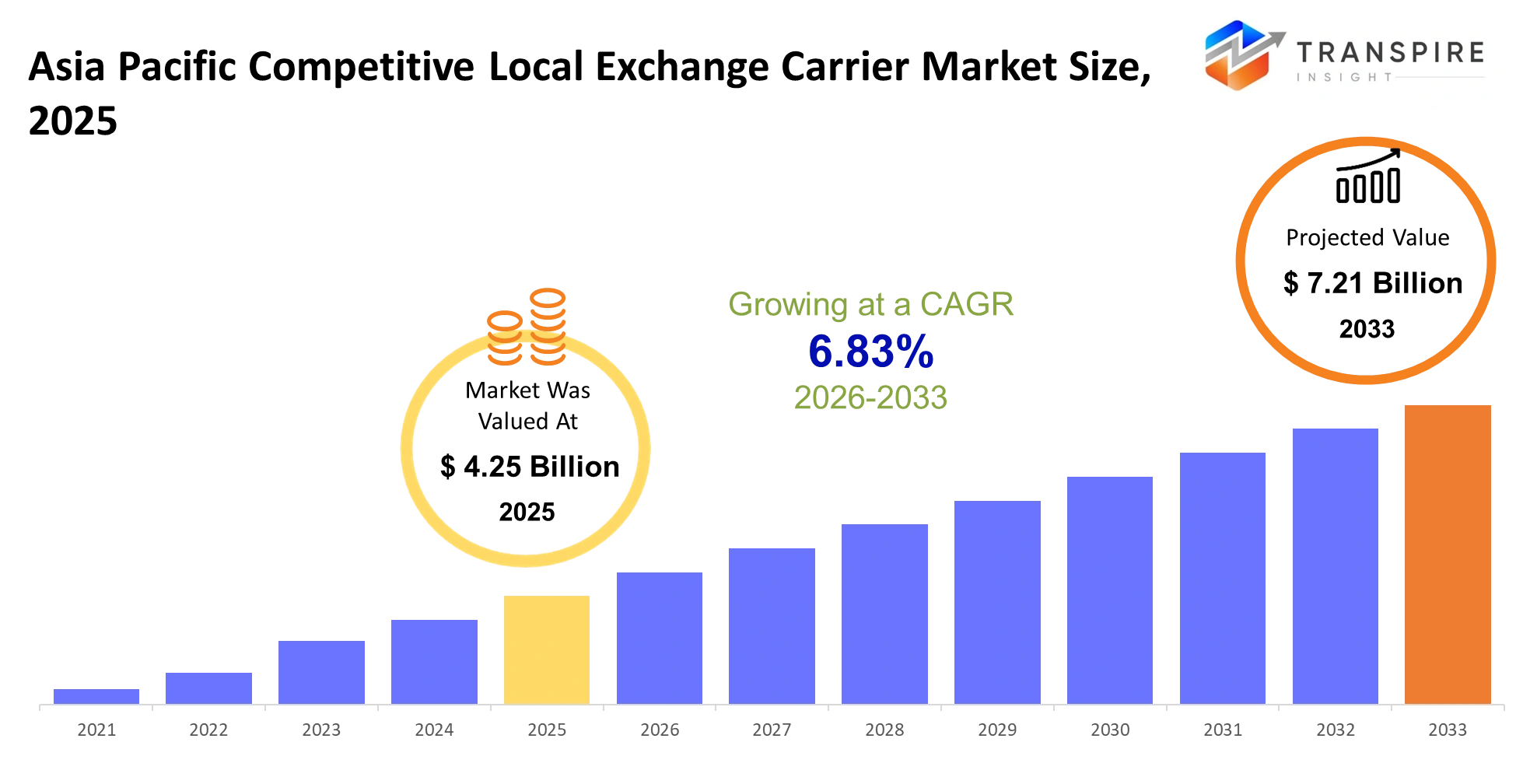
- Asia Pacific Competitive Local Exchange Carrier Market Size 2025: USD 4.25 Billion
- Asia Pacific Competitive Local Exchange Carrier Market Size 2033: USD 7.21 Billion
- Asia Pacific Competitive Local Exchange Carrier Market CAGR: 6.83%
- Asia Pacific Competitive Local Exchange Carrier Market Segments: By Type (Facilities-based CLEC, Reseller CLEC, Hybrid CLEC, Others); By Application (Residential Services, Business Communication, Enterprise Networking, Data Services, Internet Services, Others); By End-User (Residential Users, SMEs, Large Enterprises, Government, Telecom Operators, Others); By Service (Voice, Data, Internet, VoIP, Broadband, Others).
To learn more about this report,  Download Free Sample Report
Asia Pacific Competitive Local Exchange Carrier Market Summary
The Asia Pacific Competitive Local Exchange Carrier Market was valued at USD 4.25 Billion in 2025. It is forecast to reach USD 7.21 Billion by 2033. That is a CAGR of 6.83% over the period.
The Asia Pacific Competitive Local Exchange Carrier market provides regional businesses and industrial campuses and data centers and public institutions with fixed-line voice and broadband and enterprise network services that compete against traditional telecom companies. The providers deliver business solutions through their flexible pricing model and rapid service delivery and customized networking services which help businesses use cloud technology and remote work and secure data transmission across multiple locations.
The market has changed during the past three to five years because it now prioritizes fiber-based connectivity and software-defined networking and managed enterprise communication platforms instead of its previous voice-centric services. The transition to new ways of working began after the pandemic expansion of hybrid work and digital operations which demonstrated all the deficiencies present in existing copper infrastructure. Enterprises made changes to their connectivity options because of supply chain disruptions and geopolitical tensions which forced them to seek new solutions that would help them manage operational hazards. Competitive carriers are winning more enterprise contracts because organizations want to build resilient networks with quick response times while infrastructure advancements lead to increased ongoing service income.
Key Market Insights
- China controls the Asia Pacific Competitive Local Exchange Carrier Market because its extensive telecom network system, which serves multiple businesses, enables it to achieve near 34% market share during 2025.
- The fastest-growing market in India will continue its growth until 2031 because of business digitization, the development of data centers, and the relaxation of telecommunication regulations.
- Southeast Asia exhibits high growth potential because enterprise broadband usage in Indonesia, Vietnam, and Thailand shows an annual growth rate between 7% and 9%.
- In 2025, fiber-based enterprise connectivity will dominate the market with a 41% market share because businesses require communication systems that deliver low latency and high scalability.
- The managed voice and unified communications market segment maintains its position as the second largest market segment because hybrid workplace integration methods sustain its growth.
- The most rapidly growing market segment consists of SD-WAN and software-defined enterprise networking which will experience strong growth until 2031.
- The market revenue from multi-location operational needs generates 38% of total revenue which results in large-scale enterprise network connectivity becoming the dominant market force.
- Digital workflow transformation drives the growth of cloud interconnect and secure remote access solutions as their most rapidly expanding applications.
- The BFSI sector controls approximately 27% of market share which needs secure and reliable communication systems.
- Smart factory investments will lead to manufacturing and industrial automation becoming the fastest expanding end-user sector until 2030.
What are the Key Drivers, Restraints, and Opportunities in the Asia Pacific Competitive Local Exchange Carrier Market?
The Asia Pacific Competitive Local Exchange Carrier market experiences its most powerful growth driver through company adoption of cloud-native systems and their implementation of decentralized digital networks. The shift began to gather speed because the pandemic revealed the limitations which restricted both traditional copper network systems and centralized telecommunication networks. Enterprises which implemented hybrid work environments together with edge computing technology and real-time cloud solutions needed high-speed internet connections which traditional telecom systems failed to provide without delay. Competitive local exchange carriers expanded their service offerings to include fiber-based enterprise services together with software-defined networking and managed connectivity solutions. Enterprise customers now show a preference for multi-year managed service contracts which provide superior value compared to short-term data and voice packages.
The market’s biggest structural barrier is the uneven regulatory and infrastructure landscape across Asia Pacific. Countries in the region handle licensing procedures and right-of-way permits and last-mile delivery restrictions in different ways which results in expensive and slow business development across various areas. The challenge exists as a long-term problem because it requires both unified policy regulations and complete network system installation. The market entry process takes more time for smaller carriers because they need to wait for approval. The larger operators direct their funding toward established urban areas while leaving many business clients without service.
The most promising growth opportunity for future development lies in private 5G network integration. The industrial clusters of India and South Korea together with Southeast Asia regional markets are boosting their investments in private enterprise networks which enables competitive carriers to create premium business connectivity solutions through bundled fiber backhaul and edge computing and managed network orchestration services.
What Has the Impact of Artificial Intelligence Been on the Asia Pacific Competitive Local Exchange Carrier Market?
Artificial intelligence and advanced digital technologies are transforming competitive carrier operations throughout Asia Pacific by enabling faster and more flexible network management systems which require fewer manual operations. Telecom providers are increasingly implementing AI-based network orchestration platforms which enable them to automatically manage traffic routing and bandwidth distribution and fault detection and service-level compliance monitoring in their enterprise fiber and software-defined network systems. The systems enable operators to cut incident response times by 30% to 40% which results in improved service availability and better customer retention rates for enterprise service agreements.
Machine learning models have enhanced predictive performance through their development. Carriers use them to forecast congestion patterns, identify equipment degradation in edge nodes, and optimize capacity utilization before service disruptions occur. Predictive maintenance analytics can lower unplanned network outages by as much as 20%, while intelligent traffic engineering improves latency performance for cloud-based enterprise applications. The result brings about improved service dependability together with decreased operational expenses.
Digital twin modeling has developed into an essential method which enables carriers to test infrastructure enhancements while predicting how traffic will function before they invest in new capital. The implementation of AI technology across organizations faces a critical obstacle because fragmented legacy systems from different regional telecom networks make it impossible to establish common data standards. Predictive performance suffers from inconsistent operational datasets that lack high quality standards which develop in Asia Pacific markets that have not yet completed their network modernization process.
Key Market Trends
- The enterprise buyers changed their contract agreements for new connectivity solutions by 35% since 2022 because they now prefer SD-WAN-enabled managed services instead of traditional MPLS systems which provide them with better network flexibility.
- The adoption of fiber-first infrastructure strategies increased after 2021 because operators like NTT Communications and Telstra made dense metro network upgrades their primary focus.
- Since 2023 regional regulators have started to relax telecom access restrictions which now allows private companies to operate more freely in India and Southeast Asia enterprise connectivity markets.
- The cloud migration process brought about changes in carrier competition because hyperscaler interconnection capabilities now determine 60% of large enterprise procurement decisions which will occur in 2025.
- The market for bundled managed connectivity packages has grown because customers now choose them more often, which has caused a decline in separate voice service contracts that reached 18% since 2020 within established Asia Pacific regions.
- The telecommunications sector experienced rapid growth because carriers established strategic partnerships with cloud platforms after 2022, which enabled them to provide differentiated services that delivered low-latency performance for distributed enterprise workloads.
- Enterprise contracts, which involve multiple carriers, became essential for organizations, which faced regional supply chain disruptions that made network resilience their main procurement focus in financial and manufacturing industries.
- AI-based network automation systems showed significant growth in adoption between 2023 and 2025, which enabled carriers to decrease their service fault resolution times by 25% to 30%.
- The competition within the market now centers around service quality measurements instead of pricing pressure, as Singtel and Bharti Airtel now focus on providing uptime guarantees and security integration solutions.
Asia Pacific Competitive Local Exchange Carrier Market Segmentation
By Type:
The Asia Pacific Competitive Local Exchange Carrier Market maintains its competitive strength through its facilities-based CLEC segment which relies on its operational control of proprietary network infrastructure. The model will provide improved service quality through established connectivity solutions and efficient problem solving methods. Telecom companies throughout both emerging and established markets continue to build their own networks because this approach enhances their ability to conduct business operations.
Reseller CLEC services remain important for operators entering competitive urban markets with lower capital investment. Hybrid CLEC models are also growing because they combine owned assets with leased network access, creating balance between cost and service efficiency. Other service structures continue serving smaller regional demands where flexible communication access remains necessary for specific customer groups.
By Application:
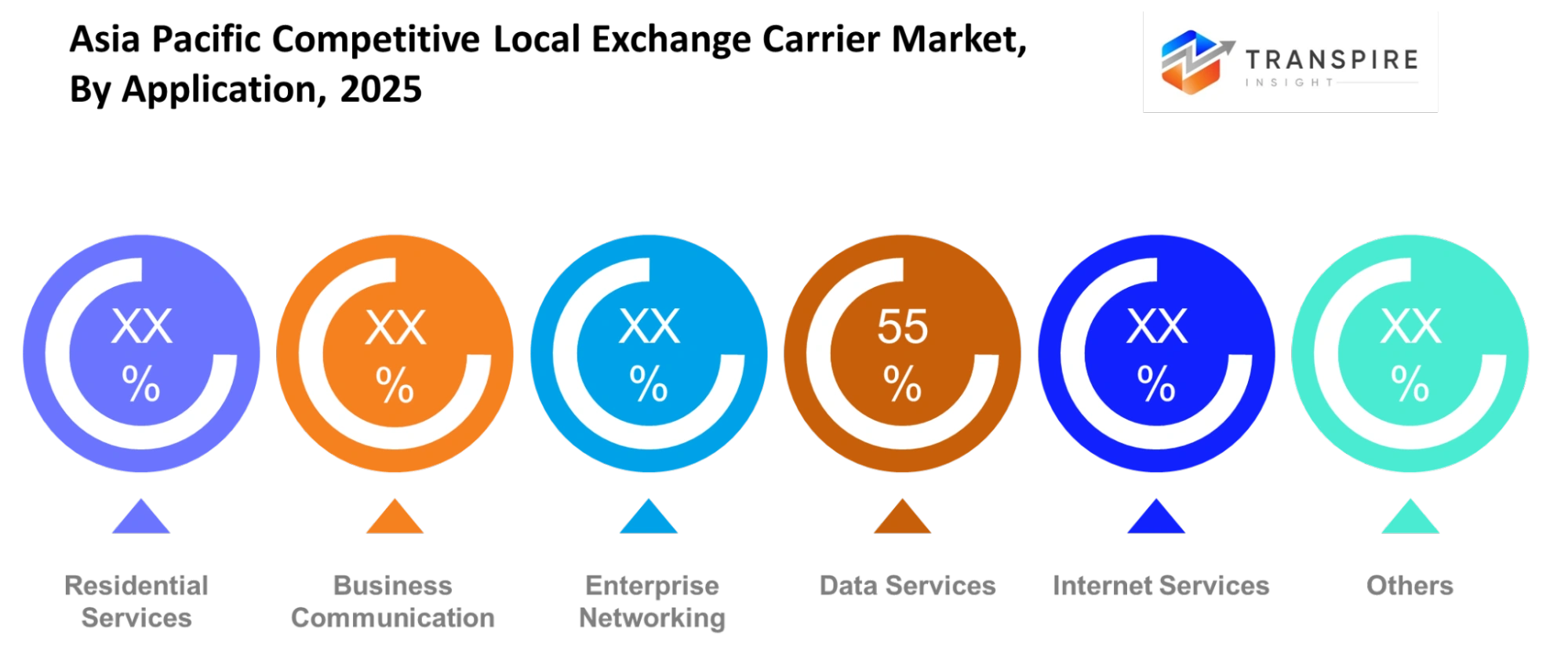
Residential services continue showing steady demand as households increase reliance on broadband communication for daily activities. The expansion of connected devices, digital entertainment, and home-based work patterns supports wider service adoption. Telecom operators focus on affordable service bundles to maintain customer retention and increase access across emerging Asia Pacific locations.
Business communication remains essential as companies seek uninterrupted connectivity for internal operations and customer engagement. Digital business development drives expansion across enterprise networking solutions which include data services and internet access. Other applications are also gaining attention as industries adopt customized communication systems that will support operational continuity and long-term efficiency improvements.
To learn more about this report, Download Free Sample Report
By End-User:
Users who require residential communication access for their digital activities constitute the main user group that drives digital communication access. The demand for services continues to rise because more people gain internet access and more users adopt mobile devices. The service providers in Asia Pacific markets work to enhance their connection services while they present multiple pricing options that suit different income levels in various Asian Pacific nations.
The digital needs of SMEs and large enterprises create a strong market potential because businesses need digital technology to handle their communication and transaction and operational tasks. Government institutions continue upgrading their public communication systems while telecom operators use competitive local exchange services for network support. The end-user groups identify their specific communication needs which they use to connect with different specialized fields.
By Service:
Digital technology needs have caused businesses and institutions to rely on dependable voice services which still serve practical purposes. The digital marketplace has created rapid growth for data and internet services which businesses now use for their essential operational needs. Regional telecom networks are experiencing infrastructure growth which drives this shift in network patterns.
The demand for VoIP and broadband services is increasing because users find cost-effective solutions and services that can be scaled according to their needs to be valuable. The VoIP adoption rate among businesses continues to increase while broadband expansion enables more people to access digital content. The Asia Pacific Competitive Local Exchange Carrier Market will continue evolving through service diversification and stronger network integration.
What are the Key Use Cases Driving the Asia Pacific Competitive Local Exchange Carrier Market?
The main purpose for competitive local exchange carrier services in Asia Pacific serves to connect enterprise-grade fiber networks which major companies and financial institutions and hyperscale data centers use. The application serves as the primary source of network demand because businesses need their networks to maintain low latency while delivering reliable connections for cloud operations and real-time activities and secure inter-office communication.
The manufacturing and healthcare sectors are developing new use cases for their operations. Smart factories need managed connectivity to enable their machines to communicate with each other and to run their industrial automation systems while hospitals build dedicated networks for telemedicine and secure patient data transfer and high-bandwidth imaging to operate.
Private 5G networks are adopting new use cases through their backhaul and edge computing capabilities which support logistics operations and smart port systems. The competitive carriers now provide support for AI-based enterprise networks which require advanced traffic control and rapid network access as digital systems progress throughout Southeast Asia and India.
|
Report Metrics |
Details |
|
Market size value in 2025 |
USD 4.25 Billion |
|
Market size value in 2026 |
USD 4.54 Billion |
|
Revenue forecast in 2033 |
USD 7.21 Billion |
|
Growth rate |
CAGR of 6.83% from 2026 to 2033 |
|
Base year |
2025 |
|
Historical data |
2021 - 2024 |
|
Forecast period |
2026 - 2033 |
|
Report coverage |
Revenue forecast, competitive landscape, growth factors, and trends |
|
Regional scope |
Asia Pacific (India, China, Japan, Australia,South Korea, Rest of Asia Pacific) |
|
Key company profiled |
AT&T, Verizon, Lumen, Frontier, Windstream, Comcast, Charter, Orange, Vodafone, Colt, GTT, Zayo, Sprint, T-Mobile, BT Group. |
|
Customization scope |
Free report customization (country, regional & segment scope). Avail customized purchase options to meet your exact research needs. |
|
Report Segmentation |
By Type (Facilities-based CLEC, Reseller CLEC, Hybrid CLEC, Others); By Application (Residential Services, Business Communication, Enterprise Networking, Data Services, Internet Services, Others); By End-User (Residential Users, SMEs, Large Enterprises, Government, Telecom Operators, Others); By Service (Voice, Data, Internet, VoIP, Broadband, Others). |
Which Regions are Driving the Asia Pacific Competitive Local Exchange Carrier Market Growth?
The Asia Pacific Competitive Local Exchange Carrier market gets its leadership from East Asia, which establishes China, Japan, and South Korea as the region's most powerful business connectivity center. The region achieves its market leadership through three main factors, including its established telecom liberalization policies, its extensive metro fiber network infrastructure, and its high-density presence of hyperscale data centers and industrial enterprise clusters. The regulatory frameworks in these markets establish rules that support infrastructure upgrades while ensuring companies maintain their essential communication services at reliable business-grade levels. Established cloud ecosystems and digitalization across enterprises and major operators like NTT Communications and China Telecom make it easier to access this advantage.
Australia leads the region of Oceania, which differs from other markets because its operational stability maintains commercial operations through all situations instead of needing high market capacity. The enterprise customers in this region experience benefits from three main factors, which include stable telecom regulations and predictable infrastructure investment patterns and ongoing demand from financial services and mining and government institutions. The Australian market focuses on enduring managed service contracts and enduring network resilience, which contrasts with the high level of competition that defines East Asia. The stability of Telstra's operations enables the company to generate dependable income through recurring revenue streams while it progressively develops its enterprise service offerings.
South Asia represents the fastest-growing regional opportunity because India maintains its growth through extensive digital infrastructure development and its telecom policy reforms which began in 2023. The competitive environment has undergone significant transformation because of the rapid establishment of data centers and the increasing use of enterprise cloud services and the deployment of government-funded fiber networks. Companies which depended on traditional service providers have begun to explore different options for their business connectivity needs in order to achieve greater operational flexibility and cost savings. The period between 2026 and 2033 presents an attractive opportunity for both market newcomers and investors to build regional infrastructure capabilities which will help them compete for enterprise contracts in the future.
Who are the Key Players in the Asia Pacific Competitive Local Exchange Carrier Market and How Do They Compete?
The Asia Pacific Competitive Local Exchange Carrier market shows moderate infrastructure consolidation at present because companies now compete through their capacity to offer managed digital network ecosystems instead of basic bandwidth services. The telecom industry still maintains its market presence because its established operators own extensive fiber networks and long-term contracts with businesses. Regional competitors and niche service providers are transforming the industry through their use of software-defined networking and cloud-based operational frameworks. The main competitive factors now include operational efficiency and network intelligence and international service availability and the capability to interface with company cloud systems.
NTT Communications uses its extensive subsea and metro fiber network throughout Asia to provide multinational clients with integrated regional low-latency connectivity solutions that operate through a single service platform. The company plans to grow its business through partnerships with major cloud providers while investing more resources into artificial intelligence systems for network management. Telstra attracts government and financial sector customers who need constant system availability through its enterprise infrastructure which focuses on building resilient systems with advanced network monitoring and security features.
Singtel has built competitive advantage through its Southeast Asia data center corridors which offer extensive interconnection capabilities that deliver faster enterprise cloud access than most regional competitors. Bharti Airtel is expanding its operations throughout India by constructing domestic fiber networks and providing bundled enterprise digital services to support the country manufacturing and technology sectors which continue to experience rapid expansion. PCCW Global develops its business operations through international partnerships that enable it to provide cross-border enterprise traffic solutions for specific market sectors.
Company List
- AT&T
- Verizon
- Lumen
- Frontier
- Windstream
- Comcast
- Charter
- Orange
- Vodafone
- Colt
- GTT
- Zayo
- Sprint
- T-Mobile
- BT Group
Recent Development News
In February 2026, Singapore Telecommunications entered a consortium acquisition of ST Telemedia Global Data Centres with KKR. The S$6.6 billion transaction to acquire the remaining 82% stake strengthens regional digital infrastructure capacity across Asia Pacific, improving enterprise-grade connectivity and reinforcing competitive telecom service delivery across the CLEC ecosystem.
Source: https://www.reuters.com/
In April 2026, Telin entered a partnership with DITO Telecommunity. The cross-border connectivity collaboration expands Southeast Asian enterprise network interconnection and improves regional wholesale telecom infrastructure, enabling more seamless international service routing for business customers.
Source: https://developingtelecoms.com/
What Strategic Insights Define the Future of the Asia Pacific Competitive Local Exchange Carrier Market?
The Asia Pacific Competitive Local Exchange Carrier market will complete its transition to integrated digital infrastructure systems between five to seven years from now because its current state requires essential connectivity providers to serve as complete enterprise system operators instead of just delivering bandwidth. The development results from three trends which include cloud-native enterprise architecture and edge computing deployment and the increasing necessity for quick regional data transmission. Whose enterprise procurement processes are moving toward outcome-based network service models will gain significant advantage from carriers that can deliver both extensive fiber networks and advanced software-defined network capabilities.
The hyperscaler market concentration creates an unpredictable danger which most people do not notice. Enterprises face margin risks from competitive carriers who depend on a few necessary platform partnerships because large cloud platforms increase their control over interconnection systems. The secondary cities of India and Southeast Asia present businesses with a chance to establish their presence because local edge data centers now operate within these regions and they support manufacturing and logistics operations and AI processing needs.
The essential strategic direction for market players requires them to build regional edge ecosystem partnerships. Investors and operators who obtain infrastructure assets in these upcoming growth areas before full enterprise demand develops will gain strong market protection through long-term contractual rights.
Asia Pacific Competitive Local Exchange Carrier Market Report Segmentation
By Type
- Facilities-based CLEC
- Reseller CLEC
- Hybrid CLEC
By Application
- Residential Services
- Business Communication
- Enterprise Networking
- Data Services
- Internet Services
By End-User
- Residential Users
- SMEs
- Large Enterprises
- Government
- Telecom Operators
By Service
- Voice
- Data
- Internet
- VoIP
- Broadband
Frequently Asked Questions
Find quick answers to common questions.
The Asia Pacific Competitive Local Exchange Carrier Market size is USD 7.21 Billion in 2033.
Key segments for the Asia Pacific Competitive Local Exchange Carrier Market are By Type (Facilities-based CLEC, Reseller CLEC, Hybrid CLEC, Others); By Application (Residential Services, Business Communication, Enterprise Networking, Data Services, Internet Services, Others); By End-User (Residential Users, SMEs, Large Enterprises, Government, Telecom Operators, Others); By Service (Voice, Data, Internet, VoIP, Broadband, Others).
Major Asia Pacific Competitive Local Exchange Carrier Market players are AT&T, Verizon, Lumen, Frontier, Windstream, Comcast, Charter, Orange, Vodafone, Colt, GTT, Zayo, Sprint, T-Mobile, BT Group.
The Asia Pacific Competitive Local Exchange Carrier Market size is USD 4.25 Billion in 2025.
The Asia Pacific Competitive Local Exchange Carrier Market CAGR is 6.83% from 2026 to 2033.
- AT&T
- Verizon
- Lumen
- Frontier
- Windstream
- Comcast
- Charter
- Orange
- Vodafone
- Colt
- GTT
- Zayo
- Sprint
- T-Mobile
- BT Group
Recently Published Reports
-
Apr 2026
3D Optical Profiler Market
3D Optical Profiler Market Size, Share & Analysis Report By Type (Desktop 3D Optical Profiler, and Portable 3D Optical Profiler), By Technology (Confocal Technology, and White Light Interference), By End-Use Industry (Manufacturing, Research Institutions, Automotive, Aerospace and Defense, Medical Devices, and Other), and Geography (North America, Europe, Asia-Pacific, Middle East and Africa, South and Central America), 2021 - 2031
-
Apr 2026
Depth Sensor Market
Depth Sensor Market Size, Share & Analysis Report By Type (Infrared Depth Sensors, Time-of-Flight (ToF) Sensors, Stereo Vision Sensors, Structured Light Sensors, Ultrasonic Depth Sensors), By Application (Automotive, Robotics, Gaming, Consumer Electronics, Industrial Automation, Healthcare, Security & Surveillance, Others), By End Users (Automotive Manufacturers, Consumer Electronics Companies, Healthcare Providers, Industrial Companies, Security Agencies, Gaming Companies, Robotics Companies, Others), and Geography (North America, Europe, Asia-Pacific, Middle East and Africa, South and Central America), 2021 – 2031
-
Apr 2026
Digital Manufacturing Market
Digital Manufacturing Market Size, Share & Analysis Report By Component (Hardware, Software, and Services), By Technology (Robotics, 3D Printing, Internet of Things (IoT), and Others), By Application (Automotive and Transportation, Aerospace and Defense, Consumer Electronics, Industrial Machinery, and Others), By Process Type (Computer-Based Designing, Computer-Based Simulation, Computer 3D Visualization, Analytics, and Others), and Geography (North America, Europe, Asia-Pacific, Middle East and Africa, South and Central America), 2021 – 2031
-
Apr 2026
Digital Visa Services Market
Digital Visa Services Market Size, Share & Analysis Report By Type (Individual Travelers, Group Travelers), By Application (Tourism, Business Travel, Others), and Geography (North America, Europe, Asia-Pacific, Middle East and Africa, South and Central America), 2021 – 2031