

Asia Pacific Chromite Market Size & Forecast:
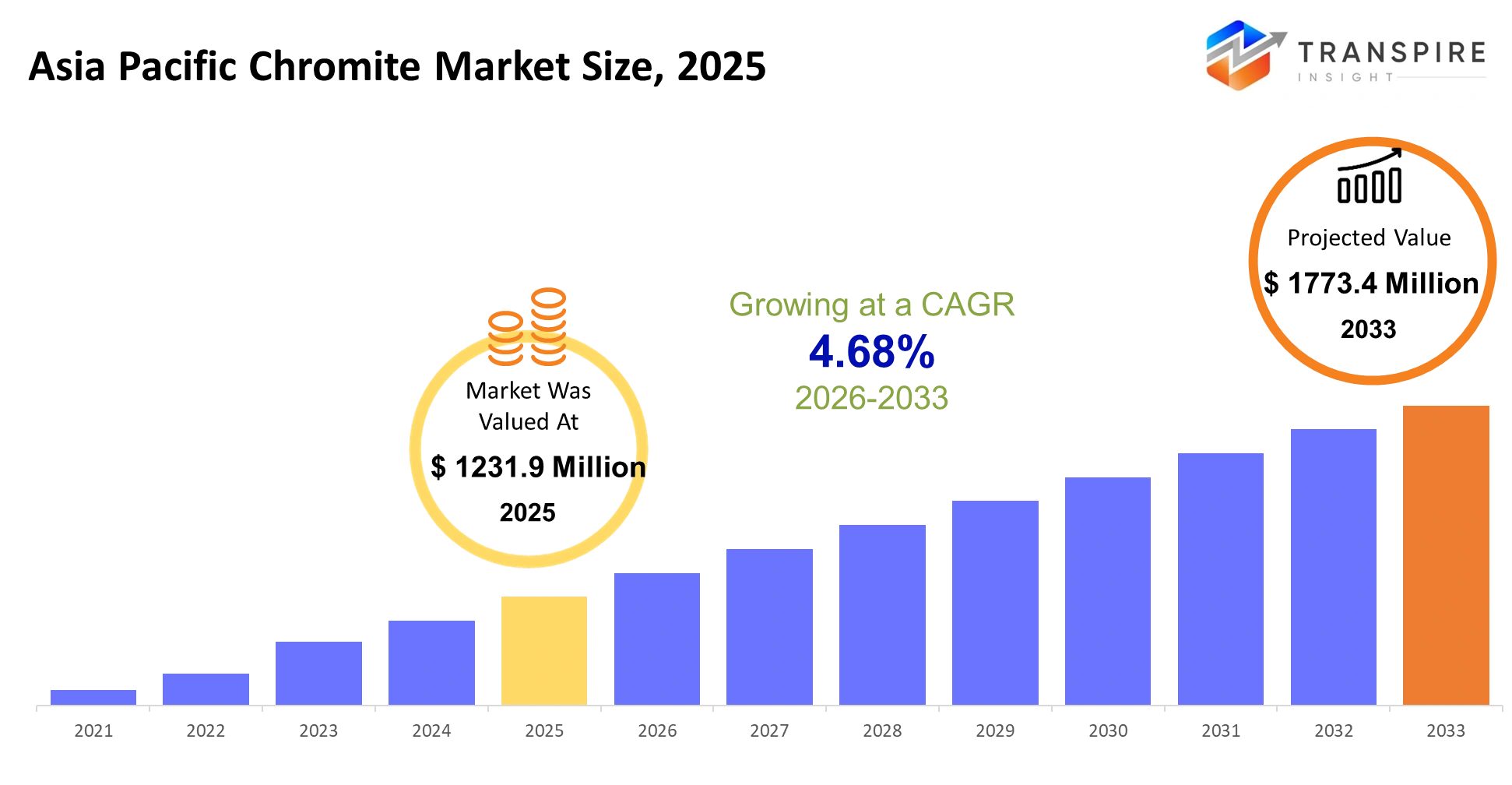
- Asia Pacific Chromite Market Size 2025: USD 1231.9 Million
- Asia Pacific Chromite Market Size 2033: USD 1773.4 Million
- Asia Pacific Chromite Market CAGR: 4.68%
- Asia Pacific Chromite Market Segments: By Type (Metallurgical Grade, Refractory Grade, Chemical Grade, Foundry Grade, Low-grade, Others); By Application (Stainless Steel, Alloys, Chemicals, Foundry, Refractories, Others); By End-User (Steel Industry, Chemical Industry, Foundries, Refractories, Industrial, Others); By Form (Lumps, Concentrates, Powder, Granules, Pellets, Others)
To learn more about this report,  Download Free Sample Report
Asia Pacific Chromite Market Summary
The Asia Pacific Chromite Market was valued at USD 1231.9 Million in 2025. It is forecast to reach USD 1773.4 Million by 2033. That is a CAGR of 4.68% over the period.
The Asia Pacific chromite market provides chromite ore which manufacturers use to create ferrochrome, a vital component for producing stainless steel and heat resistant steels needed in construction and automotive and industrial equipment applications. The material provides corrosion resistant steel systems which maintain infrastructure and energy facilities and manufacturing operations through extreme thermal and mechanical stress conditions.
The market has transformed during the last five years because India and China have developed their ferrochrome production capability which allows them to produce local supply while decreasing their dependence on imported raw materials. The structural change has received additional backing because South African export operations faced pandemic-related interruptions and ongoing freight access issues continued to disrupt international trade systems.
Procurement strategies now focus on two main objectives which include spreading risk through multiple sources and using domestic facilities for processing. The growth in demand now depends on three factors which are stainless steel production and infrastructure expansion and increasing industrial operations in manufacturing and energy sectors.
Key Market Insights
- China will lead the Asia Pacific Chromite Market in 2025 when it will control almost 45% of the market through its integrated production facilities for ferrochrome and stainless steel.
- India emerges as the fastest-growing region through 2026 to 2030 because mining operations develop and the country builds new ferroalloy production facilities.
- Southeast Asia shows increasing dependence on imports which creates greater demand for chromite used in stainless steel manufacturing supply chains that are connected to international trade.
- The Asia Pacific Chromite Market dedicates its main market share of over 70% to metallurgical grade chromite because it serves stainless steel production needs.
- The second-biggest market segment for refractory grade chromite provides essential materials which create high-temperature furnace linings used in steel and cement production facilities.
- The market for foundry-grade chromite will experience its highest growth rate until 2030 because automotive and heavy machinery industries require precision casting.
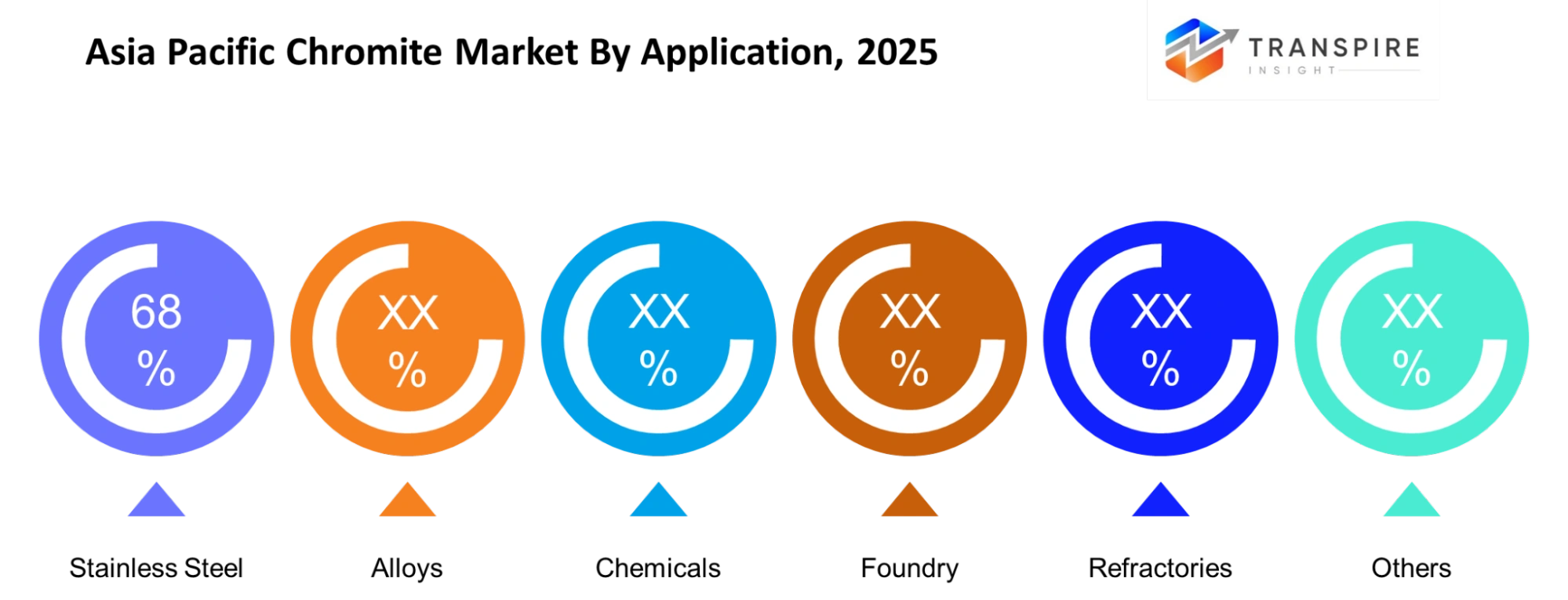
- The Asia Pacific Chromite Market sees its largest applications through stainless steel production which accounts for more than 60% of the market share.
- The chemical and refractory sectors experience their highest growth rate because industrial furnace upgrades and energy sector expansion drive their development.
- The steel manufacturing sector leads all other end-user sectors because it accounts for approximately 65% of total demand for ferrochrome inputs.
- The automotive and industrial machinery sectors experience their highest growth rate because they use lightweight and corrosion-resistant materials.
What are the Key Drivers, Restraints, and Opportunities in the Asia Pacific Chromite Market?
The stainless steel production growth in China India and Southeast Asia drives the Asia Pacific Chromite Market through its increasing production activities. The steel industry experienced this momentum shift because infrastructure projects and industrial operations began to recover after the 2020 to 2022 supply chain disruptions which made steel producers seek dependable ferrochrome sources. Integrated mining and smelting facilities have entered operational expansion because they use more chromite which results in reliable revenue streams for producers who manufacture downstream alloys.
The market faces challenges because of two main factors which include ore grade fluctuations and the uneven distribution of mineral reserves throughout different regions. The high-quality chromite deposits of India and Indonesia exist in specific mining regions which create structural dependence on these limited areas. The existing distribution of resources creates an imbalance which results in higher logistics expenses while making it difficult for buyers to manage supply interruptions and preventing smaller producers from achieving business growth. The geological resources of the market create an ongoing limit which decreases market efficiency while obstructing new investments in downstream capacity development.
The market creates a major chance for businesses to take advantage of investments made in advanced beneficiation systems and energy-efficient ferrochrome processing methods. India is implementing pelletisation together with advanced smelting projects to achieve better ore recovery results while decreasing energy consumption levels. The mining and steel industries are forming joint ventures through these advancements which will lead to increased value-added production for the Asia Pacific Chromite Market and greater long-term resilience of their supply chain networks.
What Has the Impact of Artificial Intelligence Been on the Asia Pacific Chromite Market?
The Asia Pacific Chromite Market experiences operational efficiency benefits from artificial intelligence and digital technologies, which particularly improve shipping-related supply chains and ferrochrome transportation systems. The AI-based automation system now enables real-time monitoring of exhaust gas cleaning systems on bulk carriers that transport chromite ore through scrubber performance systems. The system enables vessel operators to follow emissions regulations more effectively because it decreases operational interruptions and enables them to operate their vessels with better emissions control.
Machine learning models now find application in developing predictive maintenance systems for both propulsion systems and cargo handling equipment. Operators can use vibration pattern analysis combined with fuel consumption data and historical failure records to predict component wear that will lead to equipment breakdowns. The fleet management systems which operate on chromite trade routes throughout the Asia Pacific Chromite Market have achieved a 10 to 15 percent increase in vessel uptime while they have achieved a 5 percent reduction in fuel consumption which directly impacts logistics costs.
The maritime industry faces two main challenges that hinder its ability to implement better technology solutions because offshore routes lack adequate real-time connectivity and sensor data quality decreases in extreme maritime conditions. The high costs associated with retrofitting existing systems to modernize legacy fleets create deployment challenges that particularly impact mid-sized shipping companies. AI-driven optimization maintains its strength because it delivers better compliance reliability and operational efficiency and better supply chain predictability throughout chromite transportation systems.
Key Market Trends
- China reduced its dependency on imported chromite after 2022 because it developed its domestic ferrochrome production capabilities which created new patterns of regional trade movement.
- India increased its chromite ore processing investments after 2023 which resulted in better ore extraction performance and the establishment of advanced ferroalloy manufacturing operations.
- Indonesia implemented more extensive export limitations on its mineral resources which compelled regional buyers to select local sourcing methods in the Asia Pacific Chromite Market.
- Stainless steel producers shifted procurement contracts toward long-term supply agreements after 2021 price volatility disrupted short-term chromite sourcing stability.
- Glencore and Tata Steel Mining developed their upstream integration methods during 2024 through direct mining and processing partnerships which gave them control over ore resources.
- Ferrochrome producers adopted energy-efficient smelting technologies after 2023 which decreased their electricity use per ton and enhanced their ability to compete with operational costs.
- Maritime transporters introduced stricter emissions compliance systems in 2022, which led to increased use of scrubber-equipped vessels for chromite ore shipments.
- Southeast Asian buyers diversified their supply chains after 2021 disruptions, which allowed them to decrease their dependency on single-origin imports while they increased their use of multi-source procurement models.
- Mining operations saw growth in automation after 2023 because AI-based ore sorting systems enhanced yield efficiency while decreasing waste production in chromite processing plants.
Asia Pacific Chromite Market Segmentation
By Type:
Metallurgical grade chromite remains highly demanded because it serves as an essential material for producing stainless steel and creating metal alloys. The industrial hubs of steel manufacturing experience continuous material consumption because of ongoing industrial development. Refractory grade and foundry grade materials support high-temperature operations in furnaces and casting units. Chemical grade supports limited but stable usage in chemical processing activities.
Low-grade chromite and its different forms exist to meet specific requirements which focus on cost savings instead of maintaining high purity levels. The industrial operations use these forms for blended applications. Demand patterns remain closely linked with steel output cycles and manufacturing activity across the Asia Pacific region. The industrial sector will grow which will create balanced usage of all grade types.
By Application :
Chromite usage with stainless steel applications exists as the primary market because it enhances both strength and corrosion resistance. The production of alloys maintains constant market demand which benefits both construction and automotive sectors. The applications require continuous industrial production and infrastructure growth in both emerging and developed markets throughout the region.
The chemical and foundry industries use chromite because it provides stability during processing and enhances casting strength. Refractories rely on chromite for heat resistance in furnaces and kilns. The specialized industrial applications require materials that offer both durability and thermal performance. The demand increase receives backing from the growth of both manufacturing and metal processing industries.
To learn more about this report, Download Free Sample Report
By End-User :
The steel industry remains the primary end-user of chromite, driven by stainless steel production and alloy demand. The need for continuous operation will increase because construction and infrastructure projects continue to grow. The chemical industry currently maintains moderate consumption levels which require processing needs and catalyst operations in specific Asia Pacific market segments.
Foundries and refractories require high-temperature materials for their metal casting operations which create substantial market demand. Industrial users include diversified manufacturing sectors requiring durable materials. Other end-users include niche operations with specific performance requirements. Industrial output growth and metal processing activities will result in demand distribution that maintains equilibrium across all end-user segments.
By Form :
Lumps from chromite dominate due to direct use in smelting and stainless steel production processes. This form supports efficient handling in large-scale metallurgical operations. After beneficiation, concentrates become widely used because they provide better quality for industrial applications in regional steel and alloy production facilities.
Powder and granules serve chemical processing and refractory applications where fine material distribution is required. Pellets support controlled feeding in industrial furnaces and processing units. Each form meets specific operational needs across industries. The production methods and efficiency standards required by expanding industrial needs in Asia Pacific markets directly affect demand.
What are the Key Use Cases Driving the Asia Pacific Chromite Market?
The Asia Pacific Chromite Market serves its primary purpose for producing ferrochrome which enables stainless steel production. Stainless steel manufacturers from China India and Japan use chromite because it provides their construction and automotive parts and industrial machinery with protection against corrosion and high-temperature performance. The need for strong steel products arises from building new infrastructure and operating industrial facilities in cities.
The field now uses refractory materials in cement kilns and glass furnaces and metallurgical plants. Industrial manufacturers who need better thermal stability and extended equipment lifetimes show increasing interest in these end uses. The automotive and heavy machinery industries use chromite for precision casting which supports their foundry operations.
Advanced alloy engineering and energy transition infrastructure development create new use cases for emerging technologies. Researchers are evaluating chromite-based materials for application in high-temperature hydrogen production systems and next-generation nuclear and renewable energy components. The applications exist at an early development stage but steelmakers and materials engineering firms throughout the region begin to invest in pilot projects.
|
Report Metrics |
Details |
|
Market size value in 2025 |
USD 1231.9 Million |
|
Market size value in 2026 |
USD 1287.3 Million |
|
Revenue forecast in 2033 |
USD 1773.4 Million |
|
Growth rate |
CAGR of 4.68% from 2026 to 2033 |
|
Base year |
2025 |
|
Historical data |
2021 - 2024 |
|
Forecast period |
2026 - 2033 |
|
Report coverage |
Revenue forecast, competitive landscape, growth factors, and trends |
|
Regional scope |
Asia Pacific ( China, India, Japan, South Korea, Australia, Rest of Asia Pacific) |
|
Key company profiled |
Samancor Chrome, Glencore, Assmang, Eurasian Resources Group, Tata Steel Mining, Odisha Mining Corp, Yildirim Group, IMFA, Chrome Corp, Gulf Mining, Oman Chromite, Al Tamman, AlbChrome, Zimasco, Hernic Ferrochrome |
|
Customization scope |
Free report customization (country, regional & segment scope). Avail customized purchase options to meet your exact research needs. |
|
Report Segmentation |
By Type (Metallurgical Grade, Refractory Grade, Chemical Grade, Foundry Grade, Low-grade, Others); By Application (Stainless Steel, Alloys, Chemicals, Foundry, Refractories, Others); By End-User (Steel Industry, Chemical Industry, Foundries, Refractories, Industrial, Others); By Form (Lumps, Concentrates, Powder, Granules, Pellets, Others) |
Which Regions are Driving the Asia Pacific Chromite Market Growth?
The Asia Pacific Chromite Market finds its leading position through China which operates steel production systems that directly supply its ferrochrome needs. Advanced port facilities enable large coastal industrial clusters to conduct bulk operations while achieving fast steel production timeframes. The government supports industrial policies which maintain stainless steel production through domestic chromite sources that drive ongoing chromite market requirements. The system functions effectively through vertically integrated companies which connect their operational activities from mining to smelting and steel production through unified supply networks.
Japan functions as a stable yet different contributor because the country depends on imported chromite instead of its own mining operations. The company establishes its market presence through long-term supply agreements which result in constant demand from both precision manufacturing and specialty steel markets. Japan's growth path shows different development methods compared to China because the country focuses on producing high-grade alloys which engineers use in automotive and electronic applications. Companies that maintain strong investment guidelines together with their forecasting abilities for industrial production patterns ensure that chromite imports continue without interruption during times of global price changes.
The mining sector and ferrochrome production capacity in India experience their fastest growth because of mining development and new ferrochrome operations which began in Odisha and nearby industrial areas. The recent policy reforms which support domestic mineral processing initiatives and infrastructure development for rail and port systems have enhanced the efficiency of raw material transportation. The new private sector investments are coming to the field of smelting and alloy production. India presents an attractive market opportunity for new companies because its future development path will depend on their ability to establish upstream operations and secure long-term supply agreements until 2033.
Who are the Key Players in the Asia Pacific Chromite Market and How Do They Compete?
The Asia Pacific Chromite Market operates with a semi-consolidated market structure which allows a few global mining companies together with steel manufacturers to control premium chromite resources while the regional mining companies in India and Southeast Asia continue to operate as independent entities. The market competition depends on three factors which include operational efficiency and ore grade management and mining reserve accessibility instead of brand recognition and product differentiation from competitors. Established companies maintain their market position through vertical integration and long-term supply agreements while new companies encounter obstacles which arise from concentrated resource ownership and the need for expensive mineral processing facilities.
Tata Steel Mining strengthens its position through captive ore sourcing in India’s Odisha belt because the company combines steel production with chromite extraction through its steel production process. The approach enables better cost management because it eliminates international market procurement need which results in unpredictable cost changes that rival companies face when they depend on high-priced imported materials. The company concentrates on producing ferrochrome through efficient methods which depend on its mining site proximity to achieve stable material supply for furnace operations. The two companies are increasing their operations through simultaneous capacity expansion efforts and their investments in railway-based logistics systems which enable smoother movement of materials from mining sites to processing facilities.
Glencore operates a trading-led business model which uses its worldwide shipping systems to manage chromite distribution from Africa to Asian market locations. Samancor Chrome operates its extensive South African mining sites to achieve cost advantages which it combines with permanent export deals to Asian stainless steel manufacturing centers. CVK Group establishes its market position through unique supply chain flexibility and regional trading agreements while expanding its business by reaching mid-sized Asian stainless steel manufacturers who want to develop multiple sourcing options.
Company List
- Samancor Chrome
- Glencore
- Assmang
- Eurasian Resources Group
- Tata Steel Mining
- Odisha Mining Corp
- Yildirim Group
- IMFA
- Chrome Corp
- Gulf Mining
- Oman Chromite
- Al Tamman
- AlbChrome
- Zimasco
- Hernic Ferrochrome
Recent Development News
In February 2025, IMFA acquired Tata Steel's Kalinganagar ferro chrome plant to increase its production capabilities for ferrochrome manufacturing. The agreement boosts India's chromite-to-ferrochrome process chain by enhancing domestic value creation and establishes backdoor access to chromite ore resources which will improve supply chain reliability throughout the Asia Pacific region.
Source https://www.meralcopowergen.com
In February 2026, Indian Metals and Ferro Alloys (IMFA) completed the acquisition of Tata Steel’s ferro chrome plant in Kalinganagar, India, significantly expanding its ferrochrome production capacity. The deal strengthens domestic value addition in India’s chromite-to-ferrochrome chain and supports backward integration using captive chromite ore mines, reinforcing regional supply security in Asia Pacific.
Source https://www.newindianexpress.com/
What Strategic Insights Define the Future of the Asia Pacific Chromite Market?
The Asia Pacific Chromite Market is experiencing a fundamental transformation which establishes stronger connections between mining operations and stainless steel production centers due to persistent demand for stable supply sources and decreased need for imported materials.Over the next 5 to 7 years this alignment will deepen as governments in India and Southeast Asia prioritize domestic beneficiation and downstream ferroalloy capacity which will create new trade patterns based on regional value chains instead of international spot market buying.
The mining industry faces a hazard which remains hidden because it depends on the growing supply of resources from specific geological areas that contain high-grade mineral resources located in India and Indonesia. The process enables organizations to operate their facilities at full capacity but they face danger from unexpected governmental changes which affect mining authorization processes and environmental protection standards. The development of alternative alloy formulas for specific high-performance steel applications will create substitution pressures which will start to decrease chromite usage in particular market segments.
The development of low-carbon smelting technologies which support green steel projects represents a fresh business opportunity that will benefit India's industrial corridors. Market participants should establish joint financing projects for energy-efficient ferrochrome production while securing permanent ore access agreements because control of sustainable supply chains will determine market competition until 2033.
Asia Pacific Chromite Market Report Segmentation
By Type
- Metallurgical Grade
- Refractory Grade
- Chemical Grade
- Foundry Grade
- Low-grade
By Application
- Stainless Steel
- Alloys
- Chemicals
- Foundry
- Refractories
By End-User
- Steel Industry
- Chemical Industry
- Foundries
- Refractories
- Industrial
By Form
- Lumps
- Concentrates
- Powder
- Granules
- Pellets
Frequently Asked Questions
Find quick answers to common questions.
The Asia Pacific Chromite Market size is USD 1773.4 Million in 2033.
Key segments for the Asia Pacific Chromite Market are By Type (Metallurgical Grade, Refractory Grade, Chemical Grade, Foundry Grade, Low-grade, Others); By Application (Stainless Steel, Alloys, Chemicals, Foundry, Refractories, Others); By End-User (Steel Industry, Chemical Industry, Foundries, Refractories, Industrial, Others); By Form (Lumps, Concentrates, Powder, Granules, Pellets, Others).
Major Asia Pacific Chromite Market players are Samancor Chrome, Glencore, Assmang, Eurasian Resources Group, Tata Steel Mining, Odisha Mining Corp, Yildirim Group, IMFA, Chrome Corp, Gulf Mining, Oman Chromite, Al Tamman, AlbChrome, Zimasco, Hernic Ferrochrome.
The Asia Pacific Chromite Market size is USD 1231.9 Million in 2025.
The Asia Pacific Chromite Market CAGR is 4.68% from 2026 to 2033.
- Samancor Chrome
- Glencore
- Assmang
- Eurasian Resources Group
- Tata Steel Mining
- Odisha Mining Corp
- Yildirim Group
- IMFA
- Chrome Corp
- Gulf Mining
- Oman Chromite
- Al Tamman
- AlbChrome
- Zimasco
- Hernic Ferrochrome
Recently Published Reports
-
Apr 2026
Healthcare Polymer Packaging Market
Healthcare Polymer Packaging Market Size, Share & Analysis Report By Packaging Type (Syringes, IV Bottles and Pouches, Clamshells, Blisters, Bottles & Jars, Containers, Tubes, IV Parental Packaging, Others), By Type (Regulated, Non-regulated), By Polymer Type (LDPE (Low-Density Polyethylene), HDPE (High-Density Polyethylene), Homo-polymer (Homo), Random Copolymer (Random), Block Copolymer (Block), PET, Polystyrene, Polyvinyl Chloride, Polyamide/EVOH, Others), and Geography (North America, Europe, Asia-Pacific, Middle East and Africa, South and Central America), 2021 - 2031
-
Apr 2026
Hydrophilic Tape (Waterstop) Market
Hydrophilic Tape (Waterstop) Market Size, Share & Analysis Report By Type (Bentonite-Based Hydrophilic Tape, Rubber-Based Hydrophilic Tape), By Application (Residential Buildings, Commercial Buildings, Infrastructure Projects), and Geography (North America, Europe, Asia-Pacific, Middle East and Africa, South and Central America), 2021 - 2031
-
Apr 2026
Metalens Market
Metalens Market Size, Share & Analysis Report By Type (Visible Light Metalens, and Infrared Metalens), By Application (Consumer Electronics, Automotive Electronics, Industrial, Medical, and Others), and Geography (North America, Europe, Asia-Pacific, Middle East and Africa, South and Central America), 2021 - 2031
-
Apr 2026
PBT Resin Market
PBT Resin Market Size, Share & Analysis Report By Type (Reinforced PBT Resin, Unreinforced PBT Resin), By Processing Method (Injection Molding, Extrusion, Blow Molding, Others), By End-User (Automotive, Electrical & Electronics, Consumer Appliances, Industrial Machinery, Medical Devices, Packaging, Others), and Geography (North America, Europe, Asia-Pacific, Middle East and Africa, South and Central America), 2021 - 2031