

Asia Pacific Chrome Plating Market Size & Forecast:
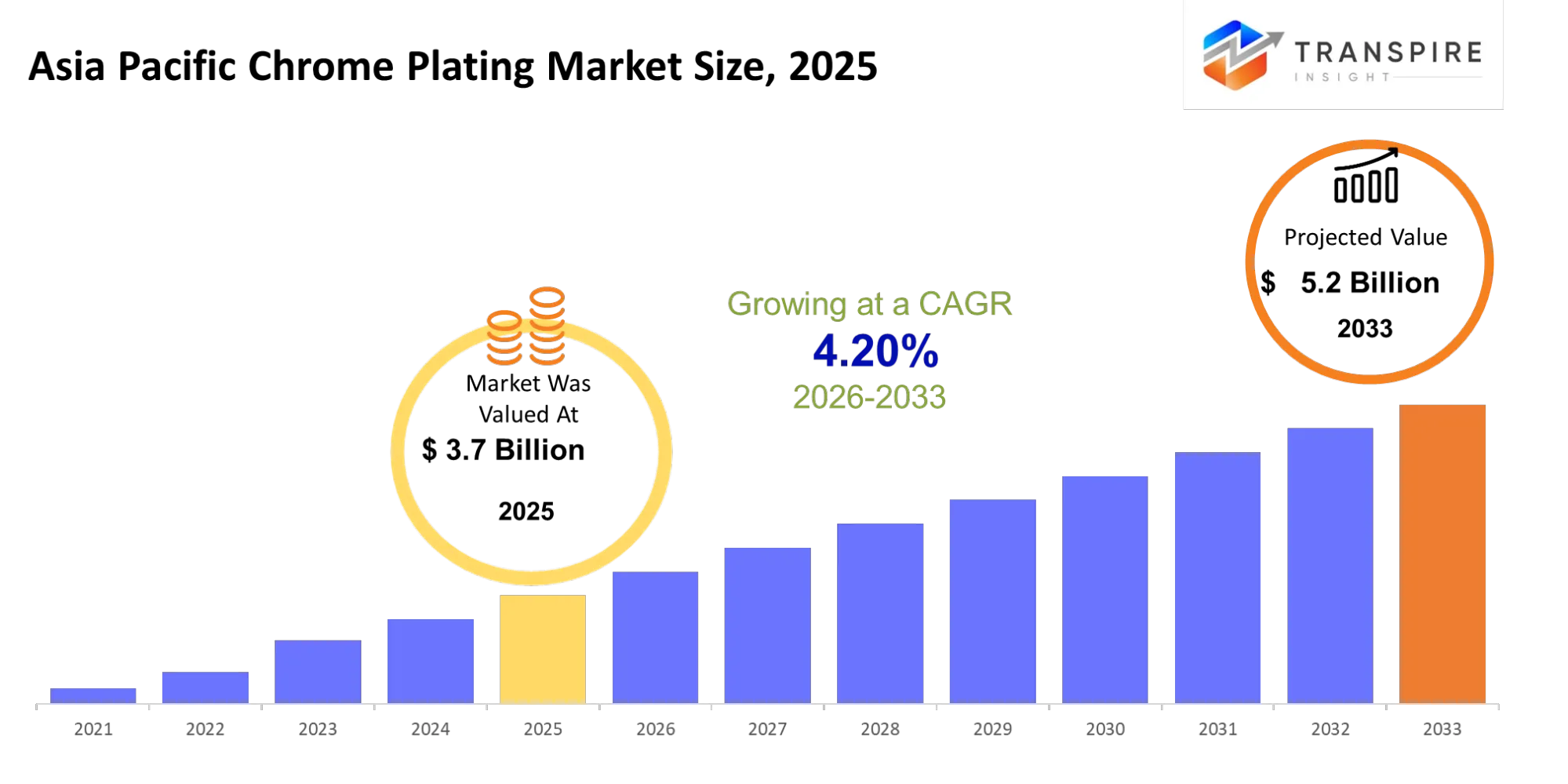
- Asia Pacific Chrome Plating Market Size 2025: USD 3.7 Billion
- Asia Pacific Chrome Plating Market Size 2033: USD 5.2 Billion
- Asia Pacific Chrome Plating Market CAGR: 4.20%
- Asia Pacific Chrome Plating Market Segments: By Type (Hard Chrome Plating, Decorative Chrome Plating, Others); By Application (Automotive, Aerospace, Industrial Machinery, Electronics, Others); By End-User (Automotive Industry, Aerospace Industry, Manufacturing Sector, Electronics Industry, Others);
To learn more about this report,  Download Free Sample Report
Asia Pacific Chrome Plating Market Summary
The Asia Pacific Chrome Plating Market was valued at USD 3.7 Billion in 2025. It is forecast to reach USD 5.2 Billion by 2033. That is a CAGR of 4.20% over the period.
Chrome plating in Asia Pacific protects metal components through its application on marine hardware and hydraulic systems and automotive and industrial machinery parts because it prevents corrosion and abrasion and heat, which leads to extended service life and decreased maintenance downtime under extreme operational conditions. A market trend during the past few years has moved away from traditional hexavalent chromium methods toward trivalent chromium and automated electroplating systems because manufacturers must comply with new environmental standards that China, Japan and South Korea established to limit toxic emissions.
The combination of increased environmental enforcement and post-pandemic recovery of shipbuilding and heavy equipment maintenance operations has become a major trigger because it revealed supply chain weaknesses in surface finishing chemicals and enforced local procurement requirements. Plating providers make investments into compliant high-precision production lines which require higher financial investment yet produce consistent output that meets both quality standards and regulatory requirements, thus resulting in industrial and maritime supply chains to achieve consolidation through high-value contract agreements.
Key Market Insights
- China controls approximately 35 to 40 percent of the Asia Pacific Chrome Plating Market because its extensive automotive and industrial manufacturing operations.
- The period from 2024 to 2030 marks India as the most rapidly developing area because of its growing industrial equipment needs and infrastructure development.
- The advanced electronics manufacturing ecosystems together with precision engineering maintain high demand for goods from both Japan and South Korea.
- Hard chrome plating leads the Asia Pacific Chrome Plating Market with significant share due to heavy machinery and hydraulic applications.
- Decorative chrome plating holds the second-largest share because automotive aesthetic needs and consumer appliance demand drive its usage.
- The period from 2024 to 2030 shows that trivalent chromium plating will become the fastest-growing market segment because regulations now prohibit the use of hexavalent chromium plating methods.
- The Asia Pacific Chrome Plating Market allocation for automotive parts reaches almost 30% because engine and transmission components make up a major portion of vehicle manufacturing.
- Automotive manufacturers lead end-use demand with over 30% share, supported by OEM production and aftermarket servicing.
- The heavy engineering and construction equipment sector is experiencing fast expansion because industrial development takes place throughout the Asia Pacific region.
- Precision coating needs and safety standards drive the growth of aerospace and defense applications.
What are the Key Drivers, Restraints, and Opportunities in the Asia Pacific Chrome Plating Market?
Environmental and occupational safety regulations which control hexavalent chromium usage have become stricter through recent changes which currently affect China and Japan and South Korea. Manufacturers need to modernize their old plating equipment because the new regulations require them to install trivalent chrome systems and closed-loop electroplating systems. OEM suppliers now increase their adoption rate because they need to comply with mandatory procurement rules which require them to spend money on capital equipment and service contracts.
The main obstacle exists because companies need to spend money on new equipment and face difficulties when they try to stop using traditional chrome methods. Plating operations need to shut down their facilities for substantial periods because they must install particular waste management equipment which requires experts to operate. The system establishes a fundamental obstacle which disrupts the supply chain and prevents progress while short-term sales growth remains restricted by strong downstream market demand.
India and Southeast Asia offer the best business potential because their industrial sectors expand and new automotive manufacturing hubs are constructed with built-in plating systems that meet regulatory standards. The establishment of greenfield manufacturing hubs in Maharashtra and Vietnam enables advanced electroplating technologies to be introduced which will develop these areas into the future growth centers of the Asia Pacific Chrome Plating Market.
What Has the Impact of Artificial Intelligence Been on the Asia Pacific Chrome Plating Market?
The operational efficiency of scrubber performance systems and electroplating-related marine and industrial supply chains in Asia Pacific is progressively being transformed through artificial intelligence and advanced digital technologies. Scrubber monitoring currently uses AI-enabled control systems to automate facility operations, which adjust chemical dosing and pressure levels and filtration cycles according to real-time sensor measurements. The system enables facilities to achieve consistent emission control results because it requires less manual work while maintaining efficiency during operations that involve high volumes of ship maintenance and industrial coating.
Machine learning models are also being deployed for predictive maintenance, where historical operating data from exhaust gas cleaning technology is analyzed to forecast pump failures, corrosion risks, and filter degradation. The systems allow operators to organize maintenance work before equipment failures happen, which results in a 10 to 15 percent increase in operational time for facilities that use digital upgrades and a decrease in unplanned repair expenses. Emissions forecasting tools assist compliance teams by predicting emissions changes that occur with different fuel loads, which results in more reliable regulatory compliance throughout port inspections.
The maritime industry faces challenges with adoption because operational data quality remains low and maritime environments experience difficulties with maintaining reliable connectivity. Many vessels still operate in low-bandwidth zones, which restricts real-time AI model updates and reduces prediction accuracy. The IoT-enabled retrofitting market and edge computing system investments continue to grow because Asian Pacific industrial networks and Chrome Plating Market facilities begin to shift towards digital emission control systems.
Key Market Trends
- The new hexavalent chromium regulations implemented by China and Japan from 2020 require more than 30 percent of plating facilities to install better emission control technologies.
- South Korea implemented automated electroplating lines between 2022 and 2025 which decreased the need for human operation while maintaining better coating quality throughout OEM supply chains.
- After 2021, supply chain disruptions forced original equipment manufacturers to shift their operations to India and Vietnam which resulted in a 25 percent increase of local plating capacity investments in that area.
- From 2023 onward, trivalent chromium adoption accelerated, replacing hexavalent processes in nearly 40% of new industrial plating installations.
- Major suppliers Atotech and Element Solutions established more automotive OEM partnerships in 2022 to create long-term coating agreements.
- The implementation of predictive maintenance systems in plating and scrubber facilities that use digital monitoring technologies achieved a 10 to 15 percent reduction of unexpected downtime by 2024.
- The rising compliance costs that started in 2021 forced small plating workshops to close their operations which resulted in the loss of 15 to 20 percent of the fragmented plating capacity present in the Asia Pacific region.
- The ship maintenance operations in Singapore and South Korea experienced increased needs for corrosion-resistant chrome coatings between 2023 and 2025.
Asia Pacific Chrome Plating Market Segmentation
By Type :
The Asia Pacific Chrome Plating Market maintains constant demand throughout its various coating options because industrial development continues and manufacturing operations increase. Heavy machinery parts require hard chrome plating because it provides both strength and resistance to wear. Decorative chrome plating is used to enhance the surface appearance of visible product components while protecting them from corrosion.
Industrial equipment relies on hard chrome plating to extend the operational time of machinery parts that undergo friction and stress. Consumer products use decorative chrome plating because it provides a visually appealing appearance and a smooth surface finish. Other plating types serve niche uses such as repair coatings and specialized industrial applications with specific performance needs.
By Application :
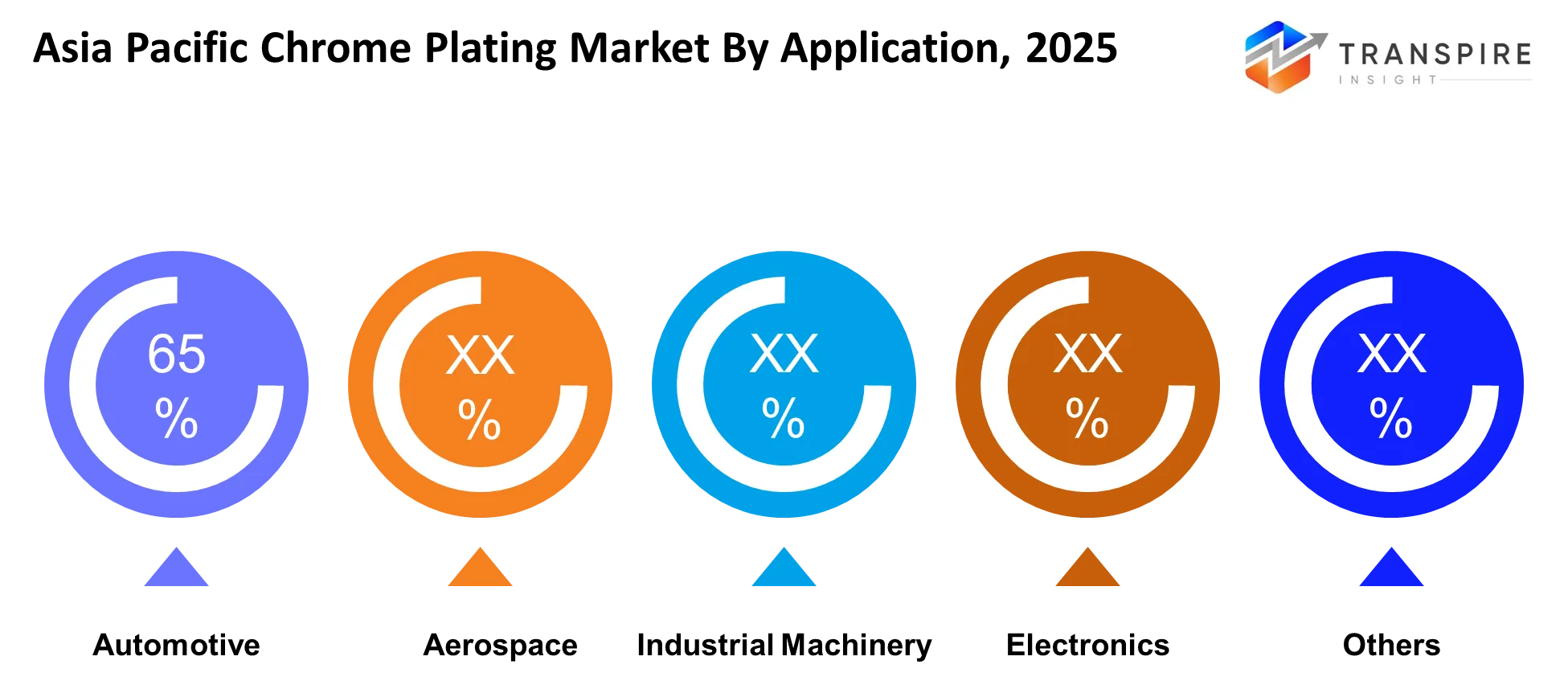
The Asia Pacific Chrome Plating Market shows strong demand from automotive applications because vehicle manufacturing increases and the need for durable engine components grows. Aerospace applications require high precision coatings for safety and performance. Chrome plating enables industrial machinery to achieve better wear resistance while prolonging the operational life of their equipment.
Electronics applications use chrome plating for connectors and conductive components requiring stable performance. Other applications include tools and specialty equipment used in manufacturing units. The industrial output growth in Asia Pacific creates constant demand for these application areas because various sectors require better performance and protection against corrosion.
To learn more about this report, Download Free Sample Report
By End-User :
The automotive industry remains a key end-user, using chrome plating for functional and decorative vehicle components. The aerospace industry applies coatings to achieve strength, heat resistance and long-term reliability. The manufacturing sector uses chrome plating for machines and tools which need to operate with reduced friction and extended operational life in continuous production environments.
The electronics industry uses chrome plating to create precision parts and connectors which have durable contact surfaces. The rising demand from end-user industries results from production capacity expansion and greater emphasis on equipment efficiency. The Asia Pacific Chrome Plating Market keeps expanding because of industrial modernization and growing use of surface enhancement technologies.
What are the Key Use Cases Driving the Asia Pacific Chrome Plating Market?
The Asia Pacific Chrome Plating Market mainly serves to protect automotive and heavy machinery components through corrosion and wear protection which applies to engine parts and hydraulic cylinders and transmission systems. OEM manufacturers depend on chrome plating because it helps their components last longer when they operate in high-friction and high-heat situations, which results in decreased warranty expenses and less need for maintenance across their production networks.
The new applications extend to both marine equipment maintenance and industrial machinery refurbishment activities, which establish special importance in shipbuilding centers such as South Korea and Singapore. Offshore vessels and port machinery increasingly require durable coatings to withstand saline exposure, while construction and mining equipment operators use chrome plating to restore worn components and reduce replacement cycles.
The aerospace industry and advanced manufacturing facilities which use precision robotics are creating new use cases. Aircraft landing gear coatings and high-precision robotic joints require ultra-smooth, low-friction surfaces, and stricter safety standards are accelerating early adoption. The applications maintain their niche status, yet they show increasing activity as manufacturing automation and high-performance engineering expand across Asia Pacific.
|
Report Metrics |
Details |
|
Market size value in 2025 |
USD 3.7 Billion |
|
Market size value in 2026 |
USD 3.9 Billion |
|
Revenue forecast in 2033 |
USD 5.2 Billion |
|
Growth rate |
CAGR of 4.20% from 2026 to 2033 |
|
Base year |
2025 |
|
Historical data |
2021 - 2024 |
|
Forecast period |
2026 - 2033 |
|
Report coverage |
Revenue forecast, competitive landscape, growth factors, and trends |
|
Regional scope |
Asia Pacific (India, China, Japan, Australia,South Korea, Rest of Asia Pacific) |
|
Key company profiled |
Atotech, MacDermid Enthone, Coventya, Sarrel Group, Pioneer Metal Finishing, ChromeTech, Aalberts, Roy Metal Finishing, Arlington Plating, Precision Plating, Interplex, Bajaj Electroplaters, Chrome India, Galvatek, Hohman Plating |
|
Customization scope |
Free report customization (country, regional & segment scope). Avail customized purchase options to meet your exact research needs. |
|
Report Segmentation |
By Type (Hard Chrome Plating, Decorative Chrome Plating, Others); By Application (Automotive, Aerospace, Industrial Machinery, Electronics, Others); By End-User (Automotive Industry, Aerospace Industry, Manufacturing Sector, Electronics Industry, Others); |
Which Regions are Driving the Asia Pacific Chrome Plating Market Growth?
The Asia Pacific Chrome Plating Market relies on China because the country contains multiple automotive manufacturing centers and shipbuilding facilities and industrial regions. The implementation of stronger environmental regulations by the government has led to the replacement of traditional hexavalent systems with trivalent plating facilities that meet environmental standards in coastal provinces. The country benefits from supply ecosystems which link its raw material producers to its plating service providers and its original equipment manufacturers in industrial areas. The operational requirements of marine maintenance activities and export-oriented manufacturing needs remain protected by the extensive port facilities which exist in Shanghai Guangzhou and Tianjin.
Japan serves as a reliable industrial partner because of its stable development process which focuses on precision engineering rather than large-scale operations. The demand originates from industrial machinery which has a long operational life and from automotive component exports and from the strict quality requirements which manufacturing facilities must meet. Japanese shipowners and industrial firms prioritize lifecycle efficiency, leading to steady investments in corrosion-resistant coatings rather than rapid capacity expansion. Established compliance systems together with advanced material science abilities create a stable system which serves as an ongoing revenue source during times when industrial demand experiences normal fluctuations.
India has become the fastest-growing region through its industrial corridor projects and its expanded automotive production under national production incentives. The new greenfield facilities in Gujarat and Maharashtra are developing their chrome plating systems through their design process to prevent incurring expenses from outdated systems. The modernization projects for Mumbai and Chennai ports have created new requirements for marine maintenance coatings. Between 2026 and 2033 the Asia Pacific Chrome Plating Market will enable investors to expand their operations through capacity development in India because the country maintains lower costs for regulatory changes compared to developed markets.
Who are the Key Players in the Asia Pacific Chrome Plating Market and How Do They Compete?
The Asia Pacific Chrome Plating Market operates through moderate market divisions because global chemical companies and local plating companies both vie for customers in the automotive marine and industrial markets. The market now requires competitors to demonstrate their technological capabilities and operational effectiveness and their ability to meet environmental certification standards instead of competing through lower prices. Companies sustain their market position by improving their trivalent chrome systems and developing complete surface treatment systems while smaller local companies face difficulties because they cannot keep up with stricter emissions regulations and increasing equipment costs.
Element Solutions Inc uses its combined surface treatment product offerings and its strong original equipment manufacturer links to establish dominance in the automotive and electronics supply chain markets. MacDermid Alpha Electronics Solutions its subsidiary develops high-performance finishing chemicals that enhance coating uniformity while decreasing operational waste which results in better performance for precision manufacturing facilities. Atotech establishes its unique identity through its development of advanced systems that automate electroplating processes and its creation of digital monitoring tools which businesses in regulated sectors like automotive and industrial equipment use to ensure compliance.
Coventya competes through its dedicated development of eco-friendly decorative and functional plating chemical solutions which serve European and Asia Pacific original equipment manufacturers who are moving away from hexavalent treatments. Technic Inc expands through its combination of technical service contracts and development of customized plating solutions which serve aerospace and high-reliability industrial sectors. JCU Corporation establishes a stronger presence in Japan and Southeast Asia through its dedication to high-purity electroplating technologies and its long-term supply agreements with electronics and automotive manufacturers.
Company List
- Atotech
- MacDermid Enthone
- Coventya
- Sarrel Group
- Pioneer Metal Finishing
- ChromeTech
- Aalberts
- Roy Metal Finishing
- Arlington Plating
- Precision Plating
- Interplex
- Bajaj Electroplaters
- Chrome India
- Galvatek
- Hohman Plating
Recent Development News
In March 2026, MKS Instruments (Atotech) expanded its advanced electroplating technology portfolio for Asia Pacific electronics and automotive applications through ongoing regional deployment of sustainable plating systems. The solutions provide protection against corrosion through chrome finishing while they decrease hexavalent chromium usage throughout manufacturing facilities located in China India and Southeast Asia. Source https://www.atotech.com/
In April 2026,The IMARC Group published a Chrome Plating Manufacturing Plant Project Report which evaluates investment possibilities for establishing chrome plating operations that meet automotive aerospace and electronics sector requirements across Asia Pacific countries which include China and India and Southeast Asia. The report shows that more funds are being invested in infrastructure which provides corrosion-resistant coatings and in new plating technology systems.Source https://www.imarcgroup.com/
What Strategic Insights Define the Future of the Asia Pacific Chrome Plating Market?
The Asia Pacific Chrome Plating Market is moving toward an ecosystem that requires compliance and uses advanced technology while automated systems replace manual plating work to deliver environmentally controlled surface engineering services. The implementation of strict emissions regulations together with industrial coating operations moving toward digital process control will change procurement methods which he automotive and marine supply sectors will follow for the next five to seven years.
The hidden danger becomes more pronounced through material substitution pressure which affects advanced ceramic coatings and thermal spray technologies that are now being accepted for use in high-wear situations. If performance parity improves faster than expected, chrome plating will lose its industrial demand in specific sectors which include aerospace and precision machinery.
India’s industrial corridors and Vietnam’s manufacturing zones present a new opportunity because companies need to establish greenfield plating facilities that meet all environmental regulations from their initial construction phase. The companies should establish partnerships with original equipment manufacturers and infrastructure development firms to achieve a strategic advantage in these areas. The ability to deliver integrated low-emission plating solutions will determine strategic advantage for companies who need to move beyond chemical and service solutions.
Asia Pacific Chrome Plating Market Report Segmentation
By Type
- Hard Chrome Plating
- Decorative Chrome Plating
By Application
- Automotive
- Aerospace
- Industrial Machinery
- Electronics
By End-User
- Automotive Industry
- Aerospace Industry
- Manufacturing Sector
- Electronics Industry
Frequently Asked Questions
Find quick answers to common questions.
The Asia Pacific Chrome Plating Market size is USD 5.2 Billion in 2033.
segments for the Asia Pacific Chrome Plating Market are By Type (Hard Chrome Plating, Decorative Chrome Plating, Others); By Application (Automotive, Aerospace, Industrial Machinery, Electronics, Others); By End-User (Automotive Industry, Aerospace Industry, Manufacturing Sector, Electronics Industry, Others).
Major Asia Pacific Chrome Plating Market players are Atotech, MacDermid Enthone, Coventya, Sarrel Group, Pioneer Metal Finishing, ChromeTech, Aalberts, Roy Metal Finishing, Arlington Plating, Precision Plating, Interplex, Bajaj Electroplaters, Chrome India, Galvatek, Hohman Plating.
The Asia Pacific Chrome Plating Market size is USD 3.7 Billion in 2025.
The Asia Pacific Chrome Plating Market CAGR is 4.20% from 2026 to 2033.
- Atotech
- MacDermid Enthone
- Coventya
- Sarrel Group
- Pioneer Metal Finishing
- ChromeTech
- Aalberts
- Roy Metal Finishing
- Arlington Plating
- Precision Plating
- Interplex
- Bajaj Electroplaters
- Chrome India
- Galvatek
- Hohman Plating
Recently Published Reports
-
Apr 2026
Healthcare Polymer Packaging Market
Healthcare Polymer Packaging Market Size, Share & Analysis Report By Packaging Type (Syringes, IV Bottles and Pouches, Clamshells, Blisters, Bottles & Jars, Containers, Tubes, IV Parental Packaging, Others), By Type (Regulated, Non-regulated), By Polymer Type (LDPE (Low-Density Polyethylene), HDPE (High-Density Polyethylene), Homo-polymer (Homo), Random Copolymer (Random), Block Copolymer (Block), PET, Polystyrene, Polyvinyl Chloride, Polyamide/EVOH, Others), and Geography (North America, Europe, Asia-Pacific, Middle East and Africa, South and Central America), 2021 - 2031
-
Apr 2026
Hydrophilic Tape (Waterstop) Market
Hydrophilic Tape (Waterstop) Market Size, Share & Analysis Report By Type (Bentonite-Based Hydrophilic Tape, Rubber-Based Hydrophilic Tape), By Application (Residential Buildings, Commercial Buildings, Infrastructure Projects), and Geography (North America, Europe, Asia-Pacific, Middle East and Africa, South and Central America), 2021 - 2031
-
Apr 2026
Metalens Market
Metalens Market Size, Share & Analysis Report By Type (Visible Light Metalens, and Infrared Metalens), By Application (Consumer Electronics, Automotive Electronics, Industrial, Medical, and Others), and Geography (North America, Europe, Asia-Pacific, Middle East and Africa, South and Central America), 2021 - 2031
-
Apr 2026
PBT Resin Market
PBT Resin Market Size, Share & Analysis Report By Type (Reinforced PBT Resin, Unreinforced PBT Resin), By Processing Method (Injection Molding, Extrusion, Blow Molding, Others), By End-User (Automotive, Electrical & Electronics, Consumer Appliances, Industrial Machinery, Medical Devices, Packaging, Others), and Geography (North America, Europe, Asia-Pacific, Middle East and Africa, South and Central America), 2021 - 2031