
Asia Pacific Anti-aging Supplements Market Summary
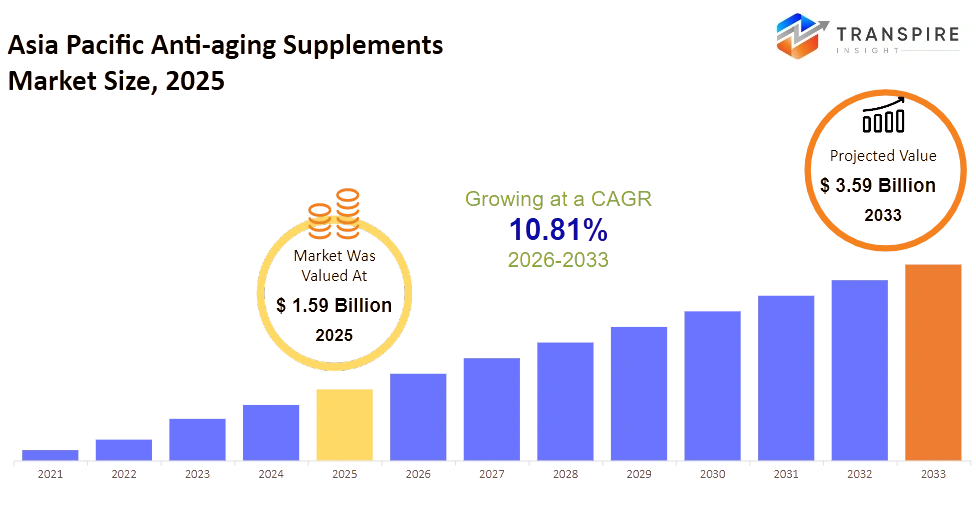
As per Transpire Insight Analysis the Asia Pacific Anti-aging Supplements Market size is estimated at USD 1.59 Billion in 2025 and is anticipated to reach USD 3.59 Billion by 2033, growing at a CAGR of 10.81% from 2026 to 2033.
In the Asia Pacific, the Anti-aging Supplements Market pretty much supports consumers who want to keep “healthy aging” going, even when things start to slow down ,like declining energy, skin resilience, joint function, cognitive sharpness, and that general sense of wellness. Instead of being bought only sometimes, these daily nutritional formulations have moved into real preventive health routines, so demand keeps showing up again across different age brackets.
Over the last five years the market has leaned away from the usual vitamin only approach, and now favors science-backed mixes. You’ll see collagen peptides, NAD+ precursors, probiotics, and botanical extracts more often, and they’re usually paired with clinical research proof. Then the COVID-19 pandemic kind of sped everything up, pushing people toward long-term personal health planning, while also making online supplement purchasing more normal across the whole region.
As consumers increasingly judge options by ingredient clarity ,and by measurable health outcomes, brands are responding by rolling out more premium lines and putting more money into clinical validation. Basically this shift helps create clearer brand differentiation, supports repeat buying, and opens up better revenue potential through both retail and digital channels.
Asia Pacific Anti-aging Supplements Market Size & Forecast:
- Asia Pacific Anti-aging Supplements Market Size 2025: USD 1.59 Billion
- Expected Market Value 2033: USD 3.59 Billion
- Forecast CAGR: 10.81%
- Leading region in 2025: China
- Fastest Growing region: India
- Key Profile: Amway, Herbalife, Nestlé Health Science, Abbott Laboratories, Blackmores, Swisse Wellness, GNC, NOW Foods, Nature's Bounty, Himalaya Wellness, Bayer, USANA Health Sciences, Life Extension, Shaklee, Pharmavite
Key Market Insights
- China really dominated the Asia Pacific anti aging supplements market, with about 38% market share in 2025, it is backed by more mature e-commerce channels and the growing appetite for premium nutrition adoption.
- India is likely to stay the fastest growing regional market during 2025–2033, mainly because nutraceutical manufacturing keeps expanding, plus wider spending on preventive healthcare programs is getting more common.
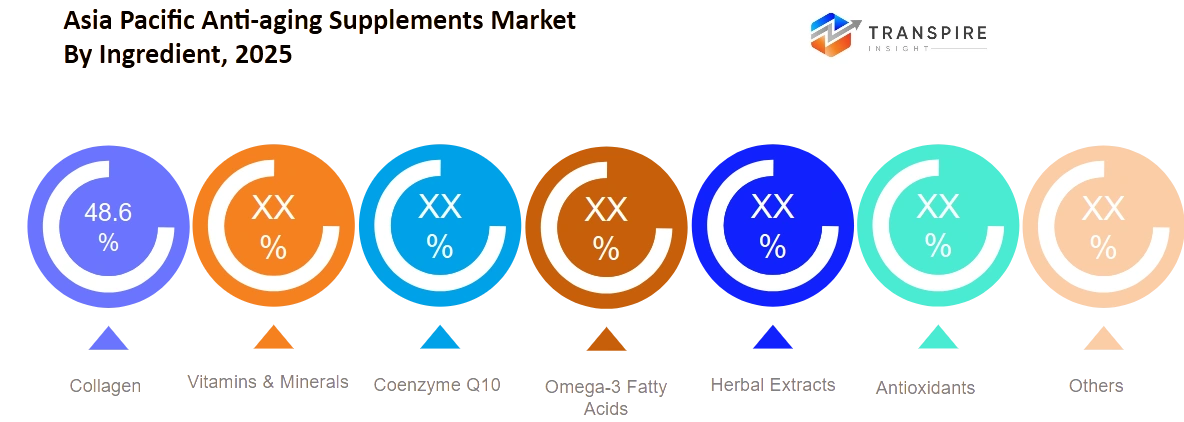
- On the product side, collagen supplements were out in front, capturing nearly 34% share in 2025, since beauty from within formulations are getting stronger retail penetration and yes, shoppers are noticing them.
- Vitamin and antioxidant supplements sat as the second largest category because consumers more and more try to merge daily wellness routines together with healthy aging strategies.
- NAD+ boosters and cellular health supplements are forecast to show the quickest expansion through 2033 as scientific validation keeps improving and that helps premium product positioning.
- Healthy aging and general wellness together accounted for roughly 46% market share in 2025, which shows supplements are being folded into preventive health programs, in a more organized way.
- Cognitive health applications are expected to grow the fastest across the forecast period too, because aging populations want memory and brain performance support.
- For end users, adults aged 35–55 years made up the leading group with around 49% share in 2025, supported by recurring preventive supplement buys, over time.
- And senior consumers aged over 60 years should record the fastest expansion through 2033, helped by longer life expectancy and more personalized nutrition adoption.
What are the Key Drivers, Restraints, and Opportunities in the Asia Pacific Anti-aging Supplements Market?
The biggest growth engine feels like it’s coming from that overlap between preventive healthcare and clinically supported nutrition. A lot of the underlying scientific work—on collagen peptides, probiotics, coenzyme Q10, and cellular health related ingredients—has given enough confidence that both clinicians and regular consumers are willing to start choosing higher tier formulations earlier in adulthood. On top of that, digital pharmacies and cross-border e-commerce sort of lowered the friction to buy across Southeast Asia. With more choice, subscription style recurring purchases grew, premium price points stayed supported, and revenue visibility looked clearer for the more established supplement makers.
Still, product credibility is the largest kind of structural brake. The rules change a lot across Asia Pacific, while ingredient clearances, labeling expectations, and health claim thresholds do not match cleanly from one country to another. To move forward, businesses end up rethinking packaging, doing extra testing, and walking through separate compliance lanes before they can actually commercialize. From what Transpire Insight gathered in its review of regional procurement updates and launch timing, supply chain concentration stays the most direct execution risk. These limitations tend to postpone regional rollouts, raise compliance expenses, and quietly cap revenue chances for smaller manufacturers, especially those without enough regulatory bandwidth.
Personalized nutrition looks like the next big chance, kinda, right now. AI supported health assessments, microbiome tests, genetic screening, and biomarker driven guidance are making it possible to roll out targeted supplement plans instead of using the same standardized formula for everyone. There’s also a lot of money going into digital health platforms across China, Japan, South Korea, Singapore, and India , which is helping commercialization take off. The companies that combine individualized recommendations with subscription style distribution and ingredients that are actually clinically validated, will probably keep customers longer and end up with better long term margins .
What Has the Impact of Artificial Intelligence Been on the Asia Pacific Anti-aging Supplements Market?
Artificial intelligence is quietly reshaping the regional anti-aging supplement space , sort of like , not overnight but more steadily , because it helps with product development, manufacturing efficiency, and the whole commercial decision making process. More manufacturers are leaning on AI to keep an eye on ingredient consistency, automate quality inspections, and catch production oddities before whole batches even hit compliance testing failure , you know. Alongside that, digital quality management systems help smooth out the paperwork that comes with multiple regulatory jurisdictions across Asia Pacific.
Machine learning models then go a step further and forecast ingredient demand by looking at seasonal buying habits, online search interest, and what distributors currently hold in their inventory. This lets companies fine-tune procurement while minimizing both stock shortages and excess inventory, which is a pretty big deal. Those predictive abilities also boost production scheduling , shorten replenishment lead times, and reduce inventory carrying costs through regional supply routes.
On the research side, AI-assisted formulation platforms speed everything up by flagging credible ingredient pairings , the ones that are backed by clinical evidence that’s already been published. That reduces the time it takes to develop premium wellness products. Meanwhile, marketing teams use predictive analytics to personalize recommendations and improve retention, especially via digital subscription platforms.
Still, AI adoption is uneven because it takes real money to implement, mainly for integrated manufacturing systems and high quality clinical datasets. Smaller supplement manufacturers often don’t have solid standardized digital infrastructure, and the regulatory rules are scattered across countries , so scaling AI driven compliance tools becomes harder than it should be , even if the operational benefits look clear.
Key Market Trends
- Since 2022, collagen peptides have kinda moved away from beauty positioning, and into more holistic healthy aging formulations, backed by broader clinical evidence.
- AI enabled demand forecasting has also helped cut down inventory skews across leading manufacturers, starting around 2023, which improved regional supply chain responsiveness in practice.
- Meanwhile cross-border e-commerce platforms broadened access to premium supplements across Southeast Asia between 2021 and 2025, giving international brands more room to land and grow.
- More companies are combining probiotics, botanical extracts , and cellular health ingredients into multifunctional blends instead of keeping things as just one ingredient, neat and simple.
- After 2022, subscription based digital wellness platforms really took off, and that lifted recurring revenue via personalized nutrition recommendations.
- On the manufacturing side, investment in clinical validation studies increased between 2023 and 2025 to separate premium formulations from generic alternatives, you know.
- China and India have pulled in new manufacturing investments as well, which supports regional ingredient sourcing, and reduces dependence on imported finished products.
- Also strategic partnerships between nutraceutical manufacturers and digital health providers sped up commercialization of personalized supplement ecosystems, after 2023.
- Finally, premium clean-label formulations with transparent ingredient sourcing turned into a stronger purchasing criteria across developed Asia Pacific markets in 2022.
Asia Pacific Anti-aging Supplements Market Segmentation
By Ingredient :
Collagen kinda holds a leading position, for beauty, skin elasticity, and that healthy aging narrative, products that is. Actually, across major countries, the consumer interest stays strong and keeps drawing people in. Premium collagen peptides, especially the ones with higher absorption rates, will back product innovation and, you know, help drive repeat purchases too. Vitamins and minerals still feel like a main category, because daily nutritional support really influences those long-term wellness routines people stick with.
Coenzyme Q10 keeps gaining steady acceptance, mostly since energy support and cardiovascular wellness are still key purchase considerations. Omega-3 fatty acids keep a fairly stable demand too, used for heart health and cognitive support applications across different age groups. Herbal extracts do well with regional acceptance, notably where traditional botanical ingredients already have that consumer confidence built up.Antioxidants keep expanding as well, in formulations aiming at cellular protection and healthy aging, while other specialty ingredients add product diversity with targeted nutritional benefits. Continuous research on ingredient effectiveness will motivate manufacturers to introduce advanced formulations, with stronger clinical support.
By Form:
Capsules still feel like the preferred format, mainly because convenience in dosing , easy carry-ability, and that longer shelf-life really makes it work for everyday use. Tablets also keep a solid spot for folks who care about cost efficiency and the fact they are widely available across retail channels , you know. Powder formulations pull in consumers who want more flexibility with serving sizes and those blend-in combination products that just mix with drinks. Gummies keep showing strong momentum too, mostly from their enjoyable flavor and that simple, no-fuss way of eating them which appeals to younger adults and even family buyers.
Liquid supplements tend to offer faster absorption, and they fit people who prefer easy intake without having to swallow solid items. Softgels remain well-liked for oil-based ingredients like omega-3 fatty acids and Coenzyme Q10, because stronger stability supports the overall product quality. Other delivery formats keep popping up as manufacturers introduce more differentiated products, and they seem to line up with changing daily routines and lifestyle preferences. Overall product innovation across different dosage forms will widen customer choice and help the category grow further.
By Distribution Channel :
Pharmacies keep leading the distribution because trusted healthcare guidance keeps that consumer confidence steady when people are picking products, more or less. Health stores also hold a key place by offering specialized nutritional options, plus premium supplement ranges. Meanwhile supermarkets and hypermarkets make everything feel easier by putting wellness products inside regular shopping trips, not as an extra errand or so. With broader retail access, purchasing convenience should get better across cities and developing markets.
Online retail keeps seeing the quickest growth via digital marketplaces, subscription programs and direct brand websites, where there’s a wider variety to look at. Direct selling still supports premium nutritional products, often through personalized consultations and well known distributor networks. The other distribution routes help too, because they focus on niche customer groups and regional markets with specialized offerings. If digital investment stays strong, and logistics networks get better, product reach across the whole region will likely improve.
By End User :
Adults are probably the biggest consumer group, mainly because preventive nutrition has sort of turned into regular wellness planning during the working years. The elderly population keeps growing as life expectancy keeps getting longer, so there is more interest in nutritional support for healthy aging. Fitness enthusiasts also open up extra avenues, not just by buying generic items, but by choosing products that help with recovery, joint function, and day to day performance. If purchasing patterns stay consistent, it will help solidify long-term category growth.
Women stay a key customer segment, because beauty nutrition and skin health products still get strong market acceptance. Men also keep moving toward nutritional supplements that back energy, heart health, and active lifestyles across different age brackets. Other consumer categories chip in by offering targeted wellness solutions built for specific nutritional needs. When brands broaden product personalization, it should boost engagement across a wider mix of customer groups.
By Application :
Skin health stays the main application, because beauty nutrition keeps influencing supplement purchases across the region. Joint health holds steady demand too , since aging populations are looking for nutrient based support for mobility and everyday comfort. Cognitive health is showing quicker growth, as memory support and healthy brain function get more attention from middle-aged plus older consumers, kind of naturally. Product development will keep leaning on clinically supported formulations, not just marketing claims.
Heart health is still a big application, with ingredients that back cardiovascular wellness and healthy aging. General wellness keeps pulling in wide consumer interest, because daily nutritional routines push preventive healthcare habits. Other applications are widening as specialized products come in, made for specific health objectives and newer lifestyle needs. And overall, ongoing scientific research along with ingredient innovation will keep strengthening what comes next for application development across the industry.
What are the Key Use Cases Driving the Asia Pacific Anti-aging Supplements Market?
The largest use case kind of leans toward skin health support, through collagen, antioxidants, and vitamin oriented formulations, you know that daily glow type idea. Working adults and women stay the main buyers, because daily supplementation fits into preventive wellness routines and beauty care aims. With premium product placement and ingredients that have clinical backing, it’s easier to drive repeat purchases across pharmacies, health stores, and online retail channels too.
Joint health and also cognitive health applications keep getting more traction, especially with elderly consumers and fitness enthusiasts. Joint support products help active people stay mobile, while cognitive blends seem to pull in professionals and older adults who want memory and focus support. Healthcare practitioners, along with specialty nutrition retailers, also make adoption broader, and it helps a lot with visibility.
Personalized nutrition feels like a newer use case with real long term promise. AI assisted wellness checks and microbiome driven suggestions are nudging supplement makers to craft more targeted formulations, for individual health profiles. Regulatory progress for functional ingredients and more solid clinical validation should support wider market rollout over the forecast period.
|
Report Metrics |
Details |
|
Market size value in 2025 |
USD 1.59 Billion |
|
Market size value in 2026 |
USD 1.75 Billion |
|
Revenue forecast in 2033 |
USD 3.59 Billion |
|
Growth rate |
CAGR of 10.81% from 2026 to 2033 |
|
Base year |
2025 |
|
Historical data |
2021 - 2024 |
|
Forecast period |
2026 - 2033 |
|
Report coverage |
Revenue forecast, competitive landscape, growth factors, and trends |
|
Regional scope |
Asia Pacific (India, China, Japan, Australia, South Korea, Rest of Asia Pacific) |
|
Key company profiled |
Amway, Herbalife, Nestlé Health Science, Abbott Laboratories, Blackmores, Swisse Wellness, GNC, NOW Foods, Nature's Bounty, Himalaya Wellness, Bayer, USANA Health Sciences, Life Extension, Shaklee, Pharmavite . |
|
Customization scope |
Free report customization (country, regional & segment scope). Avail customized purchase options to meet your exact research needs. |
|
Report Segmentation |
By Ingredient (Collagen, Vitamins & Minerals, Coenzyme Q10, Omega-3 Fatty Acids, Herbal Extracts, Antioxidants, Others); By Form (Capsules, Tablets, Powders, Gummies, Liquids, Softgels, Others); By Distribution Channel (Pharmacies, Health Stores, Supermarkets & Hypermarkets, Online Retail, Direct Selling, Others); By End User (Adults, Elderly Population, Fitness Enthusiasts, Women, Men, Others); By Application (Skin Health, Joint Health, Cognitive Health, Heart Health, General Wellness, Others) |
Which Regions are Driving the Asia Pacific Anti-aging Supplements Market Growth?
China takes up the most of the regional industry, with roughly 38% of overall revenue. The functional food rules are clear, manufacturing capacity is pretty advanced, and the e-commerce setup is strong, so products stay on shelves regularly and people feel more confident as consumers. Big local nutraceutical players, well known global brands, contract manufacturers, plus ingredient suppliers, all work together in one sort of connected supply chain, which helps commercialization move faster. If they keep putting money into research, better or “premium” formulations, and digital retail channels, market leadership should remain intact across the whole forecast window.
Japan comes next as the second-largest regional contributor mainly due to an aging population and a fairly steady healthcare structure that keeps supplement consumption consistent. There are strict quality standards, and labeling is transparent, so shoppers trust what they buy, and that also supports repeat purchases over different age groups. Ongoing funding for clinical research and higher value nutrition products adds resilience even though population growth is slower. Retail distribution stays stable, and the product positioning leans premium, so Japan ends up being a dependable wellspring of recurring revenue for manufacturers.
India is the fastest-growing regional market, as expanding nutraceutical manufacturing and digital commerce, plus supportive food supplement regulations improve product accessibility. There’s also more investment going into domestic production facilities , and retail penetration keeps widening so products show up across metro areas and emerging cities faster. People who work longer hours are getting more comfortable with preventive nutrition, and that has boosted premium supplement sales through both online , and in-person channels. From 2026 to 2033 the expansion outlook looks especially strong, so it should set up a nice environment for fresh brands, strategic partnerships, and manufacturing investments.
Who are the Key Players in the Asia Pacific Anti-aging Supplements Market and How Do They Compete?
The competitive landscape still looks fairly broken up, like a lot of pieces, with global nutrition businesses going head to head with well known local supplement manufacturers. In this space the main fight is more about new product ideas, proof from science, ingredient quality, and digital distribution, not just price, by itself. Big established brands keep protecting their share with higher end lineups, while newer players tend to push niche blends and direct-to-consumer approaches that kind of mess with the usual retail playbook.
Amway stands out using that wide nutrition portfolio, plus direct selling and one-on-one wellness consultations, so it builds longer relationships with shoppers across multiple Asia Pacific markets. Herbalife blends digital wellness tools with nutrition coaching, which helps keep customers engaged even after the first purchase, more like ongoing support. Nestlé Health Science leans hard on science-backed formulations and clinical studies, making it easier to hold a premium stance in prevention focused nutrition categories. Blackmores expands by working through pharmacy partnerships and regional distribution, reinforcing its credibility with consumers who prioritize healthcare style products.
Shiseido is boosting its competitive position by mixing beauty nutrition with know-how from cosmetics , so that the brand can offer products that feel more like integrated wellness answers for everyday consumers. Meanwhile, By-Health is putting money into newer formulations, ingredient studies, and also domestic manufacturing capability, with the goal of raising overall product quality and cutting down commercialization timelines a bit faster than before. As the years go on, more regional partnerships, premium launches, and added research funding should keep pushing brand differentiation forward, even as competition gets more intense across the whole forecast period.
Company List
- Amway
- Herbalife
- Nestlé Health Science
- Abbott Laboratories
- Blackmores
- Swisse Wellness
- GNC
- NOW Foods
- Nature's Bounty
- Himalaya Wellness
- Bayer
- USANA Health Sciences
- Life Extension
- Shaklee
- Pharmavite
Recent Development News
In April 2026, Kirin Holdings established Kirin Health Science International (KHSI) to integrate Blackmores, FANCL, Kyowa Hakko Bio, and other health science businesses outside Japan. The new entity strengthens regional expansion across Asia Pacific by combining supplement brands, scientific capabilities, and product innovation under a unified strategy.
Source https://www.kirinholdings.com/
In April 2026, Nestlé and Nanyang Technological University (NTU) Singapore announced a strategic partnership to establish a joint research laboratory focused on longevity and women's health nutrition. The collaboration will accelerate clinical nutrition research and support the development of next-generation healthy aging supplements for Asia Pacific markets.
Source https://www.nutraingredients.com/
What Strategic Insights Define the Future of the Asia Pacific Anti-aging Supplements Market?
The Asia Pacific Anti-aging Supplements Market is set to drift toward precision nutrition, but it’s going to be pushed by clinical validation, digital health tie ins, and better value formulations, not so much the old-school volume driven growth. What will really move the needle is stronger scientific proof, clearer ingredient trackability, and those personalized wellness platforms that make people choose premium products, in both developed and up-and-coming economies.
Now, one hidden risk, which kind of quietly lingers, is how much some brands rely on only a few suppliers for specialty components like collagen peptides and bioactive compounds. If there’s a supply interruption, or even a small quality problem, it can mess up production timetables, and then you start seeing pressure on profit margins.
At the same time, an emerging chance is showing up via microbiome based nutrition, along with supplement suggestions that use biomarker guidance. This feels especially relevant as digital health ecosystems grow across India, Singapore, and South Korea. Market participants can get ahead by funding more clinical work, widening their ingredient supply chains, and building regional manufacturing collaborations. That approach can improve regulatory flexibility, while also boosting consumer trust and supporting long term competitiveness across many distribution paths.
Asia Pacific Anti-aging Supplements Market Report Segmentation
By Ingredient
- Collagen
- Vitamins & Minerals
- Coenzyme Q10
- Omega-3 Fatty Acids
- Herbal Extracts
- Antioxidants
By Form
- Capsules
- Tablets
- Powders
- Gummies
- Liquids
- Softgels
By Distribution Channel
- Pharmacies
- Health Stores
- Supermarkets & Hypermarkets
- Online Retail
- Direct Selling
By End User
- Adults
- Elderly Population
- Fitness Enthusiasts
- Women
- Men
By Application
- Skin Health
- Joint Health
- Cognitive Health
- Heart Health
- General Wellness
Frequently Asked Questions
Find quick answers to common questions.
The expected Asia Pacific Anti-aging Supplements Market size for the market will be USD 3.59 Billion in 2033.
Key segments for the Asia Pacific Anti-aging Supplements Market are By Ingredient (Collagen, Vitamins & Minerals, Coenzyme Q10, Omega-3 Fatty Acids, Herbal Extracts, Antioxidants, Others); By Form (Capsules, Tablets, Powders, Gummies, Liquids, Softgels, Others); By Distribution Channel (Pharmacies, Health Stores, Supermarkets & Hypermarkets, Online Retail, Direct Selling, Others); By End User (Adults, Elderly Population, Fitness Enthusiasts, Women, Men, Others); By Application (Skin Health, Joint Health, Cognitive Health, Heart Health, General Wellness, Others).
Major Asia Pacific Anti-aging Supplements Market players are Amway, Herbalife, Nestlé Health Science, Abbott Laboratories, Blackmores, Swisse Wellness, GNC, NOW Foods, Nature's Bounty, Himalaya Wellness, Bayer, USANA Health Sciences, Life Extension, Shaklee, Pharmavite.
The Asia Pacific Anti-aging Supplements Market size is USD 1.59 Billion in 2025.
The Asia Pacific Anti-aging Supplements Market CAGR is 10.81% from 2026 to 2033.
- Amway
- Herbalife
- Nestlé Health Science
- Abbott Laboratories
- Blackmores
- Swisse Wellness
- GNC
- NOW Foods
- Nature's Bounty
- Himalaya Wellness
- Bayer
- USANA Health Sciences
- Life Extension
- Shaklee
- Pharmavite
About the Authors

Chetan Dhatrak
I’m Chetan Dhatrak, a Senior Research Analyst at Transpire Insight, specializing in the Consumer Goods, Foods and Beverages industry. I focus on analyzing market trends, consumer behavior, competitive landscapes, and industry developments to deliver accurate, data-driven insights. My research at Transpire Insight is built on credible sources and in-depth analysis, helping businesses and readers better understand market dynamics, emerging opportunities, and evolving consumer preferences. I’m committed to creating reliable, well-researched content that supports informed decision-making and reflects the latest developments in the consumer goods and food & beverage sectors.

Chakradhar Khansole
Chakradhar serves as the Research Director at Transpire Insight, bringing over 8 years of experience in technology, innovation, and strategic market intelligence. He specializes in transforming complex market data into actionable business insights that enable organizations to make informed, growth-oriented decisions. Recognized for his strategic vision and analytical expertise, Chakradhar leads high-impact research initiatives, delivering comprehensive market assessments, competitive intelligence, and forward-looking industry analysis.
Recently Published Reports
-
Apr 2026
Bottled Water Market
Bottled Water Market Size, Share & Analysis Report By Product Type (Still Bottled Water, Carbonated Bottled Water, Functional Bottled Water, and Others), By Packaging (PET, Cans, and Others), By Sales Channel (Supermarkets/Hypermarkets, Convenience Stores/Drug Stores, Grocery Stores/Club Stores, Foodservice, and Others) and Geography (North America, Europe, Asia-Pacific, Middle East and Africa, South and Central America), 2021 - 2032
-
Apr 2026
Color Cosmetic Packaging Market
Color Cosmetic Packaging Market Size, Share & Analysis Report By Application (Mascara Packaging, Liquid Packaging, and Liquid Face), By Type (Tubes & Bottles, Pens & Markers, Compacts & Containers, and Droppers & Pumps), and Geography (North America, Europe, Asia-Pacific, Middle East and Africa, South and Central America), 2021 - 2031
-
Apr 2026
External Microphone For Camera Market
External Microphone For Camera Market Size, Share & Analysis Report By Type (Shotgun Microphone, Lavalier Microphone, and Others), By Application (Digital Camera, Professional Video Camera, and Others), and Geography (North America, Europe, Asia-Pacific, Middle East and Africa, South and Central America), 2021 - 2031
-
Apr 2026
Foot Orthotic Insoles Market
Foot Orthotic Insoles Market Size, Share & Analysis Report By Type (Pre-fabricated, and Custom-made), By Material (Thermoplastic, Composite Carbon Fiber, and Others), By Distribution Channel (Drug Stores, Hospitals & Clinics, and Others), and Geography (North America, Europe, Asia-Pacific, Middle East and Africa, South and Central America), 2021 - 2031