

Asia Pacific Alumina Trihydrate Market Size & Forecast:
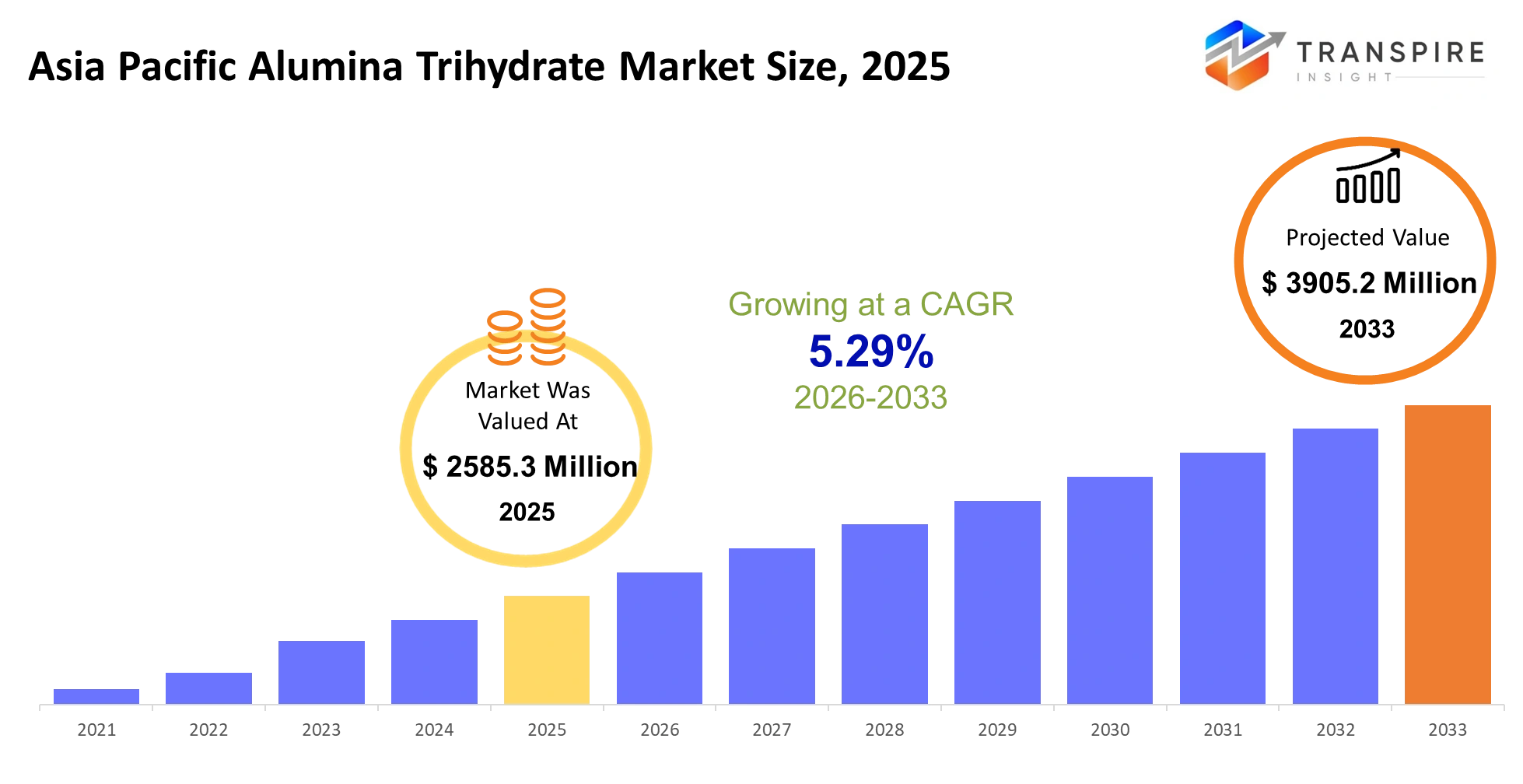
- Asia Pacific Alumina Trihydrate Market Size 2025: USD 2585.3 Million
- Asia Pacific Alumina Trihydrate Market Size 2033: USD 3905.2 Million
- Asia Pacific Alumina Trihydrate Market CAGR: 5.29%
- Asia Pacific Alumina Trihydrate Market Segments: By Type (Ground ATH, Precipitated ATH, Fine ATH, Coarse ATH, Ultra-fine ATH, Others); By Application (Flame Retardants, Fillers, Coatings, Plastics, Rubber, Others); By End-User (Construction, Electrical, Automotive, Industrial, Chemicals, Others); By Form (Powder, Granules, Slurry, Paste, Crystals, Others).
To learn more about this report,  Download Free Sample Report
Asia Pacific Alumina Trihydrate Market Summary:
The Asia Pacific Alumina Trihydrate Market size is estimated at USD 2585.3 Million in 2025 and is anticipated to reach USD 3905.2 Million by 2033, growing at a CAGR of 5.29% from 2026 to 2033. The Asia-Pacific alumina trihydrate market in the speciality chemicals industry will be considered an ecosystem of materials that will be characterized by the need for industrial safety and advances in material science.
The market will be dominated by the use of the material as a filler in fire retardants. The producers will focus on developing a product that emits low smoke and is free of halogens to comply with the stringent fire safety requirements in the construction and electronic industries. There will be changes in the demand pattern for the material due to the need for green materials that do not contain toxic additives.
What Has the Impact of Artificial Intelligence Been on the Asia Pacific Alumina Trihydrate Market?
Artificial intelligence is steadily redefining how the asia pacific alumina trihydrate market operates, introducing data-driven precision into a traditionally material-focused industry. AI in asia pacific alumina trihydrate market environments will enhance market research by processing large datasets from construction, plastics, and electronics sectors, uncovering demand signals that were previously difficult to detect.
Artificial intelligence in asia pacific alumina trihydrate market operations will also reshape manufacturing efficiency. Smart automation systems will optimize refining and particle treatment processes, improving consistency in product quality while minimizing waste and energy consumption. AI-powered monitoring tools will detect anomalies in real time, reducing downtime and enhancing operational reliability. In parallel, supply chain optimization will benefit from intelligent routing, inventory balancing, and cost modeling, ensuring timely delivery while controlling logistics expenses. These capabilities will position businesses to respond quickly to changing regulatory standards and customer expectations.
Beyond efficiency, AI will unlock innovation within the Asia Pacific alumina trihydrate market by enabling tailored material solutions for specific industrial applications. Companies will leverage advanced analytics to design customized formulations that meet evolving safety and sustainability benchmarks. As market trends continue to shift toward eco-conscious materials, AI-driven insights will offer a competitive advantage, helping organizations align product development with emerging environmental and performance demands.
Key Market Trends & Insights:
- China will emerge as the dominant player in the asia pacific alumina trihydrate market, accounting for more than 42% share in 2025, owing to its huge manufacturing capabilities and investments in infrastructure.
- Among all regions, India will emerge as the fastest growing region, recording over 6.5% CAGR till 2030, on account of growing demands from the construction and polymer industries.
- Ground alumina trihydrate accounts for the largest share in terms of more than 48%, on the back of economic manufacturing processes and wide industry application.
- Precipitated types will emerge as the second-most-popular grade, driven by high-purity requirements in specialised applications.
- Surface-treated types will gain prominence, emerging as the fastest-growing segment during 2025-2030 on account of their suitability in polymer applications.
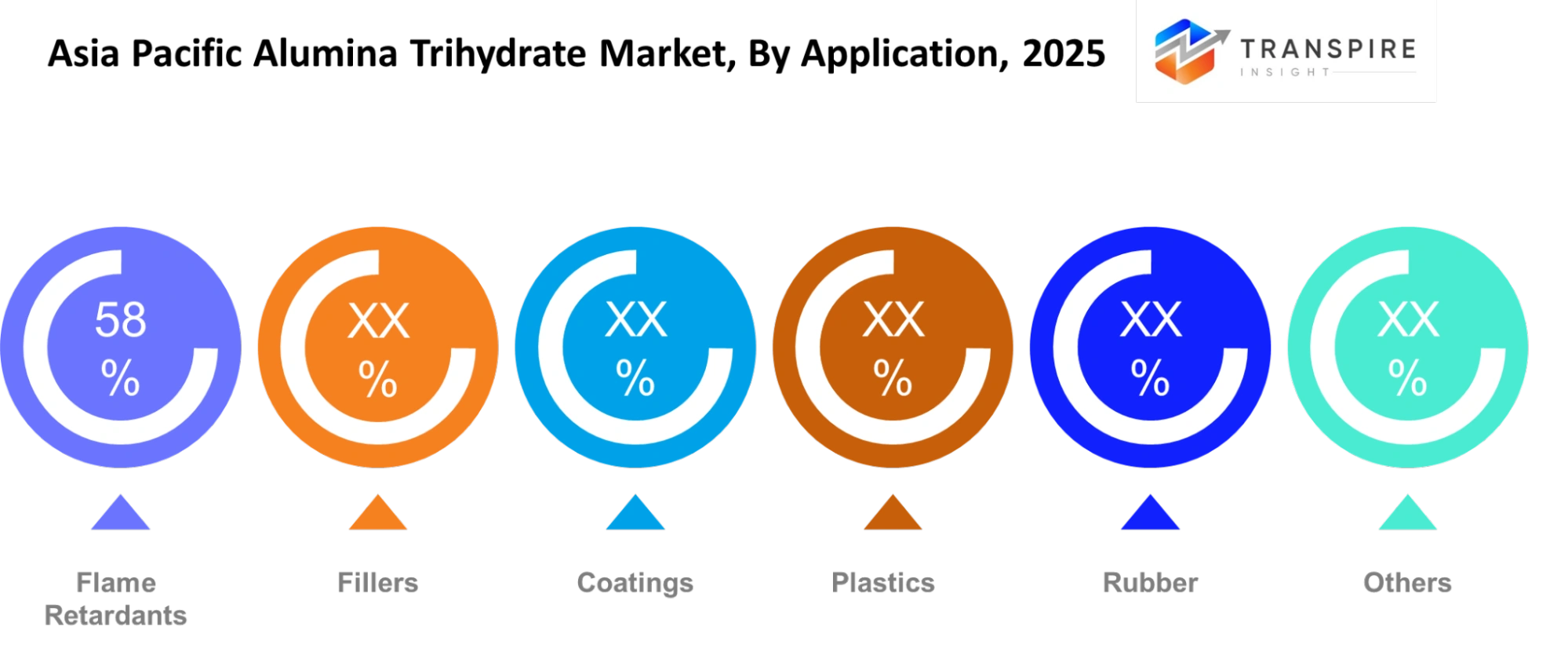
- Flame retardant applications account for more than 55% share in 2025, thanks to growing demands from the construction and insulation industries.
- Applications in plastics and coatings will emerge as the fastest-growing applications on account of light and flame-retardant materials.
- The building & construction will lead among other end-user segments with approximately 50% share in the market in 2025.
- Electronics manufacturing will be the fastest growing end-user segment on account of high demands in electronic component manufacturing.
Asia Pacific Alumina Trihydrate Market Segmentation
By Type
The ground ATH will occupy a firm footing based on its cost-effectiveness and applicability in industrial volume production. The precipitated ATH will rise in importance in those applications where purity is important along with controllable particle size. Fine and ultra fine ATH will find usage in advanced applications which need effective dispersion and smooth finishing. Coarse ATH will retain its relevance in those industries where large sized particles offer enhanced mechanical strength.
Various product types will cater to different requirements of the industries. The ultra fine ATH will experience increased application in high end coatings and polymer industries because of better surface interactions. Ground and coarse ATH will continue to cater to mass constructions and other fillers. Differentiation among such product types will help the manufacturers cater to industry demands without having to alter costs.
By Application
The usage of flame retardants will persist as the primary end use as a result of strict safety standards for building materials and electronic components. Fillers will help meet demand from volume perspective by enhancing strength and lowering costs in manufacturing processes. Coatings will employ ATH for improved aesthetics and flame retardancy. Uses in plastics and rubber will increase owing to the need for lighter-weight and safer products.
Versatility in end uses will ensure continuous demand in different markets. Increased use of flame retardants is expected due to stringent building safety codes. Applications in plastics and coatings will incorporate high-quality ATH materials. Demand in industry will be evenly split between cost efficiency and functionality improvement.
To learn more about this report, Download Free Sample Report
By End-User
The construction industry will come first due to extensive infrastructure development and safety needs. The electrical industry will use ATH for insulation and heat resistance purposes. The automobile industry will make use of ATH in lightweight materials. The industrial and chemicals industries will have steady demand for ATH due to processing needs.
Distribution by end-users will show heavy reliance on the construction and growth in the manufacturing sector. Construction will still top the list because of increased urban construction activities and safety. Electrical and automobile industries will grow as a result of increased production.
By Form
Powder form will prevail because of easy handling and versatility of applications. Granule form will enable controlled use for selective production processes. Slurry and paste form will be favored when precise mixing is necessary. Crystal form will be used selectively in certain industrial processes.
The choice of form will vary based on the process employed and final use. Powder form will still be broadly utilized owing to its versatility and economic benefits. Slurry and paste form will attract attention for their applicability in automated systems. Granule and crystal form will have selective use in certain industrial processes.
What are the Main Challenges for the Asia Pacific Alumina Trihydrate Market Growth?
The Asia Pacific alumina trihydrate market is bound to be constrained by certain technological and logistical factors that can pose a threat to reliability and effectiveness during utilization. Differences in the size distribution of the particles and moisture content in the product will affect its stability, particularly during high performance polymers and coatings uses. There will also be manufacturing issues since the product needs to be processed and refined in a controlled manner to guarantee quality.
Logistical issues that are likely to affect the manufacturing process include sourcing the raw materials. The other issue is that there will be increased need for capital investments due to the need to continuously upgrade the process technologies so as to be able to meet environmental standards and regulations. Another logistical issue will be the delays in introducing new product variants like ultra-fines and coated grades.
Adoption barriers will continue to play a key role, especially for developing countries in the asia pacific alumina trihydrate market environment. The lack of technical knowledge and insufficient processing facilities will limit the product's use in certain applications. Consumer cost sensitivity will also make it hard for end users to consider a changeover to high-quality products despite their advantages.
Limitations will also be posed by increased competition and changing risk factors. Flame retardants that can replace ATH products will limit prices and make dependency on ATH products harder. Technological advancements and stringent regulations will also force manufacturers to make ongoing adjustments.
Regional Insights
Asia Pacific Alumina Trihydrate Market: The asia pacific alumina trihydrate market would see consistent industrial coordination with construction, electrical, and polymer industries. Demand factors include safety concerns and resource efficiency. There would be a correlation between production and consumption with infrastructure operations and manufacturing production levels. Regional diversification would determine the supply-demand relationship within prominent economies.
There would be ongoing adaptation to market dynamics resulting from regulatory shifts and processes. Suppliers would focus on providing products of consistent quality and economic feasibility. Industrial utilization would increase according to performance criteria and industry demands.
Regional Trends: The Asia Pacific region will exhibit significant diversity, driven by industry capabilities and economic growth trends. China will be the dominant player in this region, with extensive manufacturing capabilities and strong demand. India will become an emerging region owing to growing demands from construction and an increased industrial base. Southeast Asian countries will make contributions through gradual development.
Demand will vary according to regional policies, investments, and industrial development in each country. Regions such as Japan and South Korea will emphasize quality and application-oriented products. Emerging markets will favor affordable material for extensive usage.
Recent Development News
In March 2026, Huber Engineered Materials announced acquisition of alumina trihydrate assets from R.J. Marshall Company. The deal strengthened fire-retardant material capabilities and expanded specialty mineral portfolio in Asia Pacific supply chains.
Source: https://www.usdanalytics.com
|
Report Metrics |
Details |
|
Market size value in 2025 |
USD 2585.3 Million |
|
Market size value in 2026 |
USD 2721.8 Million |
|
Revenue forecast in 2033 |
USD 3905.2 Million |
|
Growth rate |
CAGR of 5.29% from 2026 to 2033 |
|
Base year |
2025 |
|
Historical data |
2021 - 2024 |
|
Forecast period |
2026 - 2033 |
|
Report coverage |
Revenue forecast, competitive landscape, growth factors, and trends |
|
Regional scope |
Asia Pacific (China, India, Japan, South Korea, Australia, Rest of Asia Pacific) |
|
Key company profiled |
Albemarle, Nabaltec, Huber Engineered Materials, LKAB Minerals, Sumitomo Chemical, Hindalco, Aluminum Corp of China, Showa Denko, TOR Minerals, Almatis, BASF, Sibelco, Rio Tinto, Alcoa, Imerys. |
|
Customization scope |
Free report customization (country, regional & segment scope). Avail customized purchase options to meet your exact research needs. |
|
Report Segmentation |
By Type (Ground ATH, Precipitated ATH, Fine ATH, Coarse ATH, Ultra-fine ATH, Others); By Application (Flame Retardants, Fillers, Coatings, Plastics, Rubber, Others); By End-User (Construction, Electrical, Automotive, Industrial, Chemicals, Others); By Form (Powder, Granules, Slurry, Paste, Crystals, Others). |
How Can New Companies Establish a Strong Foothold in the Asia Pacific Alumina Trihydrate Market?
The new entrant can create an entry advantage by positioning themselves for niche applications that still lack a product that performs optimally. The entry advantage will be gained by targeting areas such as the production of low smoke flame retardants that can be incorporated in the construction of smart buildings or producing advanced fillers to be used in electronics. In order to achieve success, new entrants into the asia pacific alumina trihydrate market should focus on developing specialized grades rather than volumes. This will also conform to the changing trends.
The strategy adopted in gaining a foothold within the asia pacific alumina trihydrate market will be based on innovation. Innovations will be focused towards solving the existing challenges facing manufacturers such as poor compatibility and poor dispersion of particles during application in different products. For instance, new players such as Hindalco Innovation Labs have come up with eco-friendly ATH alternatives which reduce processing emissions, while Nippon Advanced Fillers has focused on high purity grades which are useful in electronics insulation.
Entry into the Market Will Be Facilitated by Strategic Partnerships and Localization of Manufacturing. Collaboration with local suppliers, contractors, and compounders will help new firms integrate with the current network. It is imperative that a firm should be near the centers of consumption since efficiency and timely delivery are essential in the Asia Pacific alumina trihydrate market.
Key Asia Pacific Alumina Trihydrate Market Company Insights
Asia Pacific Alumina Trihydrate Market: The asia pacific alumina trihydrate market is expected to exhibit stable demand from its use in construction, electrical, and polymer industry applications. Market composition will be dependent on the quality of materials used, pricing balance, and compliance. Processing techniques will be adopted to facilitate a constant flow of material and output in the market.
Market growth will be determined by the expansion of infrastructure and development of manufacturing activities within the leading markets. Demand will continue being dependent on the adherence to safety standards as well as efficient use of materials in industry applications. Cost effective processing techniques will become a priority for all market players.
Competitive dynamics: Competitors in the market will consist of multinational as well as local firms, who will compete based on pricing, quality, and product range. Larger firms will retain their competitive edge because of their ability to process materials using advanced processing plants and efficient distribution channels.
Their competitive strength will derive from expanding the scale of operations through capacity expansion and developing alliances. They will adopt enhanced processing techniques that will enable them to produce efficient products to match market demands.
Company List
- Albemarle
- Nabaltec
- Huber Engineered Materials
- LKAB Minerals
- Sumitomo Chemical
- Hindalco
- Aluminum Corp of China
- Showa Denko
- TOR Minerals
- Almatis
- BASF
- Sibelco
- Rio Tinto
- Alcoa
- Imerys
What are the Key Use-Cases Driving the Growth of the Asia Pacific Alumina Trihydrate Market?
One of the factors driving the Asia Pacific alumina trihydrate market is its application in the creation of flame-retardant systems, particularly in buildings and power grid structures. Contractors are finding increasing uses for this compound in cables, boards, and insulation to meet stringent fire-safety building standards. It is thus expected that the rising trend in the regulation of safety standards will continue to boost the market in the region.
One of the drivers in the Asia Pacific alumina trihydrate market is its functionality in filling applications in plastics, rubbers, and paint coatings. This compound is often used by producers to increase product durability while lowering costs and improving aesthetic properties. Its application in the manufacturing of automotive parts is one of the cases of increased functionality in this particular industry.
In the same way, the electronics industry is increasing the demand for ATH. The ability to withstand heat and be non-toxic makes ATH appropriate for applications that must meet high levels of safety. Furthermore, the current and future trends of smart infrastructure and renewable energy sources will bring about more demand for compounds containing ATH. With increased production and emphasis on safe products, these real-life applications will continue to drive the growth of the asia pacific alumina trihydrate market.
Asia Pacific Alumina Trihydrate Market Report Segmentation
By Type
- Ground ATH
- Precipitated ATH
- Fine ATH
- Coarse ATH
- Ultra-fine ATH
- Others
By Application
- Flame Retardants
- Fillers
- Coatings
- Plastics
- Rubber
- Others
By End-User
- Construction
- Electrical
- Automotive
- Industrial
- Chemicals
- Others
By Form
- Powder
- Granules
- Slurry
- Paste
- Crystals
- Others
Frequently Asked Questions
Find quick answers to common questions.
The approximate Asia Pacific Alumina Trihydrate Market size for the market will be USD 3905.2 Million in 2033.
Key segments for the Asia Pacific Alumina Trihydrate Market are By Type (Ground ATH, Precipitated ATH, Fine ATH, Coarse ATH, Ultra-fine ATH, Others); By Application (Flame Retardants, Fillers, Coatings, Plastics, Rubber, Others); By End-User (Construction, Electrical, Automotive, Industrial, Chemicals, Others); By Form (Powder, Granules, Slurry, Paste, Crystals, Others).
Major Asia Pacific Alumina Trihydrate Market players are Albemarle, Nabaltec, Huber Engineered Materials, LKAB Minerals, Sumitomo Chemical, Hindalco, Aluminum Corp of China, Showa Denko, TOR Minerals, Almatis, BASF, Sibelco, Rio Tinto, Alcoa, Imerys.
The Asia Pacific Alumina Trihydrate Market size is USD 2585.3 Million in 2025.
The Asia Pacific Alumina Trihydrate Market CAGR is 5.29%.
- Albemarle
- Nabaltec
- Huber Engineered Materials
- LKAB Minerals
- Sumitomo Chemical
- Hindalco
- Aluminum Corp of China
- Showa Denko
- TOR Minerals
- Almatis
- BASF
- Sibelco
- Rio Tinto
- Alcoa
- Imerys
Recently Published Reports
-
Dec 2024
Healthcare Polymer Packaging Market
Healthcare Polymer Packaging Market Size, Share & Analysis Report By Packaging Type (Syringes, IV Bottles and Pouches, Clamshells, Blisters, Bottles & Jars, Containers, Tubes, IV Parental Packaging, Others), By Type (Regulated, Non-regulated), By Polymer Type (LDPE (Low-Density Polyethylene), HDPE (High-Density Polyethylene), Homo-polymer (Homo), Random Copolymer (Random), Block Copolymer (Block), PET, Polystyrene, Polyvinyl Chloride, Polyamide/EVOH, Others), and Geography (North America, Europe, Asia-Pacific, Middle East and Africa, South and Central America), 2021 - 2031
-
Jan 2025
Hydrophilic Tape (Waterstop) Market
Hydrophilic Tape (Waterstop) Market Size, Share & Analysis Report By Type (Bentonite-Based Hydrophilic Tape, Rubber-Based Hydrophilic Tape), By Application (Residential Buildings, Commercial Buildings, Infrastructure Projects), and Geography (North America, Europe, Asia-Pacific, Middle East and Africa, South and Central America), 2021 - 2031
-
Jan 2025
Metalens Market
Metalens Market Size, Share & Analysis Report By Type (Visible Light Metalens, and Infrared Metalens), By Application (Consumer Electronics, Automotive Electronics, Industrial, Medical, and Others), and Geography (North America, Europe, Asia-Pacific, Middle East and Africa, South and Central America), 2021 - 2031
-
Jan 2025
PBT Resin Market
PBT Resin Market Size, Share & Analysis Report By Type (Reinforced PBT Resin, Unreinforced PBT Resin), By Processing Method (Injection Molding, Extrusion, Blow Molding, Others), By End-User (Automotive, Electrical & Electronics, Consumer Appliances, Industrial Machinery, Medical Devices, Packaging, Others), and Geography (North America, Europe, Asia-Pacific, Middle East and Africa, South and Central America), 2021 - 2031