
Asia Pacific AI In Video Surveillance Market Summary
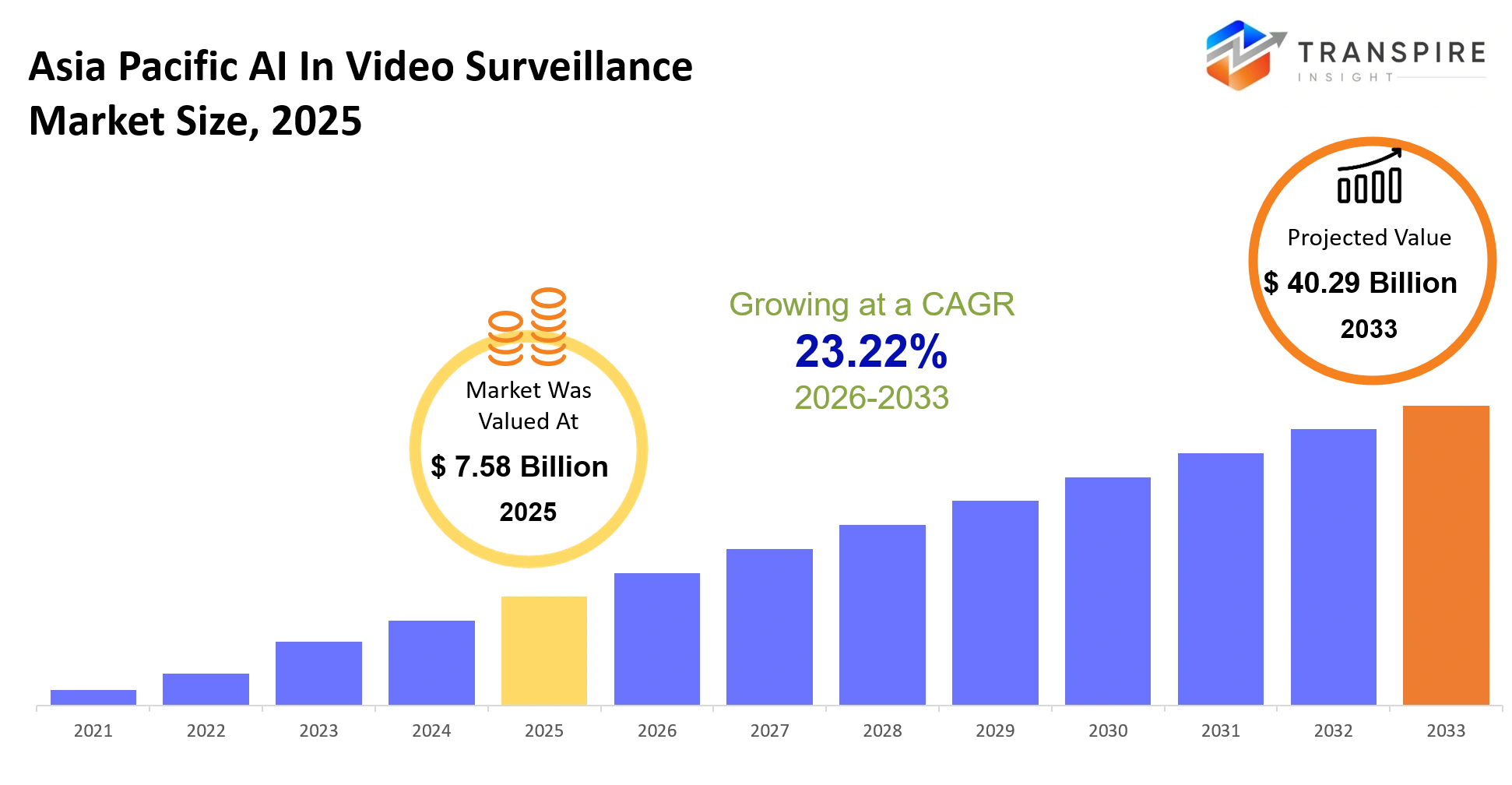
As per Transpire Insight Analysis the Asia Pacific AI In Video Surveillance Market size is estimated at USD 7.58 Billion in 2025 and is anticipated to reach USD 40.29 Billion by 2033, growing at a CAGR of 23.22% from 2026 to 2033.
The Asia Pacific AI in Video Surveillance Market helps organizations keep an eye on public spaces industrial sites , transportation corridors and retail locations with smarter camera setups that can catch possible threats, spot strange or unusual conduct, and aid teams make choices more quickly , out there in the field.Instead of depending on nonstop human watching, AI driven surveillance turns live video into ready to use insights, which then boosts safety, better safeguarding of assets, and smoother incident handling. In the last five years, the market seems to move away from standard CCTV structure toward edge AI plus cloud connected analytics that can process video data in real time. Big smart city spending, along with tougher public safety efforts after the COVID-19 pandemic, really pushed broader rollout across transport hubs, healthcare buildings, and mission critical infrastructure. That shift, has also grown steady recurring software and analytics income, and it nudges companies to swap out older surveillance systems for more intelligent platforms—ones that bring automated monitoring, reduced day to day costs, and clearer situational awareness.
Asia Pacific AI In Video Surveillance Market Size & Forecast:
- Asia Pacific AI In Video Surveillance Market Size 2025: USD 7.58 Billion
- Expected Market Value 2033: USD 40.29 Billion
- Forecast CAGR: 23.22%
- Leading region in 2025:
- Fastest Growing region:
- Key Profile: Hikvision, Dahua Technology, Axis Communications, Bosch Security Systems, Hanwha Vision, Huawei, Motorola Solutions, Avigilon, Honeywell, NEC Corporation, i-PRO, Uniview, Sony, Intel, NVIDIA
Key Market Insights
- Asia Pacific AI in Video Surveillance market is forecast to reach USD 40.29 billion by 2033 , kind of reflecting strong adoption of intelligent video analytics across both public and private sectors , at the same time.
- China still dominates the region, with an estimated 46–48% market share in 2025, pushed forward by wide smart city deployments and serious AI infrastructure investment.
- India on the other hand is showing the fastest growth trajectory all the way through 2033, powered by digital infrastructure programs, rising urban surveillance projects, and industrial automation initiatives that keep getting wider.
- For components, AI Cameras lead the segment, with about 28% share in 2025, while Video Analytics software stays second-largest in revenue because licensing keeps repeating , you know.
- Edge AI Devices are expected to post the fastest growth across the forecast period, since organizations prioritize low latency analytics, and they also want reduced bandwidth load.
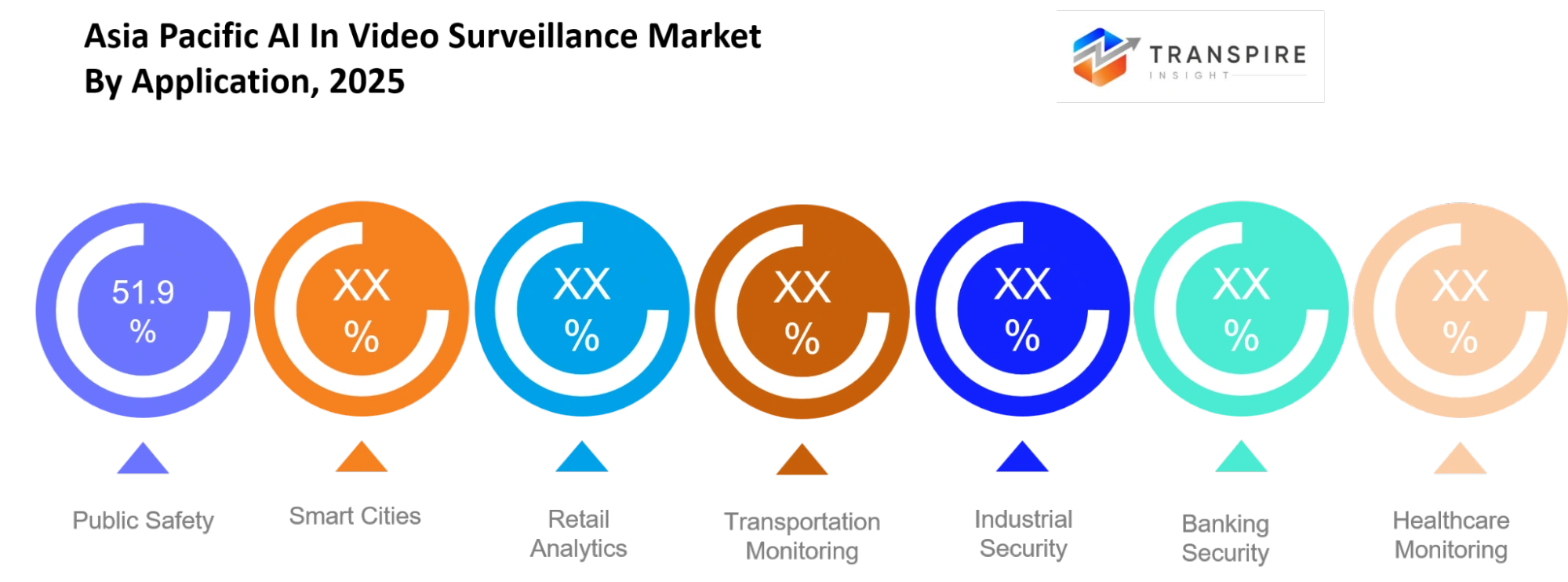
- In terms of application, Public Safety takes almost 35% of the application revenue in 2025 , whereas Transportation Monitoring keeps gaining momentum with AI-enabled traffic control and railway surveillance.
- As for end users , Government agencies remain the biggest category, holding roughly 38% market share, while Manufacturing is becoming one of the speedier adopters for workplace safety and also asset protection.
- Key players like Huawei , Hikvision , Dahua Technology , Hanwha Vision , Axis Communications, and Bosch Security Systems continue strengthening their competitive standing via AI powered analytics and more intelligent edge devices.
- Vendors increasingly go for technology partnerships, cloud platform integration , plus regional expansion, to improve deployment flexibility and capture more enterprise customers across Southeast Asia , steadily.
What are the Key Drivers, Restraints, and Opportunities in the Asia Pacific AI In Video Surveillance Market?
The main driver for the Asia Pacific AI In Video Surveillance Market is mostly the fast expansion of smart city programs and government backed funding for public security infrastructure, like theyre really pushing it. National digital transformation plans in China, India, Singapore, South Korea, and a number of Southeast Asian economies have pushed the rollout of intelligent surveillance networks that can do automated threat detection, traffic monitoring, and emergency response. Meanwhile, edge computing along with deep learning keeps trimming response times, and also lowers how much they need continuous human watching. Because of that, enterprises and public bodies feel more comfortable spending on software upgrades and AI-enabled cameras, which then creates a repeating income model through analytics subscriptions plus managed surveillance services.
That said, a major restraint still shows up pretty clearly, which is the high cost of tying AI platforms into older surveillance setups. A lot of organizations are still running legacy CCTV systems, so they often need major hardware replacement, network modernization, and computing upgrades before the advanced analytics can really work properly. On top of that, there are data privacy regulations, cybersecurity obligations, and frankly limited access to skilled AI professionals, and all of it stretches the deployment timeline. So these kinds of structural hurdles slow modernization programs, and they also reduce adoption among small and medium sized organizations that just have tighter tech budgets.
Looking forward, the biggest long term opportunity is edge AI surveillance paired with 5G connectivity across industrial sites, transportation routes, and smart manufacturing surroundings. Since the processing happens near the camera, it helps cut bandwidth use, and it also supports instant incident detection without depending only on centralized cloud infrastructure, you know.
What Has the Impact of Artificial Intelligence Been on the Asia Pacific AI In Video Surveillance Market?
Artificial intelligence has sort of flipped video surveillance from plain, passive recording into more proactive monitoring, where systems start supporting automated decision making across public infrastructure, manufacturing facilities, airports, commercial buildings, and transportation networks. Deep learning models keep analyzing live video feeds to spot suspicious actions, detect unauthorized access, read license plates, and categorize objects with very little human involvement. At the same time, Edge AI processors handle many of these tasks locally , so there’s less delay and also less bandwidth needed for sending everything up to the cloud.
Then machine learning comes in with predictive capabilities as well, basically using older video patterns to anticipate equipment failures, crowd congestion, traffic bottlenecks, and even security risks before incidents get bigger. Organizations lean on those findings to fine tune workforce deployment, boost how well a facility gets used, reinforce regulatory compliance, and lower operational costs that normally come with manual monitoring. Automated analytics also helps speed up incident response , broaden coverage, and improve system reliability when compared with conventional CCTV setups.
Still, AI adoption has practical limits. When you try to connect it with legacy surveillance networks it can demand a noticeable amount of investment for hardware upgrades , plus data storage and computing infrastructure. Also, performance may drop when lighting is weak, weather turns harsh, areas get crowded, or video quality is inconsistent. On top of that, if labeled training datasets are limited for local operating conditions, detection accuracy can suffer in messy, real world deployments.
Key Market Trends
- Governments across China, India, and Singapore kinda pushed smart city surveillance programs forward between 2021 and 2025, so basically the roll out got faster for AI-enabled cameras, and then centralized monitoring platforms too.
- Edge AI adoption meanwhile has risen a lot, with more than 60% of new enterprise surveillance deployments folding in on-device analytics, to cut latency, reduce bandwidth usage ,and also avoid extra cloud processing costs.
- And the video analytics software… it used to be mostly one-time licensing, but now it tends to shift toward subscription based SaaS arrangements. That shift creates recurring revenue, plus it makes vendors more willing to keep upgrading features, often powered by ongoing AI model improvements.
- Many organizations are now combining 5G connectivity along with IoT sensors and AI surveillance, which lets them do real time incident detection. In big transportation and industrial settings, response times have been reported to drop around 30–40% depending on deployment style.
- Privacy regulations that appeared across several Asia Pacific markets have pushed vendors to build stronger encryption, stronger anonymization, and better data governance workflows. Not just camera hardware focus, but more like the whole treatment of data.
- Manufacturing companies too have expanded AI-powered workplace monitoring since 2022. They use intelligent vision systems for safety compliance improvements, spot operational anomalies, and reduce production downtime, sometimes pretty directly.
- Companies like Hikvision, Dahua Technology, Huawei, Hanwha Vision, Bosch Security Systems, and Axis Communications continue investing in deep learning routines, edge processors, and cloud-native surveillance platforms, all aimed at keeping their competitive position solid.
- Buyers are also showing a growing preference for open platform surveillance ecosystems, the kind that integrate with access control, building management, and emergency response software, rather than going for isolated security solutions only.
Asia Pacific AI In Video Surveillance Market Segmentation
By Component
AI cameras are kind of the base line for smart surveillance rollouts, because the image capture plus real time processing happens basically in one little device. With advanced chipsets you get facial recognition, object classification, motion tracking, and behavioral analysis, and it doesn’t have to depend 100% on centralized servers. Adoption keeps rolling forward in public safety, transportation hubs, commercial complexes, and even manufacturing facilities where quick incident detection helps response times a lot.
Then there’s video analytics software, which turns captured and live footage into useful intelligence. It spots odd behavior, counts people, identifies vehicles, and issues automated alerts, kinda like quietly keeping an eye out. Storage systems also matter, since AI enabled networks keep producing huge amounts of high resolution video, and you still need somewhere to keep it. Cloud platforms bring scalable computing plus remote access for multi site operations. Edge AI devices push faster reaction by handling data locally, while AI processors speed up the more complex deep learning tasks. Monitoring solutions let teams manage security in one place, and the “others” bucket covers supporting hardware and specialized surveillance accessories, which overall strengthens the complete system performance, even when things are slightly chaotic on site.
By Technology
Facial recognition is still one of the most widely used technologies, because identity checking , access control and suspect identification all need accurate real-time recognition. Public systems, like airports, government buildings, and commercial sites, are still adding facial recognition into larger surveillance networks, so security gets tighter while manual verification efforts shrink. Also, improvements in deep learning models have boosted recognition accuracy, even when conditions vary across different operating environments, which is kind of important.
Object Detection helps with automated identification of vehicles, bags , equipment and other restricted items, while Behavior Analytics looks for suspicious movement patterns , and odd behaviors before anything turns into an incident. License Plate Recognition matters a lot for traffic flow, toll collection, and law enforcement , whereas Crowd Analytics is used by authorities to watch how dense a crowd gets at public events. Motion Detection continues supporting automated alerts for perimeter protection. Deep Learning Analytics also allows more and more accurate video interpretation, and the others include specialized AI technologies developed for industry specific surveillance applications.
By Deployment
Cloud based deployment now seems like the go to option for many organizations that want centralized monitoring across several facilities, and don’t really want to pour money into on site computing hardware. Being able to reach things remotely, expanding storage as needed, getting software updates automatically , and keeping system management simpler, all of that makes the approach pretty appealing for enterprises where operations are spread out geographically. Also, cloud security keeps getting better, and faster network connectivity helps a lot. Together they have really reinforced adoption in commercial, government, and industrial settings.
Meanwhile on premise deployment is still pretty relevant when organizations deal with sensitive data or have strict regulatory rules, especially in government and critical infrastructure. Then there are hybrid models, where some work happens locally while cloud based analytics does the heavy lifting, so you can balance performance with security. In a similar kind of direction, Edge AI processes video right at the camera, or on nearby devices, so latency stays lower. Private Cloud deployments tend to give more control over confidential information, Public Cloud gives scalable computing resources, and Distributed Systems support surveillance over huge areas. Others is mostly about customized deployment models built around specific operational needs, and sometimes that “fits” better than one size fits all.
By Application
Public safety is still the main use case, as authorities keep expanding intelligent surveillance across cities, transportation hubs, public venues, and also critical infrastructure. AI-driven systems help with rapid threat detection, automated incident alerts, crowd monitoring, and quicker emergency response. It all improves situational awareness, but also cuts down on the need for nonstop manual watching, which is kinda the big point here.
Smart Cities blend intelligent surveillance with traffic management, environmental monitoring, and public services, so urban operations run more smoothly. Retail Analytics lets businesses get a clearer view of customer movement, and reduce inventory loss, while Transportation Monitoring supports road, rail, airport, and metro security in a more organized way. Industrial Security safeguards manufacturing facilities and warehouses by using automated risk detection, Banking Security boosts fraud prevention and branch protection. Healthcare Monitoring backs patient safety plus restricted-area management, and Others covers education, hospitality, logistics, and utility infrastructure, so it s pretty broad overall.
By End User
Government organizations take up the biggest share of deployments, mostly because public security, border protection law enforcement, and urban surveillance need constant monitoring that’s backed by intelligent analytics, you know. National security programs, alongside smart city initiatives keep expanding surveillance infrastructure through a lot of major metro areas. AI-enabled monitoring boosts operational efficiency too, and it also makes incident investigations faster, plus it helps emergency coordination.
Meanwhile BFSI institutions depend on intelligent surveillance in order to strengthen branch security, ATM oversight, and fraud detection. Retail organizations use AI systems to tighten store security, and also to look at customer behavior patterns in a smarter way. Transportation operators roll out advanced monitoring for passenger safety, and traffic control as well. Manufacturing facilities focus on workplace safety plus asset protection, Healthcare organizations keep track of patients, and also restricted zones. Commercial buildings improve access management and occupancy monitoring, while “Others” covers educational institutions, logistics centers, energy facilities, and hospitality establishments.
What are the Key Use Cases Driving the Asia Pacific AI In Video Surveillance Market?
Public safety still seems to be the main reason people adopt AI In Video Surveillance across Asia Pacific. In practice government agencies roll out intelligent surveillance in airports, railway stations, metro lines, border checkpoints, and dense city zones, to spot concerning behavior, keep an eye on crowds and also help with fast emergency response. The AI based analytics cut down on all that manual watching, and they let security teams act on confirmed incidents with more speed, and better accuracy too, without all the lag.
On top of that retail analytics and transportation monitoring are growing pretty fast, especially since businesses and transport authorities want clearer operational visibility. Retailers use AI enabled video systems to reduce inventory loss, track how customers move through aisles, and tune store layouts. Meanwhile transport operators lean on automated surveillance for traffic management, early incident detection, and day to day passenger safety along highways, rail corridors, and transit terminals.
Also, some newer applications are starting to show up in manufacturing and healthcare, which is kind of interesting. Industrial sites increasingly install AI vision for worker safety, keeping restricted areas under watch, and doing predictive equipment supervision. Hospitals, for their part, adopt intelligent surveillance to protect sensitive departments, boost patient safety, and handle emergency events in real time. These use cases should gather more momentum as edge AI , 5G links, and cloud analytics become more common across the region, not just in big markets but more broadly.
|
Report Metrics |
Details |
|
Market size value in 2025 |
USD 7.58 Billion |
|
Market size value in 2026 |
USD 9.34 Billion |
|
Revenue forecast in 2033 |
USD 40.29 Billion |
|
Growth rate |
CAGR of 23.22% from 2026 to 2033 |
|
Base year |
2025 |
|
Historical data |
2021 - 2024 |
|
Forecast period |
2026 - 2033 |
|
Report coverage |
Revenue forecast, competitive landscape, growth factors, and trends |
|
Regional scope |
United States; Canada; Mexico; United Kingdom; Germany; France; Italy; Spain; Denmark; Sweden; Norway; China; Japan; India; Australia; South Korea; Thailand; Brazil; Argentina; South Africa; Saudi Arabia; United Arab Emirates |
|
Key company profiled |
Hikvision, Dahua Technology, Axis Communications, Bosch Security Systems, Hanwha Vision, Huawei, Motorola Solutions, Avigilon, Honeywell, NEC Corporation, i-PRO, Uniview, Sony, Intel, NVIDIA |
|
Customization scope |
Free report customization (country, regional & segment scope). Avail customized purchase options to meet your exact research needs. |
|
Report Segmentation |
By Component (AI Cameras, Video Analytics Software, Storage Systems, Edge AI Devices, Cloud Platforms, AI Processors, Monitoring Solutions, Others); By Technology (Facial Recognition, Object Detection, Behavior Analytics, License Plate Recognition, Crowd Analytics, Motion Detection, Deep Learning Analytics, Others); By Deployment (Cloud-Based, On-Premise, Hybrid, Edge AI, Private Cloud, Public Cloud, Distributed Systems, Others); By Application (Public Safety, Smart Cities, Retail Analytics, Transportation Monitoring, Industrial Security, Banking Security, Healthcare Monitoring, Others); By End User (Government, BFSI, Retail, Transportation, Manufacturing, Healthcare, Commercial Buildings, Others) |
Which Regions are Driving the Asia Pacific AI In Video Surveillance Market Growth?
China i s leading the Asia Pacific AI in Video Surveillance Market, mainly because of steady government funding for smart city infrastructure , plus upgrades for public safety systems, and also faster domestic AI innovation. With national digital transformation initiatives rolling out, intelligent cameras and video monitoring are being deployed at scale across transportation routes, city hubs, airport facilities, industrial zones , and other critical assets. There is also this pretty solid ecosystem around AI chips, camera makers , cloud platforms , and software firms , so products keep moving forward while the need to rely on the supply chain from outside can be lowered. When technology companies, local governments, and research organizations coordinate closely, advanced video analytics can become commercial much quicker, which helps China hold on to the biggest share in the region.
Japan is the next biggest contributor, though the growth story is not the same as China’s. Instead of pushing for quick expansion, Japan leans more toward long-term modernization of infrastructure, meeting regulatory requirements, and putting dependable money into high-value surveillance solutions for transport systems, manufacturing , and business sites. With a workforce that is aging, there’s been more adoption of AI-based automation, to reduce manual watch duty while still keeping day to day reliability in place. Even with a more cautious rollout speed, consistent corporate spending, strong industrial automation capabilities, and ongoing improvements to existing surveillance setups keep revenue coming in.
India is expected to show the fastest growth from 2026 to 2033, since public infrastructure spending, urban expansion, and digital governance programs continue to ramp up the adoption of intelligent surveillance systems.
Who are the Key Players in the Asia Pacific AI In Video Surveillance Market and How Do They Compete?
Competition is still kind of moderately consolidated, so you see long standing surveillance manufacturers still in the mix, but they’re also up against AI software developers, and then semiconductor players that provide those advanced computing platforms. What really drives the fight now is technology innovation ,but not only that, because regional manufacturing scale, software maturity, cybersecurity posture, and even ecosystem integration can sway purchasing decisions. Suppliers aren’t really trying to win just by “camera hardware” anymore, they’re differentiating more through AI analytics, cloud native management platforms, edge computing, and also longer term software services that keep bringing recurring revenue, basically.
Hikvision keeps pushing its lead by putting deep learning algorithms directly into the edge devices , so object detection and behavioral analysis can run faster ,with less need for heavy network reliance. Dahua Technology goes another way, it leans on wide product breadth, like cameras plus video management software and AI enabled edge platforms , which makes deployment feel simpler across public safety and commercial environments. Huawei meanwhile brings cloud infrastructure strength, AI processors, and 5G connectivity together, delivering more complete intelligent surveillance ecosystems, especially for smart city programs and transportation initiatives.
Axis Communications is more into premium network surveillance options, with solid cybersecurity controls and an open platform approach that plays nicely with third party software. Bosch Security Systems is focused on AI driven video analytics for industrial facilities, transportation infrastructure, and commercial buildings, where operational reliability and regulatory compliance are not negotiable, or at least that’s the angle.
Company List
• Hikvision
• Dahua Technology
• Axis Communications
• Bosch Security Systems
• Hanwha Vision
• Huawei
• Motorola Solutions
• Avigilon
• Honeywell
• NEC Corporation
• i-PRO
• Uniview
• Sony
• Intel
• NVIDIA
Recent Development News
In October 2025, Hikvision launched its Gualan Large-Scale AI Models, introducing advanced multimodal artificial intelligence capabilities for intelligent video surveillance and operational analytics across public safety and enterprise applications. The launch strengthened the company's AI portfolio and expanded high-value intelligent surveillance solutions.https://www.hikvision.com
In September 2025, Axis Communications introduced new AI-powered network cameras built on the latest ARTPEC platform with improved deep learning performance and cybersecurity capabilities. The product launch strengthened intelligent edge analytics for transportation, commercial buildings, and critical infrastructure deployments.https://newsroom.axis.com
What Strategic Insights Define the Future of the Asia Pacific AI In Video Surveillance Market?
The Asia Pacific AI in Video Surveillance Market is slowly moving, into a more intelligent, kinda autonomous security ecosystem where edge AI and cloud analytics, plus real time decision support are treated like baseline stuff not only “extra premium” add ons. And yeah this shift is not random, it’s being pulled along by steady spending into smart infrastructure, digital public services, and enterprise automation , so the whole industry keeps building demand for software centered business models, plus that recurring analytics revenue that companies tend to like more.
There’s also a less obvious risk, though, like the regional data privacy rules getting more complicated over time. That could raise compliance costs , and make cross border deployment of AI surveillance platforms a bit slower than people expect. Meanwhile, AI enabled video analytics for manufacturing logistics, and industrial automation is still kind of underpenetrated. It feels like an opportunity that can move beyond the older security use cases, and expand pretty broadly.
Firms that put money into open platform architectures, stronger cybersecurity, localized AI models, and partnerships with cloud providers and system integrators are likely to be positioned best for long term growth. This includes both the developed areas and the emerging parts of Asia Pacific, where adoption cycles can look different but the direction is similar.
Asia Pacific AI In Video Surveillance Market Report Segmentation
By Component
• AI Cameras
• Video Analytics Software
• Storage Systems
• Edge AI Devices
• Cloud Platforms
• AI Processors
• Monitoring Solutions
• Others
By Technology
• Facial Recognition
• Object Detection
• Behavior Analytics
• License Plate Recognition
• Crowd Analytics
• Motion Detection
• Deep Learning Analytics
• Others
By Deployment
• Cloud-Based
• On-Premise
• Hybrid
• Edge AI
• Private Cloud
• Public Cloud
• Distributed Systems
• Others
By Application
• Public Safety
• Smart Cities
• Retail Analytics
• Transportation Monitoring
• Industrial Security
• Banking Security
• Healthcare Monitoring
• Others
By End User
• Government
• BFSI
• Retail
• Transportation
• Manufacturing
• Healthcare
• Commercial Buildings
• Others
Frequently Asked Questions
Find quick answers to common questions.
The expected Asia Pacific AI In Video Surveillance Market size for the market will be USD 40.29 Billion in 2033.
Key segments for the Asia Pacific AI In Video Surveillance Market are By Component (AI Cameras, Video Analytics Software, Storage Systems, Edge AI Devices, Cloud Platforms, AI Processors, Monitoring Solutions, Others); By Technology (Facial Recognition, Object Detection, Behavior Analytics, License Plate Recognition, Crowd Analytics, Motion Detection, Deep Learning Analytics, Others); By Deployment (Cloud-Based, On-Premise, Hybrid, Edge AI, Private Cloud, Public Cloud, Distributed Systems, Others); By Application (Public Safety, Smart Cities, Retail Analytics, Transportation Monitoring, Industrial Security, Banking Security, Healthcare Monitoring, Others); By End User (Government, BFSI, Retail, Transportation, Manufacturing, Healthcare, Commercial Buildings, Others).
Major Asia Pacific AI In Video Surveillance Market players are Hikvision, Dahua Technology, Axis Communications, Bosch Security Systems, Hanwha Vision, Huawei, Motorola Solutions, Avigilon, Honeywell, NEC Corporation, i-PRO, Uniview, Sony, Intel, NVIDIA.
The Asia Pacific AI In Video Surveillance Market size is USD 7.58 Billion in 2025.
The Asia Pacific AI In Video Surveillance Market CAGR is 23.22% from 2026 to 2033.
• Hikvision
• Dahua Technology
• Axis Communications
• Bosch Security Systems
• Hanwha Vision
• Huawei
• Motorola Solutions
• Avigilon
• Honeywell
• NEC Corporation
• i-PRO
• Uniview
• Sony
• Intel
• NVIDIA
About the Authors

Mayur Shinde
I am Mayur Shinde, a Senior Research Analyst at Transpire Insight, specializing in the Automotive & Transportation and Information & Communication Technology (ICT) Industry. My work focuses on analyzing emerging market trends, technological advancements, competitive landscapes, and industry developments to deliver accurate, data-driven insights. I am passionate about transforming complex market information into clear, actionable content that helps businesses, professionals, and decision-makers stay informed and make confident strategic decisions.

Chakradhar Khansole
Chakradhar serves as the Research Director at Transpire Insight, bringing over 8 years of experience in technology, innovation, and strategic market intelligence. He specializes in transforming complex market data into actionable business insights that enable organizations to make informed, growth-oriented decisions. Recognized for his strategic vision and analytical expertise, Chakradhar leads high-impact research initiatives, delivering comprehensive market assessments, competitive intelligence, and forward-looking industry analysis.
Recently Published Reports
-
Apr 2026
3D Optical Profiler Market
3D Optical Profiler Market Size, Share & Analysis Report By Type (Desktop 3D Optical Profiler, and Portable 3D Optical Profiler), By Technology (Confocal Technology, and White Light Interference), By End-Use Industry (Manufacturing, Research Institutions, Automotive, Aerospace and Defense, Medical Devices, and Other), and Geography (North America, Europe, Asia-Pacific, Middle East and Africa, South and Central America), 2021 - 2031
-
Apr 2026
Depth Sensor Market
Depth Sensor Market Size, Share & Analysis Report By Type (Infrared Depth Sensors, Time-of-Flight (ToF) Sensors, Stereo Vision Sensors, Structured Light Sensors, Ultrasonic Depth Sensors), By Application (Automotive, Robotics, Gaming, Consumer Electronics, Industrial Automation, Healthcare, Security & Surveillance, Others), By End Users (Automotive Manufacturers, Consumer Electronics Companies, Healthcare Providers, Industrial Companies, Security Agencies, Gaming Companies, Robotics Companies, Others), and Geography (North America, Europe, Asia-Pacific, Middle East and Africa, South and Central America), 2021 – 2031
-
Apr 2026
Digital Manufacturing Market
Digital Manufacturing Market Size, Share & Analysis Report By Component (Hardware, Software, and Services), By Technology (Robotics, 3D Printing, Internet of Things (IoT), and Others), By Application (Automotive and Transportation, Aerospace and Defense, Consumer Electronics, Industrial Machinery, and Others), By Process Type (Computer-Based Designing, Computer-Based Simulation, Computer 3D Visualization, Analytics, and Others), and Geography (North America, Europe, Asia-Pacific, Middle East and Africa, South and Central America), 2021 – 2031
-
Apr 2026
Digital Visa Services Market
Digital Visa Services Market Size, Share & Analysis Report By Type (Individual Travelers, Group Travelers), By Application (Tourism, Business Travel, Others), and Geography (North America, Europe, Asia-Pacific, Middle East and Africa, South and Central America), 2021 – 2031