
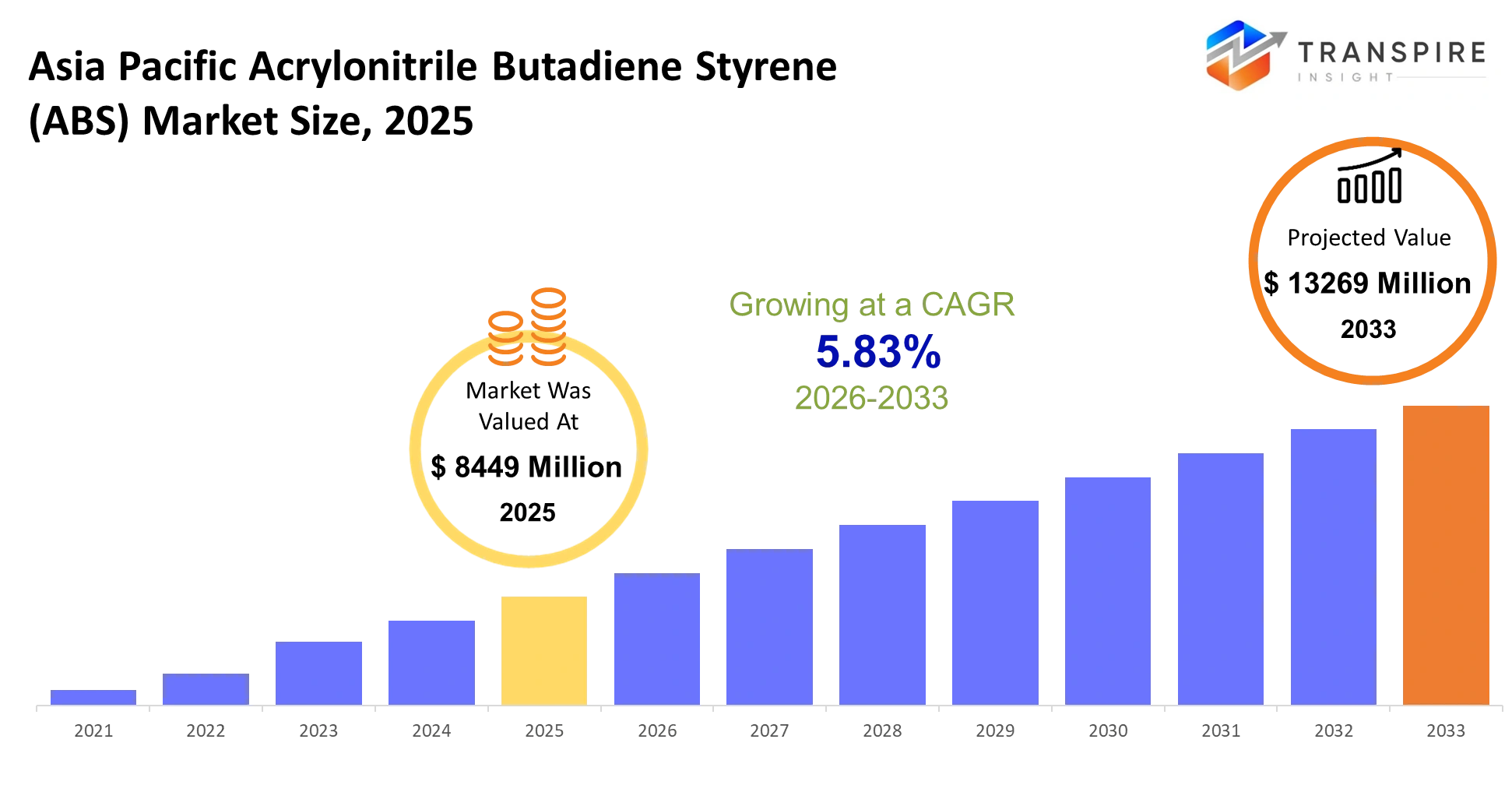
Asia Pacific Acrylonitrile Butadiene Styrene (ABS) Market Size & Forecast:
- Asia Pacific Acrylonitrile Butadiene Styrene (ABS) Market Size 2025: USD 8449 Million
- Asia Pacific Acrylonitrile Butadiene Styrene (ABS) Market Size 2033: USD 13269 Million
- Asia Pacific Acrylonitrile Butadiene Styrene (ABS) Market CAGR: 5.83%
- Asia Pacific Acrylonitrile Butadiene Styrene (ABS) Market Segments: By Type (General Purpose ABS, Flame Retardant ABS, High Impact ABS, Transparent ABS, Others, Specialty ABS); By Application (Automotive, Electronics, Appliances, Construction, Consumer Goods, Others); By End-User (Automotive, Electronics, Industrial, Construction, Packaging, Others); By Form (Pellets, Granules, Powder, Sheets, Blends, Others)
To learn more about this report,  Download Free Sample Report
Asia Pacific Acrylonitrile Butadiene Styrene (ABS) Market Summary:
The Asia Pacific Acrylonitrile Butadiene Styrene (ABS) Market size is estimated at USD 8449 Million in 2025 and is anticipated to reach USD 13269 Million by 2033, growing at a CAGR of 5.83% from 2026 to 2033. The Asia Pacific Acrylonitrile Butadiene Styrene ABS Market will demonstrate changing material preferences in automotive and electronics and consumer goods manufacturing throughout the plastics and polymer sector. The need for lightweight and durable and impact-resistant materials will determine product design choices which manufacturers will adopt in their production processes.
The development of new technology for polymer blending and recycling will enable better material efficiency and consistent performance throughout the recycling process. Environmental regulations which control plastic waste and demand environmental compliance will determine production practices and materials selection. The Asia Pacific Acrylonitrile Butadiene Styrene ABS Market will need to meet growing demands for better thermal stability and enhanced surface finish performance in industrial usage.
What Has the Impact of Artificial Intelligence Been on the Asia Pacific Acrylonitrile Butadiene Styrene (ABS) Market?
- China will control approximately 40 percent of the market share in 2025 which positions it as the leading force in the Asia Pacific acrylonitrile butadiene styrene (ABS) industry because of its extensive production capacity for automotive and electronics goods.
- Automakers and consumer product manufacturers use injection molding ABS which controls about 45 percent of the market.
- The construction and piping sectors use extrusion-grade ABS which requires specialized materials.
- The electronics industry needs flame-retardant ABS products which will become the most rapidly expanding segment from 2025 until 2030.
- The Asia Pacific acrylonitrile butadiene styrene market for automotive applications generates approximately 38 percent of total market revenue because lightweight vehicles require this material.
- The consumer goods market maintains its current position because customers continuously seek durable plastic products.
- Automakers lead the market with approximately 36 percent of total sales because they use ABS for interior and component manufacturing.
- The electronics sector will experience the most rapid growth between 2025 and 2030 because of the increasing adoption of smart devices.
- The construction industry maintains a steady need for structural polymer products in the Asia Pacific acrylonitrile butadiene styrene ABS market.
- The Asian market for acrylonitrile butadiene styrene (ABS) products will benefit from polymerization technology advancements which enhance strength and thermal resistance while reducing costs.
Asia Pacific Acrylonitrile Butadiene Styrene (ABS) Market Segmentation
By Type:
The Asia Pacific market for acrylonitrile butadiene styrene (ABS) comprises several segments that use different types of ABS in their operations. The industrial sector requires general purpose ABS because it provides both adequate strength and affordable production costs. High impact ABS supports applications requiring better durability and resistance in automotive and electronics parts. The Asia Pacific acrylonitrile butadiene styrene (ABS) market uses flame-retardant ABS as a common material for electrical components which must meet strict safety requirements throughout their manufacturing process.
Transparent ABS is well-suited for design-focused applications where appearance and clarity matter in consumer goods and appliances. Engineering solutions that require improved performance use specialty ABS and other modified grades. The Asia Pacific acrylonitrile butadiene styrene (ABS) market maintains performance stability by continuously upgrading materials to meet various industrial requirements.
By Application:
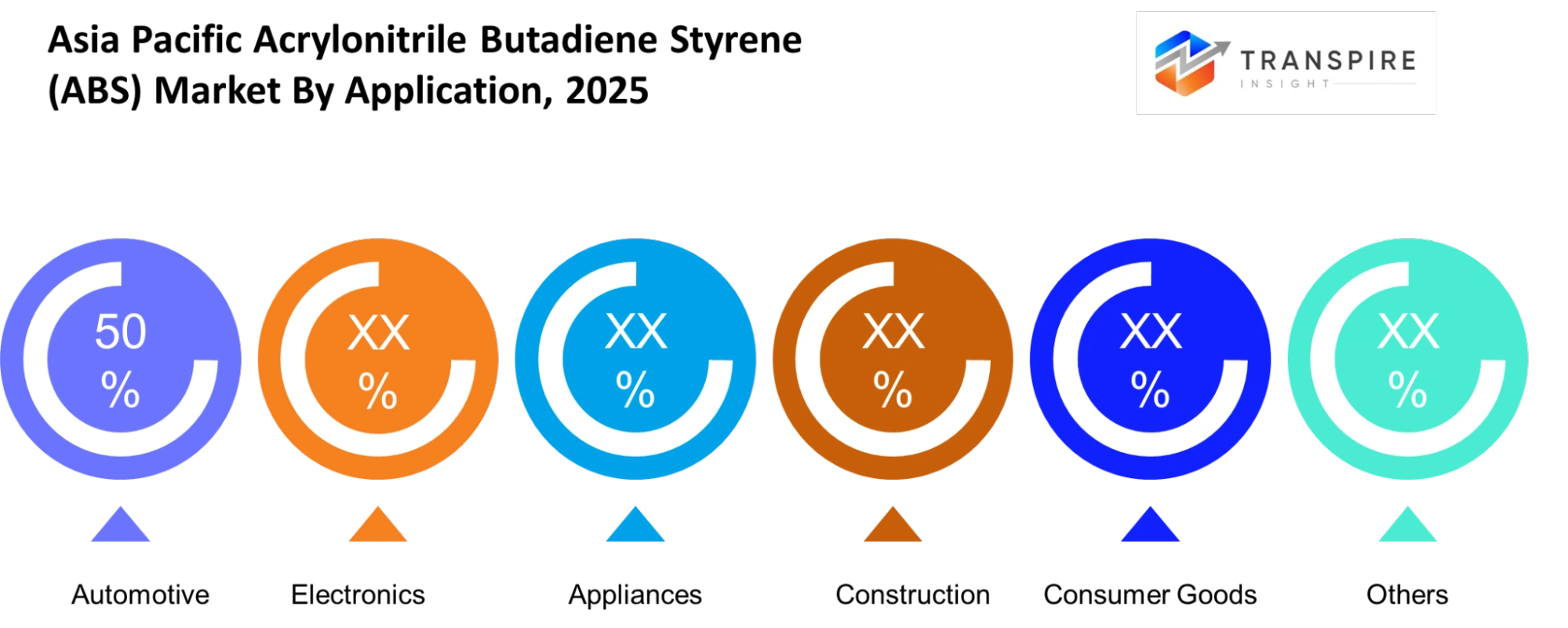
The automotive industry leads the Asia Pacific Acrylonitrile Butadiene Styrene (ABS) Market because of its need for lightweight materials that can endure impacts during vehicle production. The production of compact devices and precision parts leads to continuous growth in electronics applications. The Asia Pacific acrylonitrile butadiene styrene (ABS) market experiences strong demand from both appliances and consumer goods which drive production across all manufacturing facilities.
The construction industry uses ABS materials to build pipes and fittings and structural components which need to withstand heavy loads. Industrial equipment and molded products made to order serve as additional uses. The Asia Pacific acrylonitrile butadiene styrene (ABS) market maintains constant consumption rates because different applications exist across all manufacturing industries.
To learn more about this report, Download Free Sample Report
By End-User:
Automotive manufacturers represent the largest end-user group due to extensive use of ABS in dashboards, trims, and structural components. Electronics industries also drive strong consumption with rising demand for durable housings and device parts in the asia pacific acrylonitrile butadiene styrene (ABS) market.
Industrial and construction sectors rely on ABS for mechanical strength and versatility in applications. Packaging and other end-users continue steady usage in molded and protective products. End-user diversification strengthens long-term stability across the asia pacific acrylonitrile butadiene styrene (ABS) market.
By Form:
Pellets dominate production processes due to easy handling and compatibility with injection molding systems. Granules are widely used in extrusion processes requiring consistent material flow. Powder form supports specialized compounding applications in manufacturing units across the asia pacific acrylonitrile butadiene styrene (ABS) market.
Sheets and blends are used in fabrication and customized product development across industrial applications. Other forms support niche manufacturing needs requiring tailored material performance. Form-based diversification ensures flexible processing options across industries in the asia pacific acrylonitrile butadiene styrene (ABS) market.
What are the Main Challenges for the Asia Pacific Acrylonitrile Butadiene Styrene (ABS) Market Growth?
The Asia Pacific acrylonitrile butadiene styrene ABS market faces ongoing difficulties because manufacturers cannot maintain stable polymer properties when their production process needs to work under different temperature and operational conditions. Production processes are being disrupted due to supply chain disruptions in styrene and butadiene feedstocks, leading to production delays across all downstream industrial operations. The Asia Pacific acrylonitrile butadiene styrene ABS market faces additional difficulties because its performance capabilities become limited when exposed to extreme heat and extended periods of time, which makes it unsuitable for automotive and electronics applications that depend on product longevity.
Emerging economies face adoption challenges because industrial infrastructure is limited, skilled technical workers are in short supply, and development funding remains restricted. The Asia Pacific acrylonitrile butadiene styrene ABS market adoption challenges restrict knowledge about advanced ABS applications which are used in mid-scale manufacturing spaces. The market experiences greater restrictions because different regions have different levels of access to technology.
The use of polypropylene and polycarbonate as alternative engineering plastics creates competitive market pressure, affecting product pricing and driving customers to seek other materials. The implementation of new environmental regulations together with increasing recycling requirements creates compliance obligations which make it difficult to forecast future outcomes in the Asia Pacific acrylonitrile butadiene styrene ABS industry.
Regional Insights
The Asia Pacific Acrylonitrile Butadiene Styrene ABS market shows strong demand through China, India, Japan, South Korea and Southeast Asia because of their growing automotive and electronics manufacturing industries. China's industrial capacity and existing polymer supply networks make it the top country for both production and consumption. The Asia Pacific acrylonitrile butadiene styrene ABS market shows rising ABS usage in India because of infrastructure development and increasing appliance production.
Demand in Japan and South Korea remains constant due to their need for advanced electronics, precision engineering, and high-quality materials. Southeast Asia keeps growing because manufacturing centers move to places with cheaper production options. The Asia Pacific acrylonitrile butadiene styrene ABS market will experience stable long-term consumption because of industrial diversification and regional trade integration.
Recent Development News
In April 2026, Sogo Co., Ltd. announced an acquisition. The company acquired A&L Japan to strengthen its specialty chemicals portfolio, gaining access to an established ABS resin business and customer base in Japan.https://third-news.com
In March 2026, INEOS Styrolution completed the divestment (acquisition by buyer). The company finalized the sale of its ABS and SAN production site in Map Ta Phut, Thailand, to Styrenix Performance Materials Limited, transferring full ownership of the facility to expand Styrenix’s regional footprint.https://www.plasticsandrubberasia.com
|
Report Metrics |
Details |
|
Market size value in 2025 |
USD 8449 Million |
|
Market size value in 2026 |
USD 8922 Million |
|
Revenue forecast in 2033 |
USD 13269 Million |
|
Growth rate |
CAGR of 5.83% from 2026 to 2033 |
|
Base year |
2025 |
|
Historical data |
2021 - 2024 |
|
Forecast period |
2026 - 2033 |
|
Report coverage |
Revenue forecast, competitive landscape, growth factors, and trends |
|
Regional scope |
Asia Pacific (China, India, Japan, South Korea, Australia, Rest of Asia Pacific) |
|
Key company profiled |
LG Chem, SABIC, BASF, INEOS Styrolution, Chi Mei, Formosa Plastics, Trinseo, Asahi Kasei, Mitsubishi Chemical, Toray, Kumho Petrochemical, Lotte Chemical, Sinopec, Reliance, Versalis |
|
Customization scope |
Free report customization (country, regional & segment scope). Avail customized purchase options to meet your exact research needs. |
|
Report Segmentation |
By Type (General Purpose ABS, Flame Retardant ABS, High Impact ABS, Transparent ABS, Others, Specialty ABS); By Application (Automotive, Electronics, Appliances, Construction, Consumer Goods, Others); By End-User (Automotive, Electronics, Industrial, Construction, Packaging, Others); By Form (Pellets, Granules, Powder, Sheets, Blends, Others) |
How Can New Companies Establish a Strong Foothold in the Asia Pacific Acrylonitrile Butadiene Styrene (ABS) Market?
The Asia Pacific acrylonitrile butadiene styrene (ABS) market offers new companies an opportunity to succeed through their development of niche-sized products which address particular industry needs in automotive and electronics and healthcare manufacturing. The Asia Pacific acrylonitrile butadiene styrene (ABS) market requires companies to develop entry strategies which involve them offering distinct ABS product lines that include high-impact and flame-retardant and recycled blends which fulfill specific performance standards and sustainability criteria. Startups like “PolyNova Materials” and “EcoBlend Polymers” are emerging with bio-enhanced and recyclable ABS solutions that target eco-conscious manufacturers in electronics and consumer goods.
New companies will use partnership-driven expansion to establish their businesses in the Asia Pacific acrylonitrile butadiene styrene (ABS) market because their collaborations with OEMs and contract manufacturers will enable them to quickly establish supply chain connections. Companies will establish strategic alliances with automotive component suppliers and electronics assemblers which will result in faster product validation processes and shorter product commercialization durations. The company will strengthen its strategic position in the Asia Pacific acrylonitrile butadiene styrene (ABS) market through its technology differentiation which includes smart compounding systems and AI-assisted quality control and precision polymer blending.
New entrants will also gain advantage by targeting underserved industrial clusters in Southeast Asia and India through their development of affordable engineering plastics which industrial markets currently need. The asia pacific acrylonitrile butadiene styrene (ABS) market will reward companies that reduce production inefficiencies, improve thermal resistance performance, and offer customized material solutions for smart manufacturing ecosystems. The asia pacific acrylonitrile butadiene styrene (ABS) market will achieve sustainable competitive advantages through its organizations which focus on environmental regulations and their dedication to manufacturing products in local facilities.
Key Asia Pacific Acrylonitrile Butadiene Styrene (ABS) Market Company Insights
The Asia Pacific Acrylonitrile Butadiene Styrene ABS market maintains its active market because international and local manufacturers compete to deliver superior products at affordable prices. Key players invest in advanced polymer technologies, recycled ABS solutions, and high-performance grades to meet industrial demand. Companies establish stronger supply chains to obtain essential raw materials which enable them to produce their products continuously throughout the Asia Pacific Acrylonitrile Butadiene Styrene ABS market.
The market competition in automotive and electronics sectors depends on three factors which include how quickly companies innovate and their pricing methods and their ability to customize products. Manufacturers expand regional production facilities to reduce logistics costs and improve delivery timelines. The companies secure their long-term contracts through strategic partnerships with end-use industries which also provide them with consistent demand throughout the Asia Pacific Acrylonitrile Butadiene Styrene ABS market.
Company List
- LG Chem
- SABIC
- BASF
- INEOS Styrolution
- Chi Mei
- Formosa Plastics
- Trinseo
- Asahi Kasei
- Mitsubishi Chemical
- Toray
- Kumho Petrochemical
- Lotte Chemical
- Sinopec
- Reliance
- Versalis
What are the Key Use-Cases Driving the Growth of the Asia Pacific Acrylonitrile Butadiene Styrene (ABS) Market?
Your data training extends until the month of October in the year 2023. The asia pacific acrylonitrile butadiene styrene (ABS) market develops through high-volume automotive production because ABS enables manufacturers to build light vehicle parts which include dashboards and trims and protective panels. The automotive industry needs engineered plastics because fuel-efficient and electric vehicle production increases, which drives growth in the Asia Pacific ABS market. Automotive OEMs continue to rely on ABS because it provides them with impact resistance together with durability at an affordable price.
The asia pacific acrylonitrile butadiene styrene (ABS) market receives its market growth from electronics manufacturing because it needs durable housings and connectors together with compact device structures. The increasing demand for smartphones and home appliances and smart devices drives the need for materials which are used in precise molding processes. The Asia Pacific acrylonitrile butadiene styrene market experiences strong growth because consumer goods manufacturing employs ABS in household products that need both strength and design flexibility across various production methods.
Healthcare applications are expanding steadily, with ABS used in medical device casings, diagnostic equipment, and disposable components that require safety and reliability. The industrial sector uses ABS to manufacture its machinery components and protective gear. The various application possibilities of this material create pathways for future growth while the Asia Pacific ABS market maintains steady expansion and material development progress.
Asia Pacific Acrylonitrile Butadiene Styrene (ABS) Market Report Segmentation
By Type
- General Purpose ABS
- Flame Retardant ABS
- High Impact ABS
- Transparent ABS
- Others
- Specialty ABS
By Application
- Automotive
- Electronics
- Appliances
- Construction
- Consumer Goods
- Others
By End-User
- Automotive
- Electronics
- Industrial
- Construction
- Packaging
- Others
By Form
- Pellets
- Granules
- Powder
- Sheets
- Blends
- Others
Frequently Asked Questions
Find quick answers to common questions.
The approximate Asia Pacific Acrylonitrile Butadiene Styrene (ABS) Market size for the market will be USD 13269 Million in 2033.
Key segments for the Asia Pacific Acrylonitrile Butadiene Styrene (ABS) Market are By Type (General Purpose ABS, Flame Retardant ABS, High Impact ABS, Transparent ABS, Others, Specialty ABS); By Application (Automotive, Electronics, Appliances, Construction, Consumer Goods, Others); By End-User (Automotive, Electronics, Industrial, Construction, Packaging, Others); By Form (Pellets, Granules, Powder, Sheets, Blends, Others).
Major Asia Pacific Acrylonitrile Butadiene Styrene (ABS) Market players are LG Chem, SABIC, BASF, INEOS Styrolution, Chi Mei, Formosa Plastics, Trinseo, Asahi Kasei, Mitsubishi Chemical, Toray, Kumho Petrochemical, Lotte Chemical, Sinopec, Reliance, Versalis.
The Asia Pacific Acrylonitrile Butadiene Styrene (ABS) Market size isUSD 8449 Million in 2025.
The Asia Pacific Acrylonitrile Butadiene Styrene (ABS) Market CAGR is 5.83%.
- LG Chem
- SABIC
- BASF
- INEOS Styrolution
- Chi Mei
- Formosa Plastics
- Trinseo
- Asahi Kasei
- Mitsubishi Chemical
- Toray
- Kumho Petrochemical
- Lotte Chemical
- Sinopec
- Reliance
- Versalis
Recently Published Reports
-
Dec 2024
Healthcare Polymer Packaging Market
Healthcare Polymer Packaging Market Size, Share & Analysis Report By Packaging Type (Syringes, IV Bottles and Pouches, Clamshells, Blisters, Bottles & Jars, Containers, Tubes, IV Parental Packaging, Others), By Type (Regulated, Non-regulated), By Polymer Type (LDPE (Low-Density Polyethylene), HDPE (High-Density Polyethylene), Homo-polymer (Homo), Random Copolymer (Random), Block Copolymer (Block), PET, Polystyrene, Polyvinyl Chloride, Polyamide/EVOH, Others), and Geography (North America, Europe, Asia-Pacific, Middle East and Africa, South and Central America), 2021 - 2031
-
Jan 2025
Hydrophilic Tape (Waterstop) Market
Hydrophilic Tape (Waterstop) Market Size, Share & Analysis Report By Type (Bentonite-Based Hydrophilic Tape, Rubber-Based Hydrophilic Tape), By Application (Residential Buildings, Commercial Buildings, Infrastructure Projects), and Geography (North America, Europe, Asia-Pacific, Middle East and Africa, South and Central America), 2021 - 2031
-
Jan 2025
Metalens Market
Metalens Market Size, Share & Analysis Report By Type (Visible Light Metalens, and Infrared Metalens), By Application (Consumer Electronics, Automotive Electronics, Industrial, Medical, and Others), and Geography (North America, Europe, Asia-Pacific, Middle East and Africa, South and Central America), 2021 - 2031
-
Jan 2025
PBT Resin Market
PBT Resin Market Size, Share & Analysis Report By Type (Reinforced PBT Resin, Unreinforced PBT Resin), By Processing Method (Injection Molding, Extrusion, Blow Molding, Others), By End-User (Automotive, Electrical & Electronics, Consumer Appliances, Industrial Machinery, Medical Devices, Packaging, Others), and Geography (North America, Europe, Asia-Pacific, Middle East and Africa, South and Central America), 2021 - 2031