

Active Wheelchair Market Summary:
According to Transpire Insight, a detailed research report on the Active Wheelchair Market reflects that the rigid-frame segment dominates the Active Manual Wheelchair Market, accounting for approximately 64.6% of total revenue worldwide in 2025. Sunrise Medical leads the competitive landscape, with an estimated 12–18% active wheelchair market revenue share, supported by its QUICKIE, RGK, and ZIPPIE product portfolios, contributing to market development, lightweight wheelchair innovation, customized mobility solutions, expanding distribution capabilities, and evolving market growth dynamics.
Market Snapshot
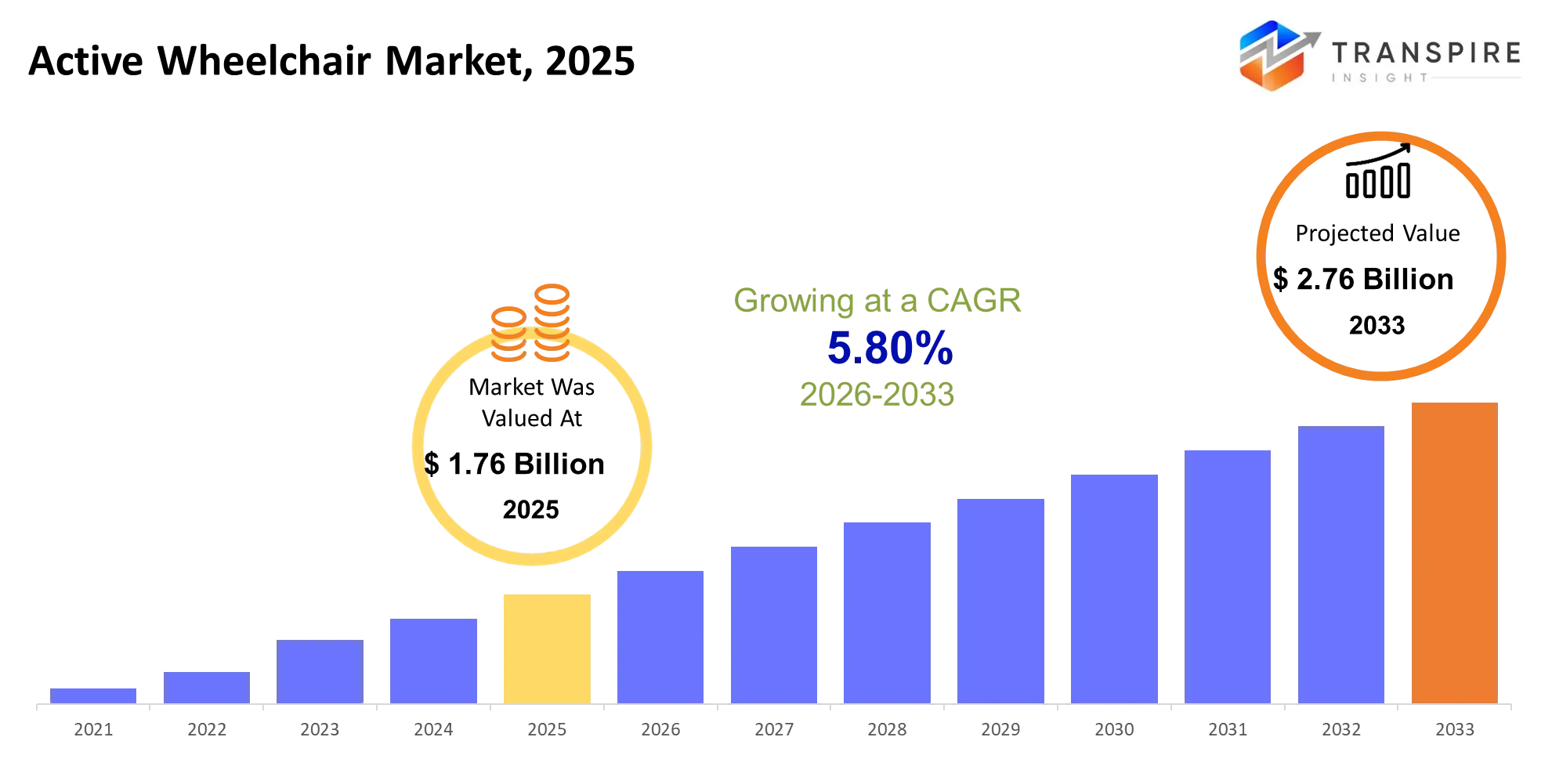
- Market Value (2025): USD 1.76 Billion.
- Expected Market Value (2026): USD 1.86 Billion.
- Estimated Market Value (2033): USD 2.76 Billion.
- Forecast CAGR (2026–2033): 5.80%.
- Leading Region in 2025: North America
- Second-largest Region: Europe
- Fastest Growing Region: Asia Pacific
Introduction
The market for active wheelchairs entails the development, manufacture, and marketing of lightweight, extremely agile mobility products for individuals who prefer to move around independently using self-powered wheelchairs. As opposed to conventional wheelchairs that are usually moved by caregivers, active wheelchairs integrate innovative technologies such as titanium, carbon fiber, and high-quality aluminum with ergonomically designed seats, customizable designs, and improved maneuverability. This product line benefits persons with disabilities such as spinal cord injuries, cerebral palsy, multiple sclerosis, and others. Awareness regarding inclusivity, development in lightweight engineering, and the need for personalized mobility devices are among the factors contributing to the consistent growth in this market, which is becoming increasingly significant to the industry of assistive technology and medical devices.
For instance:-
- North America: The investment situation in North America is quite mature because of the presence of established manufacturers, good rehabilitation facilities, and increasing demand for light weight carbon fibre and titanium wheelchairs with modular power assist devices to increase their efficiency.
- Europe: Opportunities in Europe can be attributed to consolidation through mergers and acquisitions, making changes to the existing distribution network. The EU Medical Device Regulation is tough and delays time to market, making compliance difficult.
Key Market Highlights: -
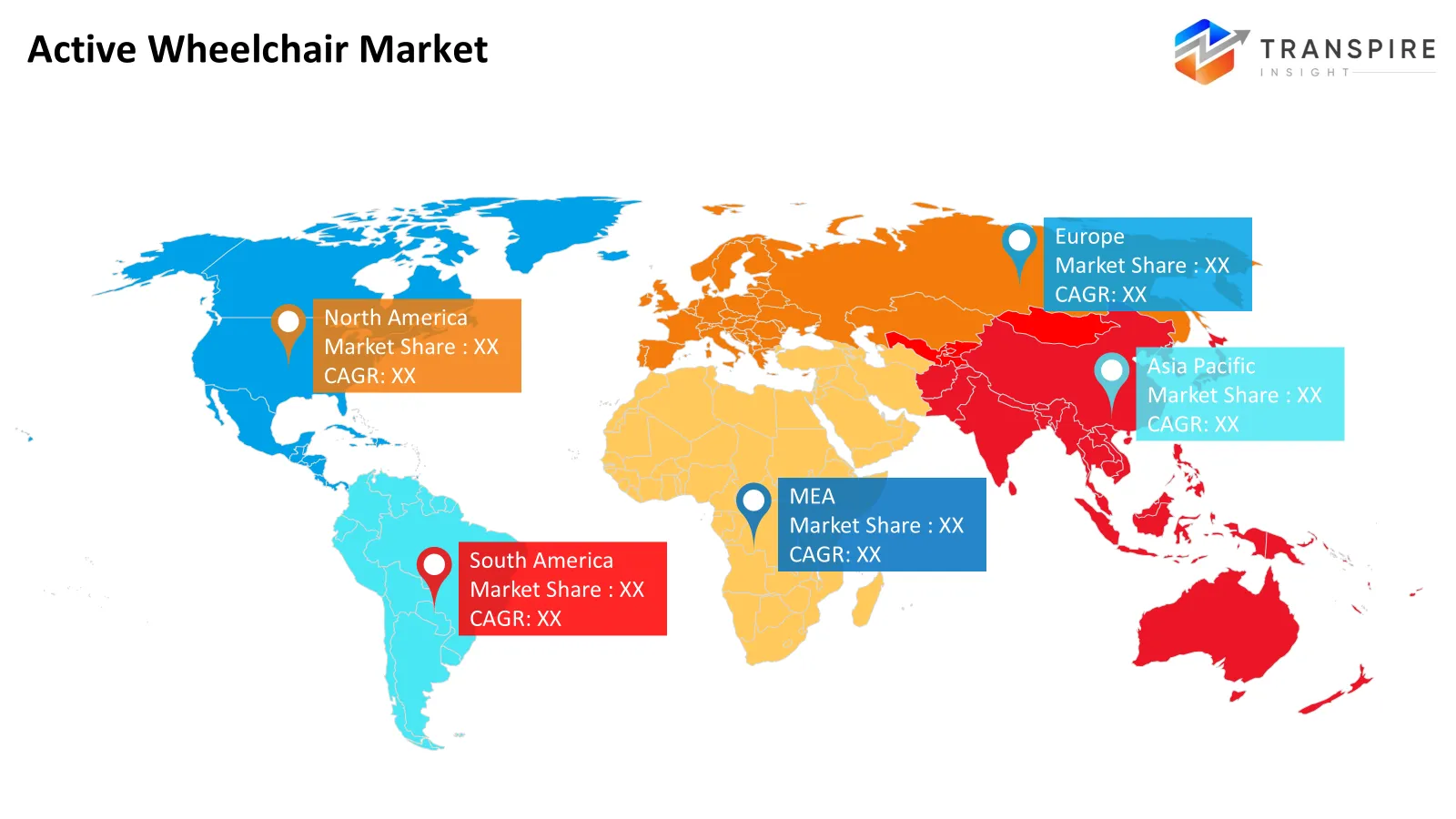
- North America is expected to grow at a rapid CAGR in the Active Wheelchair Market by holding around 40% of the share during the forecast period.
- Europe is anticipated to hold roughly 29% share of the Active Wheelchair Market over the predicted timeframe.
- Asia Pacific is anticipated to hold nearly 24% share of the Active Wheelchair Market over the predicted timeframe.
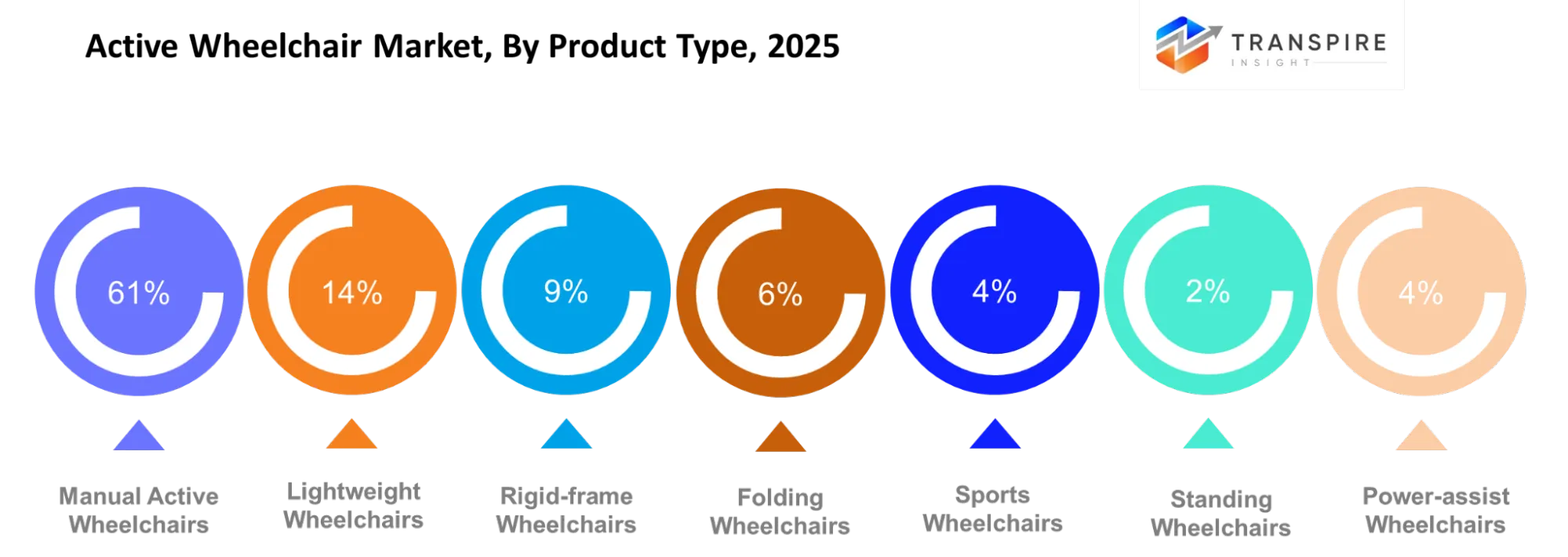
- By Product Type, the Manual Active Wheelchairs dominated the market and holds nearly 60% share in 2025 and is projected to grow at a substantial CAGR during the forecast period.
- By Wheelchair Type, the Self-propelled dominated the market and holds close to 58% share in 2025 and is projected to grow at a substantial CAGR during the forecast period.
- By Application, the Multinational Corporations dominated the market and holds about 54% share in 2025 and is projected to grow at a substantial CAGR during the forecast period.
- Government initiatives like ADIP and Rashtriya Vayoshri Yojana along with state welfare programs have increased availability of assistive devices in India, which in turn will increase demand for wheelchairs.
How is Technology Driving Growth in the Active Wheelchair Market?
One of the significant drivers for the development of the active wheelchair is technology, which contributes to the lightening and increased responsiveness and better control of the equipment. The development of carbon fiber and titanium frames allows for improved ease of handling and portability, whereas the use of power assist systems enables transformation from manual wheelchairs to the hybrid ones that have an increased operational range. Additionally, intelligent options such as connectivity, sensors, and applications help to increase safety and user-friendliness. Finally, modular systems along with 3D printing contribute to creating personalized seats and frames.
|
Report Metrics |
Details |
|
Market size value in 2025 |
USD 1.76 Billion |
|
Market size value in 2026 |
USD 1.86 Billion |
|
Revenue forecast in 2033 |
USD 2.76 Billion |
|
Growth rate |
CAGR of 5.80% from 2026 to 2033 |
|
Base year |
2025 |
|
Historical data |
2021 - 2024 |
|
Forecast period |
2026 - 2033 |
|
Report coverage |
Revenue forecast, competitive landscape, growth factors, and trends |
|
Regional scope |
United States; Canada; Mexico; United Kingdom; Germany; France; Italy; Spain; Denmark; Sweden; Norway; China; Japan; India; Australia; South Korea; Thailand; Brazil; Argentina; South Africa; Saudi Arabia; United Arab Emirates |
|
Key company profiled |
Sunrise Medical, Invacare, Permobil, Ottobock, Küschall, Panthera, TiLite, Quickie, RGK Wheelchairs, Kuschall, Pride Mobility, LEVO, Motion Composites, Etac, Meyra |
|
Customization scope |
Free report customization (country, regional & segment scope). Avail customized purchase options to meet your exact research needs. |
|
Report Segmentation |
By Product Type (Manual Active Wheelchairs, Lightweight Wheelchairs, Rigid-frame Wheelchairs, Folding Wheelchairs, Sports Wheelchairs, Standing Wheelchairs, Power-assist Wheelchairs, Others); By Wheelchair Type (Self-propelled, Attendant-propelled, Power-assisted, Sports, Pediatric, Bariatric, All-terrain, Others); By Application (Mobility Assistance, Sports & Recreation, Rehabilitation, Daily Living, Outdoor Mobility, Travel, Clinical Use, Others); By End User (Hospitals, Rehabilitation Centers, Homecare, Sports Centers, Nursing Facilities, Clinics, Individuals, Others); By Material (Aluminum, Titanium, Carbon Fiber, Steel, Magnesium, Composite, Hybrid, Others); By Distribution (Medical Stores, Specialty Dealers, Online, Hospitals, Direct Sales, Distributors, Sports Retailers, Others); By Price (Economy, Mid-range, Premium, High-end, Professional, Custom, Institutional, Others) |
Market Drivers
The active wheelchairs market is driven by an increasing number of mobility disabilities such as spinal cord injuries, traumatic injuries, sports injuries, among others, leading to a continuous need for high-performance and independent mobility. The aging population, together with the increased incidence of neurological disorders, increases the target customers base. Innovation and development of technologies related to ultra-light materials made of aluminum, titanium, and carbon fiber increase the robustness, maneuverability, and portability of the products, while financial support through reimbursements ensures wider availability of the products. Moreover, the change in attitude towards inclusive design and adaptive sports is fueling the growth of the market.
For instance:- Asia-Pacific: Asia-Pacific represents a growing market due to ageing population in countries like China, Japan, and India, increase in trauma cases, growth in rehabilitation infrastructure, and local manufacturing reducing costs for middle income people.
Restrain
The high cost of products is one of the biggest barriers that inhibit the growth of the active wheelchairs market. This is due to the fact that the cost of manufacturing such chairs using the high-end titanium and carbon frame materials, customization of the fit according to ergonomics, and subsequent maintenance increase the overall cost of the product. In addition, lack of trained clinical fitting, poor rural repair facilities, and stringent regulations hinder market development.
|
Driver |
Relative Impact on Growth (%) |
Geographic Relevance |
Impact Timeline |
Demand Strength |
Growth Mechanism (5–10 words) |
Key Beneficiaries (5–10 words) |
Major Constraint (5–10 words) |
|
1. Rising mobility impairment and aging population |
27% |
North America, Europe, Asia Pacific |
Long-term (≥4 years) |
High |
Expands demand for independent mobility and daily-living assistance. |
Active wheelchair manufacturers, users, rehabilitation providers, caregivers. |
Affordability gaps and unequal access to rehabilitation services. |
|
2. Growing preference for lightweight, ergonomic, customized wheelchairs |
23% |
North America, Europe, Japan |
Medium-term (2–4 years) |
High |
Improves propulsion efficiency, comfort, portability, and maneuverability. |
Lightweight frame manufacturers, seating specialists, active users. |
Premium material costs and limited customization affordability. |
|
3. Expansion of rehabilitation services and assistive-device access |
19% |
Asia Pacific, North America, Europe |
Medium-term (2–4 years) |
High |
Increases prescriptions, institutional procurement, and mobility-device distribution. |
Rehabilitation centers, hospitals, distributors, wheelchair manufacturers. |
Limited trained personnel and inconsistent reimbursement coverage. |
|
4. Technological advancements in active and sports wheelchairs |
17% |
North America, Europe, Japan, Australia |
Medium-term (2–4 years) |
Medium |
Enables performance gains through advanced materials and modular designs. |
Sports wheelchair brands, component suppliers, para-athletes, users. |
High development costs and specialized fitting requirements. |
|
5. Government accessibility initiatives and inclusive mobility investment |
14% |
Europe, North America, India, China |
Short-term (≤2 years) |
Medium |
Supports procurement through accessibility programs and public funding. |
Public agencies, assistive-device suppliers, users, local manufacturers. |
Budget limitations and fragmented implementation of accessibility policies. |
|
Total |
100% |
— |
— |
— |
— |
— |
— |
Analysis of Prices and Consumer Behaviour
In the Active Wheelchair Market, the market for rigid frame active wheelchairs accounts for a greater share owing to the requirement for lightweight and maneuverable construction and performance for regular movement. The high-end active wheelchairs having carbon fiber and advanced aluminum frame constructions could enjoy premium pricing compared to ordinary wheelchairs on account of their lighter weight, customization, and better performance. It is estimated that around 45% of the active wheelchair units sold belong to the category of lightweight and ultralightweight wheelchairs, thanks to their portability and independence of movement. Sports and Performance Wheelchair market accounts for another unique requirement of active wheelchairs where it caters to athletes with disabilities. The purchase behavior of the Active Wheelchair market involves preference for low weight, durability, comfort, and customization to maximize propulsion and ergonomics. Another 33% of the purchasers from institutions and business establishments are estimated to favor bulk purchases or supplier arrangements to minimize the cost of purchase and ensure constant availability of the product.
|
Company |
Est. Revenue Share Range |
Key Offerings |
Strategic Positioning |
Geographic Strength |
Technology Focus |
|
Sunrise Medical |
Estimated 12–18% |
QUICKIE rigid and folding chairs; RGK custom sports chairs; ZIPPIE pediatric chairs; JAY seating |
Broad portfolio differentiation with specialist performance brands |
North America, Europe, Asia Pacific |
Lightweight alloys, custom geometry, modular seating |
|
Permobil AB |
Estimated 8–14% |
TiLite rigid and folding manual chairs; Panthera ultra-light chairs; SmartDrive power assist |
Premium engineering through specialized manual mobility brands |
North America, Europe, Asia Pacific |
Ultra-light frames, rigid chassis, power-assist integration |
|
Invacare Corporation |
Estimated 7–12% |
Küschall active chairs; Top End sports chairs; lightweight manual wheelchair models |
Active mobility and sports specialization within broad mobility portfolio |
North America, Europe |
Custom frame geometry, sports configurations, lightweight construction |
|
Ottobock SE & Co. KGaA |
Estimated 5–9% |
Avantgarde manual chairs; Zenit folding chairs; custom mobility solutions |
Premium clinical expertise and individualized mobility solutions |
Europe, North America, Asia Pacific |
Ergonomic adjustment, modular configurations, lightweight frame design |
|
MEYRA GmbH |
Estimated 4–8% |
NEXUS active chairs; lightweight manual wheelchairs; individualized seating configurations |
European specialist focused on tailored mobility and clinical fit |
Europe, Middle East |
Adjustable geometry, modular components, personalized seating |
|
Motion Composites |
Estimated 3–6% |
HELIO series; APEX carbon-fiber chairs; VELOCE rigid chairs |
Premium lightweight differentiation and user-centered design |
North America, Europe |
Carbon fiber, optimized frame stiffness, weight reduction |
|
Karma Medical Products |
Estimated 2–5% |
KM active manual chairs; lightweight folding models; customized manual mobility solutions |
Value-oriented product breadth with regional distribution expansion |
Asia Pacific, Europe |
Lightweight aluminum frames, adjustable seating, folding mechanisms |
|
Karman Healthcare |
Estimated 2–4% |
LT- series ultralight chairs; ergonomic manual wheelchairs; customized lightweight models |
Accessible pricing with lightweight product diversification |
North America, Asia Pacific |
Aluminum and carbon-fiber options, portability, ergonomic design |
|
Wolturnus A/S |
Estimated 1–3% |
A-series active chairs; custom rigid-frame chairs; sports wheelchairs |
Niche premium customization for highly active users |
Europe, North America |
Bespoke frame geometry, individualized fit, sports-oriented engineering |
|
Vermeiren Group |
Estimated 1–3% |
V-series manual chairs; lightweight active models; configurable seating solutions |
European regional challenger emphasizing configurable mobility products |
Europe, Middle East |
Modular configurations, adjustable seating, lightweight frame construction |
Who are the Key Players in the Active Wheelchair Market and how do they compete?
The competitiveness in the Active Wheelchair market is influenced by firms focusing on innovations in technology, personal mobility solutions, and the creation of networks of distributors. Competitive focus on durable products, wheelchair technology, lightweight materials, ergonomics, and personal mobility solutions ensures the consistent development of products and assists in gaining more independence, mobility, comfort, and maneuverability for users.
With the help of the production of lightweight active wheelchairs, personal mobility solutions, ergonomics, and innovative wheelchair technologies, the position of Sunrise Medical within the industry is strengthened. Through the creation of advanced manual wheelchairs for use during daily mobility and rehabilitation needs, Invacare sets itself apart from other firms. The unique manual wheelchairs, lightweight mobility solutions, and personalized seating technologies are what make Permobil competitive in the market.
Top Companies in the Active Wheelchair Market
- Sunrise Medical
- Invacare
- Permobil
- Ottobock
- Küschall
- Panthera
- TiLite
- Quickie
- RGK Wheelchairs
- Kuschall
- Pride Mobility
- LEVO
- Motion Composites
- Etac
- Meyra
|
Investment Factor |
Why It Matters to Investors |
Opportunity |
Investment Implication |
|
1. Sustained mobility demand and aging populations |
Long-term mobility needs support a recurring replacement and upgrade market. |
Develop lightweight everyday active wheelchairs for aging and mobility-impaired users. |
Prioritize durable products with accessible pricing and dependable distribution. |
|
2. Premium lightweight and customized wheelchair engineering |
Advanced materials and tailored configurations enable product differentiation and premium pricing. |
Invest in carbon-fiber frames, ergonomic designs, and individualized fitting platforms. |
Assess material costs, production scalability, and achievable margins. |
|
3. Rehabilitation and assistive-device distribution expansion |
Clinical recommendations and specialized dealers influence product selection and purchasing decisions. |
Build partnerships with rehabilitation centers, hospitals, and mobility equipment distributors. |
Strengthen clinical relationships, fitting capabilities, and after-sales service. |
|
4. Emerging markets and localized manufacturing |
Import costs and affordability barriers create opportunities for locally adapted products. |
Expand into underserved markets through regional assembly and distributor partnerships. |
Evaluate purchasing power, local competition, service coverage, and regulatory requirements. |
|
5. Sports wheelchairs and performance mobility |
Specialized users require tailored equipment with distinct performance characteristics. |
Develop adjustable sports chairs for basketball, racing, and other adaptive sports. |
Target specialist customer groups while managing customization and inventory complexity. |
|
6. Power-assist integration and lifecycle services |
Compatible propulsion accessories and maintenance services can extend customer relationships beyond initial sales. |
Offer power-assist compatibility, replacement components, repairs, and refurbishment. |
Build recurring service revenue while evaluating compatibility and warranty exposure. |
Active Wheelchair Market Segmentation
The Active Wheelchair Market share is divided into seven categories: By Product Type, By Wheelchair Type, By Application, By End User, By Material, By Distribution, By Price.
The Manual Active Wheelchairs dominated the market, accounting for nearly 60% in 2025 and is expected to rise at a significant CAGR during the forecast period.
The Active Wheelchair Market is by product type into manual active wheelchairs, lightweight wheelchairs, rigid-frame wheelchairs, folding wheelchairs, sports wheelchairs, standing wheelchairs, power-assist wheelchairs, others. Among these, the Manual Active Wheelchairs dominated the market, accounting for nearly 60% in 2025 and expected to increase at a significant CAGR during the forecast period. Manual active wheelchairs will continue to take the lead based on the lower costs, lightweight and portability, maintenance-free nature, and their use by self-propelled individuals during sports activities.
The Self-propelled dominated the market, accounting for close to 58% in 2025, and is expected to rise at a significant CAGR during the forecast period
The Active Wheelchair Market is segmented by wheelchair type into self-propelled, attendant-propelled, power-assisted, sports, pediatric, bariatric, all-terrain, others. Among these, the Self-propelled dominated the market, accounting for close to 58% in 2025 and expected to increase at a significant CAGR during the forecast period. Self-propelled wheelchairs will continue to take the lead as individuals like the ability to be independent, affordable, portable, maintenance-free, and to get fit from the use.
The Daily Living dominated the market, accounting for about 54% in 2025 and is expected to rise at a significant CAGR during the forecast period.
The Active Wheelchair Market by application into mobility assistance, sports & recreation, rehabilitation, daily living, outdoor mobility, travel, clinical use, others. Among these, theMultinational Corporations dominated the market, accounting for about 54% in 2025 and expected to increase at a significant CAGR during the forecast period. Daily living will continue to lead since wheelchairs are important tools that are needed continuously indoors and outdoors for people suffering from chronic disabilities.
Regional Segment Analysis of the Active Wheelchair Market
- Europe (Germany, France, U.K., Italy, Spain, Rest of Europe)
- North America (U.S., Canada, Mexico)
- Asia-Pacific (China, Japan, India, Rest of APAC)
- South America (Brazil and the Rest of South America)
- The Middle East and Africa (UAE, South Africa, Rest of MEA)
North America is expected to grow at a rapid CAGR in the Active Wheelchair Market, holding around 40% of the share during the forecast period.
The North American region will continue to lead due to its well-established healthcare system, favorable reimbursement systems, and the availability of high awareness regarding assistive devices. There is a large number of people suffering from spinal cord injury and mobility problems, and disposable income allows premium products.
Europe is the high-growth region in the Active Wheelchair Market during the period, holding roughly 29% share.
The strong standing of Europe can be attributed to a well-developed system of public healthcare services, positive reimbursement policies, as well as an increasingly aging population that has significant mobility needs. The presence of mature manufacturers and the development of a rehabilitation market in this area drive constant innovation, while a strong tradition of adaptive sports increase the demand for performance products. Legislation on accessibility, urban planning for people with disabilities, and consolidation of mobility suppliers make the region a major contributor to market growth.
Asia Pacific is the fastest-growing region in the Active Wheelchair Market during the period, holding nearly 24% share.
Rapid growth in Asia Pacific stems from a rapidly aging population in China, Japan, and India, as well as increased numbers of accidents and traumas in these countries. Development of healthcare and rehabilitation services, government programs for assistive devices, as well as rising disposable income of people allow increasing access to mobility devices. Increased awareness of disability inclusion, development of adaptive sports, and local production of devices, which reduce prices for mid-income consumers contribute to market growth in the region.
Strategies for Market Growth in Non-Leading Regions:
Active wheelchair manufacturing technology, which can help develop regions that are not leaders in wheelchair production, can be used in order to help small and medium-sized companies engaged in the manufacture of mobility equipment. As far as the use of local sources for the manufacture of the parts and assembling active wheelchairs and setting up active wheelchair manufacturing plants in regions can significantly reduce dependence on imported products and costs related to the production process. It is necessary to set up strategic alliances with regional distributors, rehabilitation organizations, health care providers and mobility equipment suppliers to promote active wheelchairs on the market. Moreover, in order to raise the level of knowledge concerning the manufacture and fitting of active wheelchairs, lightweight frames engineering and customization, maintenance and quality control, it is necessary to develop training programs and improve technical skills. Finally, by implementing flexible financing, long-term supply contracts and contract manufacturing of active wheelchair products will become more affordable and will stimulate their implementation among end users.
Future Market Trends for the Active Wheelchair Market: -
- Lightweight and power assist innovations: Lightweight innovation is growing in prominence, with manufacturers using carbon fiber and titanium construction along with modular power assist features, which increase the range but also maintain the agility of manual chairs.
- Smart connectivity and personalization: Innovations around smart connectivity and personalization are increasing, with mobility management apps, smart sensors, and customized ergonomically designed seats adding to safety, comfort, and pressure relief for more active users.
- Inclusion and regional dynamics: Inclusive adaptive sports participation and disability inclusion programs are fueling innovation in this space, while technology adoption is driven by North America and Europe and the APAC region is the fastest growing market.
Recent Development
- In July 15, 2026: WHILL unveiled the Modo Breeze, an ultralight electric wheelchair made of carbon fiber, available as an affordable wheelchair solution and offering more lightweight, collapsible travel options for power wheelchair users.
- In June 19, 2026: DHCare concluded a definitive purchase agreement to take over Ottobock’s Human Mobility division; the acquisition is expected to be completed in H2 2026 and will help expand distribution in Europe.
- In June 22, 2026: IIT Madras provided the first shipment of 25 domestically produced YD One active wheelchairs made by Thryv Mobility to Army Hospital (Research & Referral), Delhi.
- In March 16, 2026: Permobil released new versions of TiLite TR and ZR titanium active wheelchairs, with a revised design for machined caster bullets and lighter frame weight through simplified center-of-gravity systems.
Market Segment
This study forecasts revenue at global, regional and country levels from 2020 to 2033. Transpire Insight has segmented the Active Wheelchair Market based on the below-mentioned segments:
Active Wheelchair Market, By Product Type
- Manual Active Wheelchairs
- Lightweight Wheelchairs
- Rigid-frame Wheelchairs
- Folding Wheelchairs
- Sports Wheelchairs
- Standing Wheelchairs
- Power-assist Wheelchairs
- Others
Active Wheelchair Market, By Wheelchair Type
- Self-propelled
- Attendant-propelled
- Power-assisted
- Sports
- Pediatric
- Bariatric
- All-terrain
- Others
Active Wheelchair Market, By Application
- Mobility Assistance
- Sports & Recreation
- Rehabilitation
- Daily Living
- Outdoor Mobility
- Travel
- Clinical Use
- Others
Active Wheelchair Market, By End User
- Hospitals
- Rehabilitation Centers
- Homecare
- Sports Centers
- Nursing Facilities
- Clinics
- Individuals
- Others
Active Wheelchair Market, By Material
- Aluminum
- Titanium
- Carbon Fiber
- Steel
- Magnesium
- Composite
- Hybrid
- Others
Active Wheelchair Market, By Distribution
- Medical Stores
- Specialty Dealers
- Online, Hospitals
- Direct Sales
- Distributors
- Sports Retailers
- Others
Active Wheelchair Market, By Price
- Economy
- Mid-range
- Premium
- High-end
- Professional
- Custom
- Institutional
- Others
Active Wheelchair Market, By Regional Analysis
North America
- US
- Canada
- Mexico
Europe
- Germany
- UK
- France
- Italy
- Spain
- Russia
- Rest of Europe
Asia Pacific
- China
- Japan
- India
- South Korea
- Australia
- Rest of Asia Pacific
South America
- Brazil
- Argentina
- Rest of South America
Middle East & Africa
- UAE
- Saudi Arabia
- Qatar
- South Africa
- Rest of the Middle East & Africa
Frequently Asked Questions
Find quick answers to common questions.
According to the report, the Active Wheelchair Market is projected to reach USD 2.76 billion by 2033, growing steadily.
Market growth is driven by mobility impairment, aging populations, lightweight materials, customization, rehabilitation access, inclusive sports, and accessibility initiatives worldwide.
Manual active wheelchairs lead the product-type segment, accounting for nearly 60% market share in 2025, according to report estimates.
North America leads the regional market, supported by established healthcare infrastructure, reimbursement systems, assistive-device awareness, and demand for premium wheelchairs.
Carbon-fiber frames, titanium engineering, modular power-assist systems, smart sensors, connectivity applications, and personalized seating are shaping wheelchair innovation.
- Sunrise Medical
- Invacare
- Permobil
- Ottobock
- Küschall
- Panthera
- TiLite
- Quickie
- RGK Wheelchairs
- Kuschall
- Pride Mobility
- LEVO
- Motion Composites
- Etac
- Meyra
About the Authors

Pankaj Ghogare Patil
I am Pankaj Ghogare Patil, a Senior Research Analyst at Transpire Insight, specializing in the Pharmaceutical, Chemicals & Materials, Healthcare IT, and Biotechnology industry. My expertise lies in conducting comprehensive market research, analyzing industry trends, evaluating competitive landscapes, and translating complex data into actionable insights. At Transpire Insight, I closely follow emerging technologies, regulatory developments, and market innovations to create accurate, well-researched, and informative content that helps businesses and professionals make informed decisions. I am committed to producing credible, evidence-based articles that reflect industry best practices while making technical topics accessible and valuable for a broad audience.

Chakradhar Khansole
Chakradhar serves as the Research Director at Transpire Insight, bringing over 8 years of experience in technology, innovation, and strategic market intelligence. He specializes in transforming complex market data into actionable business insights that enable organizations to make informed, growth-oriented decisions. Recognized for his strategic vision and analytical expertise, Chakradhar leads high-impact research initiatives, delivering comprehensive market assessments, competitive intelligence, and forward-looking industry analysis.
Recently Published Reports
-
Apr 2026
AI in Diabetic Retinopathy Market
AI in Diabetic Retinopathy Market Size, Share & Analysis Report By Type (Screening AI Systems, Diagnostic AI Systems, and Predictive AI Models), By Application Segment (Hospitals, Ophthalmology Clinics, Diagnostic Centers, and Research and Development), and Geography (North America, Europe, Asia-Pacific, Middle East and Africa, South and Central America), 2021 - 2031
-
Apr 2026
Psychometric Tests Market
Psychometric Tests Market Size, Share & Analysis Report By Type (Personality Tests, Ability/Aptitude Tests, Skill/Knowledge Tests, and Others), By Application (Talent Acquisition and Talent Management), and Geography (North America, Europe, Asia-Pacific, Middle East and Africa, South and Central America), 2021 – 2031
-
Apr 2026
Rare Biological Sample Collection Market
Rare Biological Sample Collection Market Size, Share & Analysis Report By Type (Isolation Kits & Reagent, Blood Collection Tubes, and Others), By Application (Oncology, Transcriptomics, Pharmacogenomics, and Others), and Geography (North America, Europe, Asia-Pacific, Middle East and Africa, South and Central America), 2021 – 2031
-
Jul 2026
Diabetic Retinopathy Market
Diabetic Retinopathy Market Size, Share & Analysis Report By Type (Proliferative Diabetic Retinopathy, and Diabetic Macular Edema (DME)), By Treatment Type (Anti VEGF Drug, Steroid Implants, Laser Surgeries, and Vitrectomy), and Geography (North America, Europe, Asia-Pacific, Middle East and Africa, South and Central America), 2021 – 2031
Our Clients







