
5G Telecom Towers Infrastructure Market Summery:
According to Transpire Insights, a detailed research report on the market reflects that the telecommunications network application segment dominates the 5G Telecom Towers Infrastructure Market, accounting for approximately 78% of the total share worldwide. American Tower Corporation leads the market with approximately (around USD 10.1 billion) in annual revenue and an estimated 19–23% market share, making it the leading contributor to market development, innovation, advanced 5G telecom tower infrastructure, expanding network deployment capabilities, and growth dynamics.
Market Snapshot
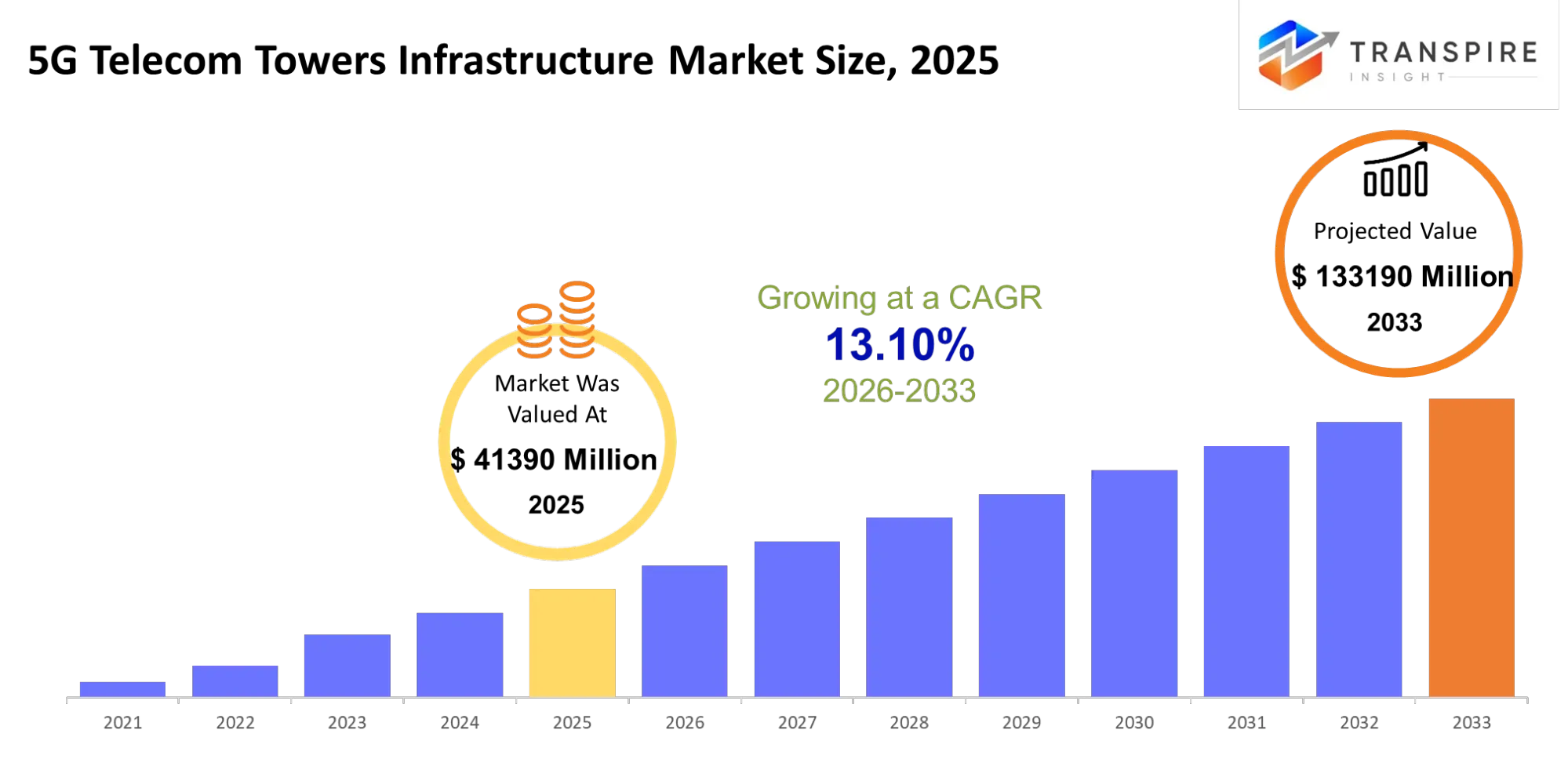
- Market Value (2025): USD 41390 Million.
- Expected Market Value (2026): USD 56320 Million.
- Estimated Market Value (2033): USD 133190 Million.
- Forecast CAGR (2026–2033): 13.10%.
- Leading Region in 2025: Asia-Pacific.
- Second-largest Region: Europe.
- Fastest Growing Region: North America.
Introduction
5G Telecom Towers Infrastructure comprises the physical infrastructure required to deploy and support fifth-generation (5G) wireless networks, including macro towers, small cells, monopoles, rooftop towers, distributed antenna systems (DAS), tower equipment, backhaul infrastructure, fiber connectivity, and edge network facilities. These infrastructures enable ultra-high-speed connectivity, low-latency communication, massive IoT deployment, and seamless mobile broadband services across urban and rural environments. Modern 5G telecom tower infrastructure integrates advanced technologies such as Massive MIMO antennas, beamforming, Open RAN architecture, AI-powered network optimization, edge computing, fiber backhaul, and energy-efficient power systems to maximize network capacity, coverage, and operational efficiency. The 5G Telecom Towers Infrastructure Market is driven by increasing 5G deployment, expanding mobile data traffic, growing investments in smart cities, rising adoption of IoT devices, digital transformation initiatives, and continuous expansion of next-generation communication networks.
- For Instance:- North America, Market Outlook: North America is expected to remain one of the largest markets in the 5G Telecom Towers Infrastructure Market, supported by rapid nationwide 5G rollout, increasing investments in telecom infrastructure modernization, expanding hyperscale edge computing facilities, and strong demand for high-speed wireless connectivity, with the regional market projected to exceed USD 28.5 billion during the forecast period.
- Europe, Advanced Digital Connectivity & Smart Infrastructure: European telecom operators are increasingly investing in shared tower infrastructure, Open RAN deployment, fiber-based backhaul networks, energy-efficient telecom towers, and AI-enabled network management solutions to improve coverage, enhance network capacity, and support smart city development while meeting stringent sustainability objectives.
Market Highlights: -
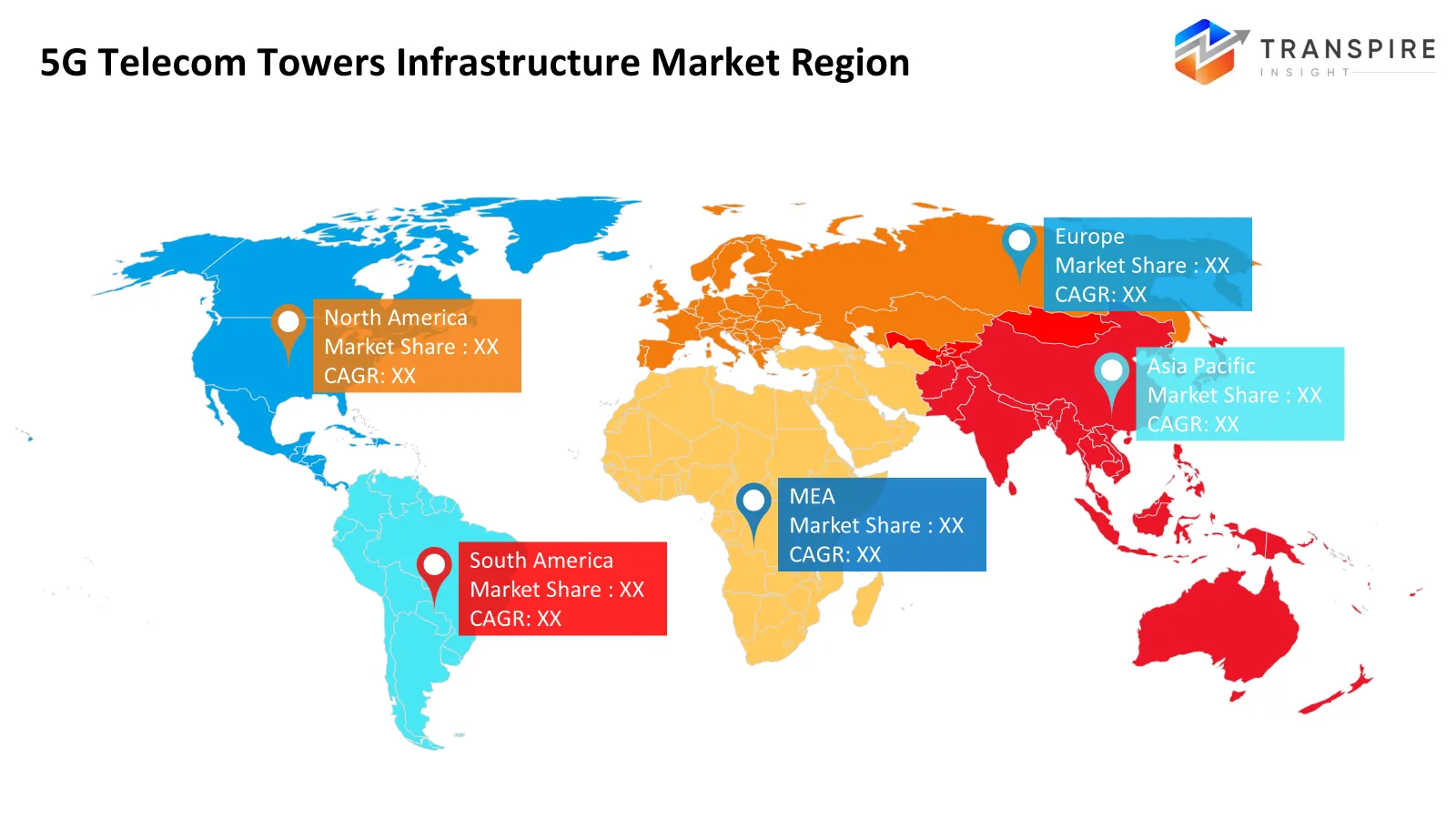
- Asia Pacific is expected to grow at a rapid CAGR in the 5G Telecom Towers Infrastructure Market, holding approximately 43% of the market share during the forecast period.
- North America remains one of the leading regional markets, accounting for approximately 28% of the 5G Telecom Towers Infrastructure Market due to strong investments in nationwide 5G deployment, digital infrastructure, and edge computing facilities.
- Europe is anticipated to hold approximately 22% of the 5G Telecom Towers Infrastructure Market over the forecast period, supported by increasing investments in Open RAN technologies, fiber infrastructure, and next-generation wireless communication networks.
- By Infrastructure Type, the Macro Cell Towers segment dominated the market, accounting for approximately 48% market share in 2025 and is projected to expand at a significant CAGR during the forecast period.
- By Application, the Mobile Network Operators segment dominated the market, holding approximately 66% market share in 2025 and is expected to witness substantial growth throughout the forecast period.
- By End User, the Telecommunication Service Providers segment dominated the market, accounting for approximately 61% market share in 2025 and is projected to grow steadily over the forecast period.
- Government Broadband & Digital Infrastructure Programs: Governments worldwide continue to increase investments in nationwide broadband expansion, 5G spectrum deployment, rural connectivity initiatives, smart city infrastructure, and digital transformation programs, creating significant growth opportunities for 5G Telecom Towers Infrastructure developers, operators, and solution providers.
How is Technology Driving Growth in the 5G Telecom Towers Infrastructure Market?
The 5G Telecom Towers Infrastructure Market is experiencing rapid growth due to continuous technological advancements in wireless communication infrastructure. Artificial Intelligence (AI), Massive MIMO, beamforming, Open RAN, edge computing, fiber-optic backhaul, cloud-native network architecture, Internet of Things (IoT), and network virtualization are transforming telecom infrastructure deployment. These technologies improve network capacity, increase spectral efficiency, reduce latency, optimize network performance, and enhance energy efficiency. AI-powered network optimization enables predictive maintenance, automated traffic management, and intelligent resource allocation, while edge computing supports ultra-low-latency applications such as autonomous vehicles, industrial automation, and smart manufacturing. Continuous investments in 5G standalone (SA) architecture and next-generation telecom infrastructure continue to accelerate market expansion.
Market Drivers
Expanding 5G Network Deployment, Rising Mobile Data Consumption & Smart City Development.The primary driver of the 5G Telecom Towers Infrastructure Market is the rapid expansion of 5G networks worldwide, driven by increasing mobile data traffic, rising smartphone penetration, growing IoT adoption, and accelerating digital transformation across industries. Governments and telecom operators continue to invest heavily in telecom tower expansion, fiber connectivity, small-cell deployment, and edge computing infrastructure to support next-generation wireless communication. Additionally, increasing demand for ultra-low latency connectivity, industrial automation, connected vehicles, smart healthcare, and smart city ecosystems continues to strengthen long-term market growth.
- For Instance:- Leading telecom operators continue to invest billions of dollars annually in expanding 5G tower infrastructure, deploying Massive MIMO antennas, upgrading fiber backhaul networks, and increasing small-cell installations to improve nationwide 5G coverage and network capacity.
Restrain
One of the major constraints affecting the 5G Telecom Towers Infrastructure Market is the high capital investment required for telecom tower construction, fiber backhaul deployment, spectrum acquisition, and network modernization. Additionally, regulatory approvals, zoning restrictions, land acquisition challenges, high maintenance costs.
Analysis of Prices and Consumer Behaviour
Mobile Network Operators represent the largest application segment in the 5G Telecom Towers Infrastructure Market, contributing approximately 68% of total market revenue due to continuous investments in nationwide 5G deployment, network densification, and wireless broadband expansion. Advanced 5G telecom towers equipped with Massive MIMO antennas, intelligent power systems, AI-based network optimization, and fiber-enabled backhaul infrastructure typically command 20–27% higher deployment costs than conventional telecom towers due to their superior network capacity, scalability, and operational efficiency. Telecommunication service providers, tower companies, and infrastructure operators collectively account for nearly 72% of total market demand, driven by increasing subscriber growth, rising mobile broadband consumption, and expanding enterprise connectivity requirements. Approximately 76% of telecom operators prioritize energy-efficient tower infrastructure, shared tower models, AI-driven network optimization, and scalable deployment capabilities when investing in 5G infrastructure solutions. The growing emphasis on digital connectivity, smart cities, edge computing, Industry 4.0, and nationwide broadband expansion continues to support sustained long-term growth in the 5G Telecom Towers Infrastructure Market.
Top Companies in the 5G Telecom Towers Infrastructure Market
- American Tower
- Crown Castle
- Cellnex Telecom
- SBA Communications
- Indus Towers
- China Tower Corporation
- Helios Towers
- IHS Towers
- Huawei
- Ericsson
- Nokia
- CommScope
- ZTE
- Bharti Infratel
- Phoenix Tower International
Market Segmentation
The 5G Telecom Towers Infrastructure Market share is divided into five categories: Product Type, Application, End User, Packaging Type, and Distribution Channel.
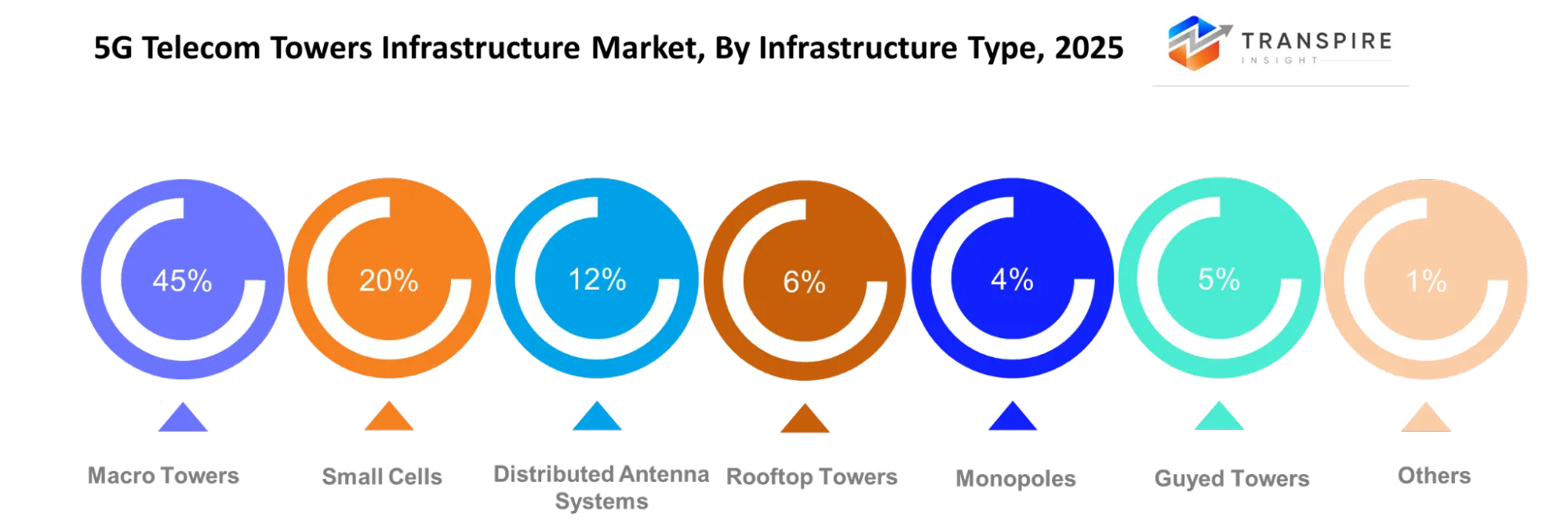
The Macro Cell Towers segment dominated the market, accounting for approximately 48% in 2025, and is expected to rise at a significant CAGR during the forecast period.
The 5G Telecom Towers Infrastructure Market is segmented by infrastructure type into Macro Cell Towers, Small Cell Towers, Rooftop Towers, Monopole Towers, Guyed Towers, Distributed Antenna Systems (DAS), Camouflaged Towers, and Others. Among these, the Macro Cell Towers segment dominated the market, accounting for approximately 48% in 2025, and is expected to expand at a significant CAGR during the forecast period. The dominance of this segment is attributed to its extensive coverage area, high-capacity network support, cost-effective deployment for nationwide 5G expansion, and ability to accommodate multiple telecom operators through shared infrastructure. Increasing investments in nationwide 5G rollout, rural connectivity initiatives, and network modernization continue to strengthen the segment's market position.
The Mobile Network Operators segment held the greatest share of approximately 66% in 2025 and is expected to increase at a substantial CAGR over the forecast period.
The 5G Telecom Towers Infrastructure Market is segmented by application into Mobile Network Operators, Smart Cities, Industrial IoT, Fixed Wireless Access (FWA), Public Safety Networks, Connected Transportation, Enterprise Private Networks, and Others. Among these, the Mobile Network Operators segment accounted for approximately 66% of the market in 2025 and is expected to register substantial growth during the forecast period. The segment's leadership is driven by increasing deployment of standalone 5G networks, growing mobile data consumption, expanding smartphone penetration, and continuous investments in nationwide wireless broadband infrastructure. Rising demand for enhanced network capacity, ultra-low latency connectivity, and improved customer experience continues to accelerate investments in advanced telecom tower infrastructure.
The Telecommunication Service Providers segment held the greatest share of approximately 61% in 2025 and is expected to increase at a high CAGR over the forecast period.
The 5G Telecom Towers Infrastructure Market is segmented by end user into Telecommunication Service Providers, Tower Infrastructure Companies, Government & Public Sector, Industrial Enterprises, Smart City Developers, Transportation & Logistics, Defense & Security, and Others. Among these, the Telecommunication Service Providers segment held the largest market share of approximately 61% in 2025 and is projected to grow at a considerable CAGR throughout the forecast period. The segment's growth is driven by expanding 5G network deployment, increasing investments in fiber backhaul infrastructure, rising demand for high-speed mobile broadband, and continuous network densification initiatives. Growing adoption of shared tower infrastructure and Open RAN technologies further supports long-term market expansion.
Regional Segment Analysis of the 5G Telecom Towers Infrastructure Market
- North America (U.S., Canada, Mexico)
- Europe (Germany, France, U.K., Italy, Spain, Rest of Europe)
- Asia-Pacific (China, Japan, India, South Korea, Rest of APAC)
- South America (Brazil, Argentina, Rest of South America)
- Middle East & Africa (UAE, Saudi Arabia, South Africa, Rest of MEA)
Asia Pacific is expected to grow at a rapid CAGR in the 5G Telecom Towers Infrastructure Market by holding approximately 43% of the share during the forecast period.
Asia Pacific is expected to witness the fastest market growth due to rapid 5G commercialization, expanding mobile subscriber base, increasing investments in digital infrastructure, and strong government support for next-generation communication networks. Countries including China, India, Japan, South Korea, and Singapore continue to invest heavily in macro towers, small cells, fiber-optic backhaul, and edge computing infrastructure to support smart cities, industrial IoT, autonomous transportation, and digital transformation initiatives. Rising smartphone adoption and increasing mobile data traffic further contribute to regional market expansion.
North America is expected to dominate the 5G Telecom Towers Infrastructure Market by holding approximately 28% of the market share during the forecast period.
North America remains one of the leading regional markets due to rapid nationwide 5G deployment, widespread cloud computing adoption, advanced telecommunications infrastructure, and significant investments in edge computing facilities. The United States and Canada continue to invest heavily in telecom tower modernization, Open RAN deployment, fiber connectivity, and private 5G networks to improve network capacity, reduce latency, and support enterprise digital transformation. The presence of major telecom tower operators and network equipment providers further strengthens regional market leadership.
Europe is anticipated to hold approximately 22% share of the 5G Telecom Towers Infrastructure Market over the forecast period.
Europe continues to experience significant market growth owing to increasing investments in smart city infrastructure, Industry 4.0 adoption, digital connectivity, and sustainable telecom network development. Countries including Germany, France, the United Kingdom, Italy, and Spain are increasingly deploying energy-efficient telecom towers, Open RAN architecture, fiber-based backhaul networks, and shared infrastructure models to improve operational efficiency and accelerate 5G rollout. Supportive government initiatives and digital transformation strategies continue to strengthen regional market expansion.
Strategies for Market Growth in Non-Leading Regions
Emerging economies can accelerate market growth by expanding telecom infrastructure, increasing spectrum availability, and encouraging private-sector investments in nationwide 5G deployment. Governments should promote public-private partnerships to improve rural connectivity, strengthen fiber-optic networks, and expand shared telecom tower infrastructure. Investments in local tower manufacturing, workforce training, AI-enabled network management, and energy-efficient telecom infrastructure will improve market penetration. Furthermore, supportive regulatory frameworks, smart city initiatives, digital inclusion programs, and foreign direct investment will create significant long-term growth opportunities across Latin America, Africa, and developing Asian economies.
Future Market Trends for the 5G Telecom Towers Infrastructure Market
1. Open RAN and Virtualized Network Infrastructure
Telecom operators are increasingly adopting Open RAN architecture and virtualized network technologies to improve network flexibility, reduce deployment costs, enhance interoperability, and accelerate large-scale 5G rollout.
2. AI-Driven Network Optimization
Artificial Intelligence, machine learning, and advanced network analytics are being integrated into telecom infrastructure to optimize traffic management, automate network maintenance, improve energy efficiency, and enhance overall network performance.
3. Expansion of Small Cells and Edge Computing
Growing deployment of small-cell infrastructure and edge computing facilities is improving network coverage, increasing data processing efficiency, reducing latency, and supporting next-generation applications such as autonomous vehicles, smart manufacturing, augmented reality, and massive IoT ecosystems.
Recent Developments
- In June 2026: Leading telecom infrastructure companies accelerated the deployment of AI-enabled 5G tower infrastructure, Massive MIMO antennas, and energy-efficient network equipment to improve wireless coverage, network capacity, and operational efficiency across urban and rural markets.
- In October 2025 – Infrastructure Expansion: Major telecom tower operators announced significant investments in macro towers, small-cell networks, fiber backhaul infrastructure, and Open RAN deployment to support increasing demand for high-speed 5G connectivity, enterprise digital transformation, and smart city development.
Market Segment
This study forecasts revenue at global, regional, and country levels from 2020 to 2033. Transpire Insights has segmented the 5G Telecom Towers Infrastructure Market based on the below-mentioned segments:
5G Telecom Towers Infrastructure Market, by By Infrastructure
- Macro Towers
- Small Cells
- Distributed Antenna Systems
- Rooftop Towers
- Monopoles
- Guyed Towers
- Smart Towers
- Others
5G Telecom Towers Infrastructure Market, By Component
- Tower Structures
- Antennas
- Radio Units
- Power Systems
- Backhaul Equipment
- Edge Computing Units
- Monitoring Systems
- Others
5G Telecom Towers Infrastructure Market, By Deployment
- Urban Areas
- Rural Areas
- Industrial Campuses
- Smart Cities
- Highways
- Stadiums
- Airports
- Others
5G Telecom Towers Infrastructure Market, By Ownership Model
- Telecom Operators
- Tower Companies
- Government-owned
- Shared Infrastructure
- Private Networks
- Neutral Host Providers
- Enterprises
- Others
5G Telecom Towers Infrastructure Market, By End User
- Telecom Operators
- Enterprises
- Government
- Utilities
- Transportation
- Manufacturing
- Defence
- Others
5G Telecom Towers Infrastructure Market, By Regional Analysis
North America
- United States
- Canada
- Mexico
Europe
- Germany
- United Kingdom
- France
- Spain
- Italy
- Rest of Europe
Asia Pacific
- Japan
- China
- Australia & New Zealand
- South Korea
- India
- Rest of Asia Pacific
South America
- Brazil
- Argentina
- Rest of South America
Middle East & Africa
- Saudi Arabia
- United Arab Emirates
- South Africa
- Rest of the Middle East & Africa
Frequently Asked Questions
Find quick answers to common questions.
Rapid deployment of 5G networks, increasing mobile data consumption, rising smartphone penetration, growing investments in telecom infrastructure, expansion of smart cities, widespread adoption of IoT devices, and continuous advancements in fiber backhaul, Massive MIMO, and Open RAN technologies are driving the growth of the 5G Telecom Towers Infrastructure Market.
Asia Pacific dominates the 5G Telecom Towers Infrastructure Market due to large-scale 5G network deployment, significant government investments in digital infrastructure, expanding telecom subscriber base, rapid urbanization, and strong presence of leading telecom equipment manufacturers across China, Japan, South Korea, and India.
5G Telecom Towers Infrastructure enables ultra-fast wireless connectivity, low-latency communication, high network capacity, extensive coverage, reliable mobile broadband services, seamless IoT connectivity, and efficient support for smart cities, autonomous vehicles, Industry 4.0, and next-generation digital applications.
The Mobile Network Operators segment leads the market, driven by continuous nationwide 5G rollout, increasing demand for enhanced mobile broadband, expanding network densification, growing subscriber traffic, and ongoing investments in advanced wireless communication infrastructure.
Major companies include American Tower Corporation, Cellnex Telecom S.A., Crown Castle Inc., SBA Communications Corporation, China Tower Corporation Limited, Indus Towers Limited, Helios Towers plc, IHS Holding Limited, Vertical Bridge Holdings, LLC, and American Tower do Brasil.
- American Tower
- Crown Castle
- Cellnex Telecom
- SBA Communications
- Indus Towers
- China Tower Corporation
- Helios Towers
- IHS Towers
- Huawei
- Ericsson
- Nokia
- CommScope
- ZTE
- Bharti Infratel
- Phoenix Tower International
About the Authors

Avinash Kumar
I’m Avinash Kumar, a Senior Research Analyst at Transpire Insight, with expertise in the Electronics and Semiconductor and Energy & Power industry. My work focuses on analyzing emerging technologies, market trends, industry developments, and innovation across these sectors. I specialize in transforming complex technical and market insights into clear, research-backed content that helps professionals, businesses, and decision-makers stay informed. Through continuous industry research and data-driven analysis, I strive to deliver accurate, reliable, and practical perspectives on the latest advancements shaping the semiconductor and energy landscape.

Chakradhar Khansole
Chakradhar serves as the Research Director at Transpire Insight, bringing over 8 years of experience in technology, innovation, and strategic market intelligence. He specializes in transforming complex market data into actionable business insights that enable organizations to make informed, growth-oriented decisions. Recognized for his strategic vision and analytical expertise, Chakradhar leads high-impact research initiatives, delivering comprehensive market assessments, competitive intelligence, and forward-looking industry analysis.
Recently Published Reports
-
Apr 2026
Fiber Optic Faceplates Market
Fiber Optic Faceplates Market Size, Share & Analysis Report By Type (< 300 mm2, 300-350 mm2, and > 350 mm2, By Application (Night Vision, Holographic Imaging, Medical, and Others), and Geography (North America, Europe, Asia-Pacific, Middle East and Africa, South and Central America), 2021 - 2031
-
Apr 2026
High Temperature Superconductors Market
High Temperature Superconductors Market Size, Share & Analysis Report By Type (1G HTS, and 2G HTS), By Application (Power Cable, Fault Current Limiter, and Transformer), and Geography (North America, Europe, Asia-Pacific, Middle East and Africa, South and Central America), 2021 - 2031
-
Apr 2026
Industrial Plugs and Socket Market
Industrial Plugs and Socket Market Size, Share & Analysis Report By Type (Industrial Plugs, Industrial Sockets), By Current (Up to 32 A, 32 to 125 A, Above 125 A), By Protection (Dustproof and Splash Proof, Waterproof, Explosion Proof), By End User (Heavy Industries, Oil and Gas, Chemicals and Pharmaceuticals, Power Generation, Others), and Geography (North America, Europe, Asia-Pacific, Middle East and Africa, South and Central America), 2021 - 2031
-
Apr 2026
InGaAs Avalanche Photodiodes Market
InGaAs Avalanche Photodiodes Market Size, Share & Analysis Report By Type (1100 - 1700 nm, and 1000 - 1600 nm), By Application (Missile Warning System, Muzzle Flash Detection, Wafer Defect Inspection, Laser Rangefinders, and Others), and Geography (North America, Europe, Asia-Pacific, Middle East and Africa, South and Central America), 2021 - 2031