

Aircraft Paints Market Summary:
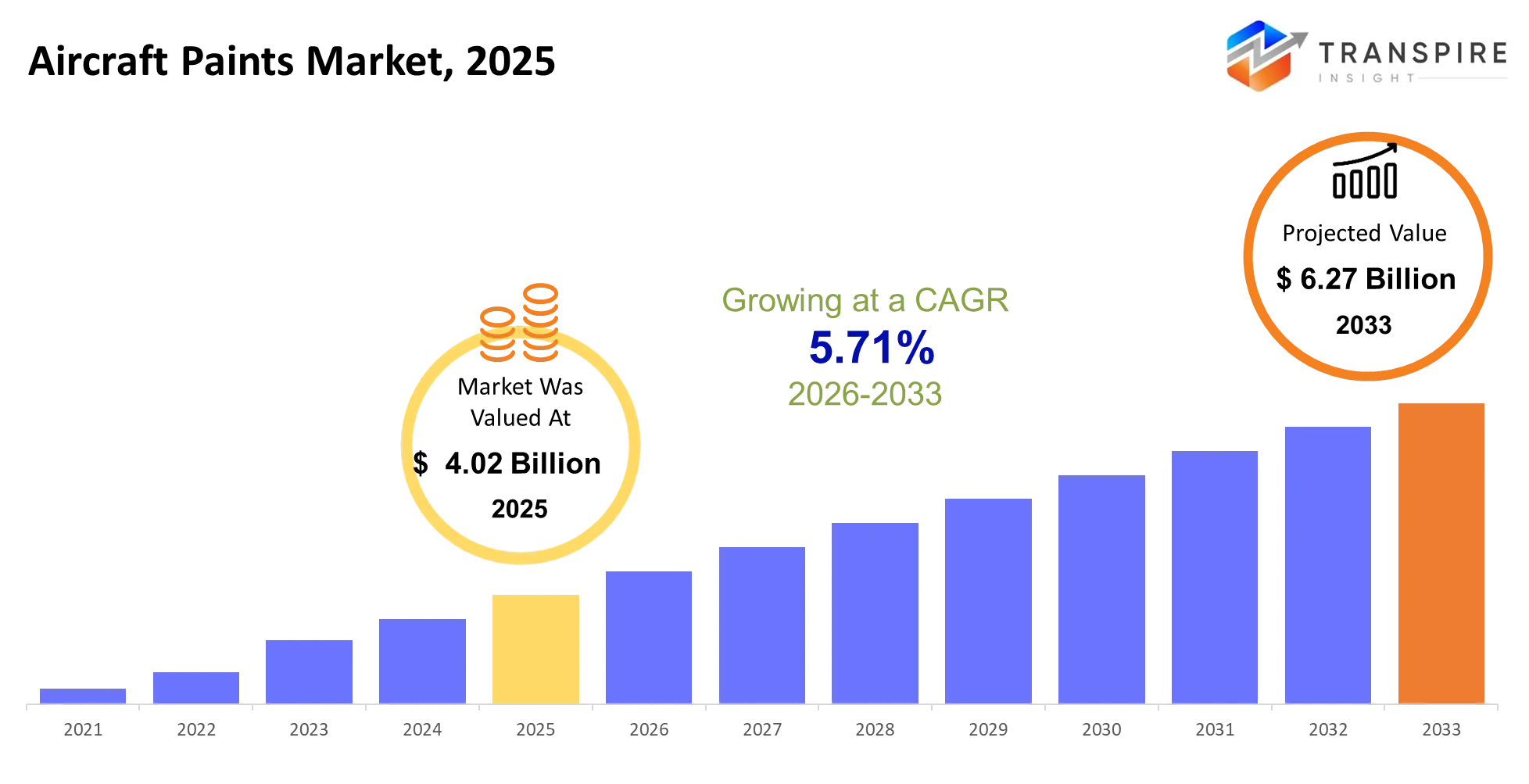
As per Transpire Insight Analysis, the Aircraft Paints Market size is estimated at USD 4.02 billion in 2025 and is anticipated to reach USD 6.27 billion by 2033, growing at a CAGR of 5.71% from 2026 to 2033.
The aircraft paints market provides aircraft manufacturing, repainting, maintenance, corrosion protection and finishing for the outside and inside of aircraft. In the last three to five years, paints used on aircraft have evolved to include light coatings, chrome-free products, quick-drying processes, and low-VOC paints. One important trend in aircraft paints is the emergence of basecoat and clear coat products and lightweight coatings, which can reduce weight of an aircraft but maintain durability and aesthetics. Environmental legislation also forces paint suppliers and MROs to use chromate-free and low-emissions products. A pragmatic driver for the development of aircraft paints is the demand from airlines and MROs to minimise aircraft downtime while maximising fuel efficiency and maintenance performance. The demand forces paint producers to develop products that can be applied in less number of layers for faster drying and improved service life.
Aircraft Paints Market Size & Forecast:
- Market Size 2025: USD 4.02 Billion
- Expected Market Value (2033): USD 6.27 Billion
- Forecast CAGR (2026–2033): 5.71%
- Leading Region in 2025: North America
- Fastest Growing Region: Asia-Pacific
- Key Company Profiles: PPG Industries, AkzoNobel, Mankiewicz, Hentzen Coatings, IHI Ionbond, Sherwin-Williams, Axalta, BASF, Henkel, Mapaero, AHC Oberflächentechnik, Sojitz Aerospace, Kansai Paint, NCP Coatings, AkzoNobel Aerospace Coatings
Key Market Insights:
The aircraft paints market is moving towards lighter weight, long-lasting, low-emission, and digitally enabled paints. New product development is being done with a focus on reducing aircraft weight and maintenance time.
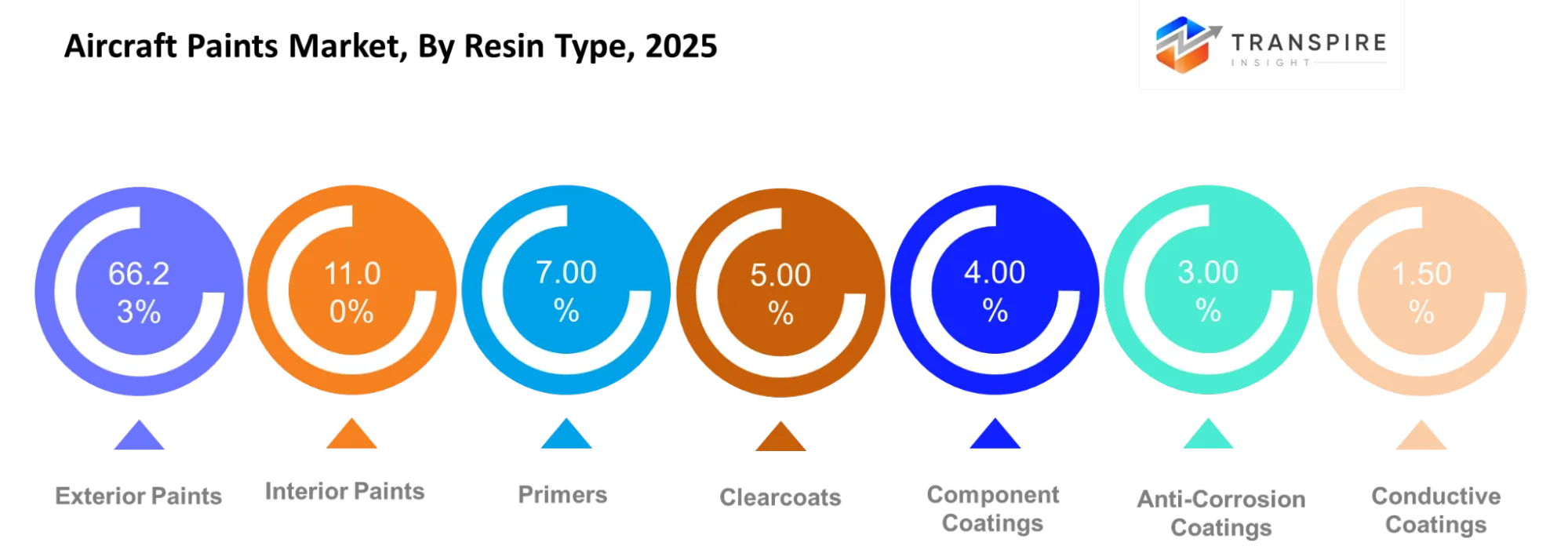
- Exterior Paints account for 66.23% market share, backed by high demand for durable finish, weather resistance, and corrosion resistance properties.
- Interior Paints register a CAGR of 5.38%, underpinned by demand for durable, low-maintenance, and uniform interior coating.
- Polyurethane and Basecoats/Clearcoats are becoming popular, as they provide durable, color-retentive and resistant to chemicals coatings.
- Chrome-free coatings have witnessed growth due to the search for substitutes which comply with the environmental regulations and workplace guidelines by aerospace manufacturers.
- Light-weight coatings are on the rise, as evidenced by the trials of AkzoNobel's Aerobase UPD coating, which results in weight reduction of aircraft
- A digital aircraft livery system is a budding technology, with the AEROVIEW digital tool provided by PPG, which enables its customers to see aircraft colours and finish digitally.
What are the Key Drivers, Restraints, and Opportunities in the Aircraft Paints Market?
Drivers
Drivers of demand for aircraft paints include the need to cut down on aircraft weight, increase coating longevity, decrease maintenance intervals, and adhere to more stringent environmental standards. Commercially viable lightweight basecoat and clearcoat systems are gaining importance since small gains in weight reduction of the coating can lead to savings in fuel costs through large aircraft fleets. The trend towards chrome-free and low-VOC coatings represents yet another driver as industry players look for substitutes that can satisfy the changing environmental and occupational safety standards.
Restraints
The high level of qualification and certification requirements with respect to aerospace coatings. New products cannot enter the market fast enough compared to less regulated industries since the developers need to conduct tests and qualify products for the specific industry. It takes more time to introduce innovations into the market and increases their cost.
Opportunities
The area of development in terms of opportunities is related to light and environmentally friendly coating systems, which are digitally managed and easy to apply. The trials of the lightweight Aerobase UPD by TAP Air Portugal show the way how innovation in coating technologies helps to reduce the weight of an aeroplane. Regional manufacturing and colour mixing centres are also opportunities in Asia-Pacific and the Middle East regions.
What Has the Impact of artificial intelligence on the Aircraft Paints Market?
The use of Artificial intelligence and digital technologies is gradually becoming part of the painting of aircraft through design visualisation, inspection, maintenance planning, and process optimisation. It does not replace coating materials but assists manufacturers, airlines, and MRO service providers with the decision-making process on the place, time, and way of applying coatings. Digital aircraft livery solutions can speed up the selection process with design visualisation without applying paint physically. PPG's AEROVIEWAI can also contribute to predictive and data-driven maintenance and thus to coatings management. The Aerofleet Coatings Management by AkzoNobel is a concept that takes into consideration the results of inspection, including drone inspections, along with information about coatings and the condition of an aircraft to assist in understanding whether or not the aircraft needs to be repainted. The major constraint is the need for integration. Currently, AI cannot fully replace technical inspection and aerospace coatings knowledge.
Instance
In September 2025, Airbus made an expansion to incorporate AI-based quality inspection systems in its manufacturing processes, including computer vision quality defect detection. AI-based inspection will aid in surface and coating defect identification, ensuring better-quality painting and less effort spent on inspections.https://www.airbus.com/en/innovation/digital-transformation/industry-4-0
Key Market Trends:
The aircraft coating industry is shifting from traditional appearance-based coatings to coatings that help make the aircraft energy-efficient and sustainable.
- The importance of lightweight coatings is increasing. The previous focus on aesthetics and durability is increasingly coupled with weight-saving, as light coatings may improve the operational efficiency of the aircraft.
- VOC-reducing formulations are more appreciated. Coating manufacturers create products that are characterised by reduced emissions but possess adhesion, durability, and aesthetics of aerospace level.
- Digital visualisation of colours is entering the procurement process. Customers can preview their aircraft painting schemes using tools like PPG AEROVIEW.
- Local production becomes a strategically important issue.
- The suppliers are building up their blending and manufacturing capacities in the regions to reduce delivery time.
- Technical aspects of customised liveries are increasing. Airline designs are characterised by complex painting schemes, including colour matching and several coating applications.
Aircraft Paints Market Segmentation
By Resin Type
Polyurethanes retain their relevance as aircraft coatings because of their properties such as durability, weatherability, gloss, and suitability for exterior aerospace applications. Epoxies continue to be relevant in the use of primers and structural protection due to their adhesive and anticorrosive properties. Acrylics, fluoropolymers, polyesters, alkyds, and hybrid systems have applications for more specific performance needs. There is a steady shift towards resin systems with durability and low emissions, application ease, and reduced material consumption. Future research will concentrate on high-performance resin systems that will meet the aerospace qualification criteria and environmental objectives.
By Applications
Exterior coatings constitute the largest share of 66.23% in terms of their applications, considering the need for protection against various environmental factors such as UV radiation, temperatures, chemicals, weathering, fuel, and others. Interior coatings constitute the second largest share of 11.00% based on the need for durable and visually appealing cabin surface finishes. Component coatings make up 7.00%, while engine coatings constitute 5.00% because of the use of specific coatings in order to provide protection from various factors. Other applications include landing gear, cabin structures, and composite surfaces.
By End User
Commercial aviation is a notable demand driver as airlines need the coatings for the delivery of new aircraft, repainting, branding, corrosion prevention, and maintenance and repair operations. Military aviation is another key segment of consumers who need specialised coatings resistant to tough operating conditions and mission needs. General aviation and business jets are shifting towards premium finish and personalized coloring while the growth of helicopters and UAVs creates possibilities for special lightweight and durable coatings. Other demand drivers are cargo aircraft and aviation operators. Growth rates of end users are likely to be determined by the increase in fleet size, aircraft usage rate, repainting, and innovations in coating technologies.
By Coating Type
Primers are one of the important technological bases for good adhesion and corrosion prevention and represent a 7.00% share of the offered segmentation. Topcoats and exterior finishing are related to the prevailing exterior-paint application, while clearcoats cover a 5.00% share and give glossiness, protection from fading, and extra durability. Basecoats, protective coatings, anti-corrosion coatings at 3.00%, conductive coatings at 1.50%, and speciality coatings are applied to specific needs of the aircraft. The trend to chrome-free, low-VOC, lightweight, and high-solids coating technologies is expected to affect future products in this
By Aircraft Type
Narrow-body and wide-body commercial aircraft generate significant coating demand due to their extensive fleets and periodic maintenance. Regional jets need coatings that are compatible with high-cycle usage, whereas business jets focus on appearance and livery customisation. Military aircraft also have specific needs with regard to coatings, considering their harsh environmental and operational conditions. . There is also a part contribution from cargo aircraft, via fleet reconditioning and maintenance activities. In essence, coating demand by aircraft type is becoming more dependent on weight, durability, and turnaround time, as well as qualifications.
What are the Key Use Cases Driving the Aircraft Paints Market?
Protection of the outside body of the aircraft is the use case of Exterior Paints. They provide protection of the fuselage, wings, and other external parts from the effects of UV rays, weathering, chemicals, corrosion, and operational conditions while preserving aircraft appearance. Coatings for internal aircraft areas are another growing use case, especially for the structure and surfaces inside aircraft cabins that require high durability, flame-resistant properties, ease of cleaning, and good appearance. Also, business jets and general aviation aircraft drive demand for custom finishes and high-quality appearance. Other emerging use cases are lightweight coatings, chrome-free primers, digital livery planning, and condition-based coating management.
|
Report Metrics |
Details |
|
Market size value in 2025 |
USD 4.02 Billion |
|
Market size value in 2026 |
USD 4.25 Billion |
|
Revenue forecast in 2033 |
USD 6.27 Billion |
|
Growth rate |
CAGR of 5.71% from 2026 to 2033 |
|
Base year |
2025 |
|
Historical data |
2021 - 2024 |
|
Forecast period |
2026 - 2033 |
|
Report coverage |
Revenue forecast, competitive landscape, growth factors, and trends |
|
Regional scope |
United States; Canada; Mexico; United Kingdom; Germany; France; Italy; Spain; Denmark; Sweden; Norway; China; Japan; India; Australia; South Korea; Thailand; Brazil; Argentina; South Africa; Saudi Arabia; United Arab Emirates |
|
Key company profiled |
PPG Industries, AkzoNobel, Mankiewicz, Hentzen Coatings, IHI Ionbond, Sherwin-Williams, Axalta, BASF, Henkel, Mapaero, AHC Oberflächentechnik, Sojitz Aerospace, Kansai Paint, NCP Coatings, AkzoNobel Aerospace Coatings |
|
Customization scope |
Free report customization (country, regional & segment scope). Avail customized purchase options to meet your exact research needs. |
|
Report Segmentation |
Resin Type (Polyurethane, Epoxy, Acrylic, Fluoropolymer, Polyester, Alkyd, Hybrid Resins, Others); Application (Exterior, Interior, Components, Engine Parts, Landing Gear, Cabin Structures, Composite Surfaces, Others); End User (Commercial Aviation, Military Aviation, General Aviation, Business Jets, Helicopters, UAVs, Cargo Aircraft, Others); Coating Type (Primer, Topcoat, Clearcoat, Basecoat, Protective Coating, Anti-Corrosion, Conductive Coating, Specialty Coating); Aircraft Type (Narrow-Body, Wide-Body, Regional Jets, Business Jets, Military Aircraft, Helicopters, UAVs, Cargo Aircraft) |
Which Regions are Driving the Aircraft Paints Market Growth?
North America
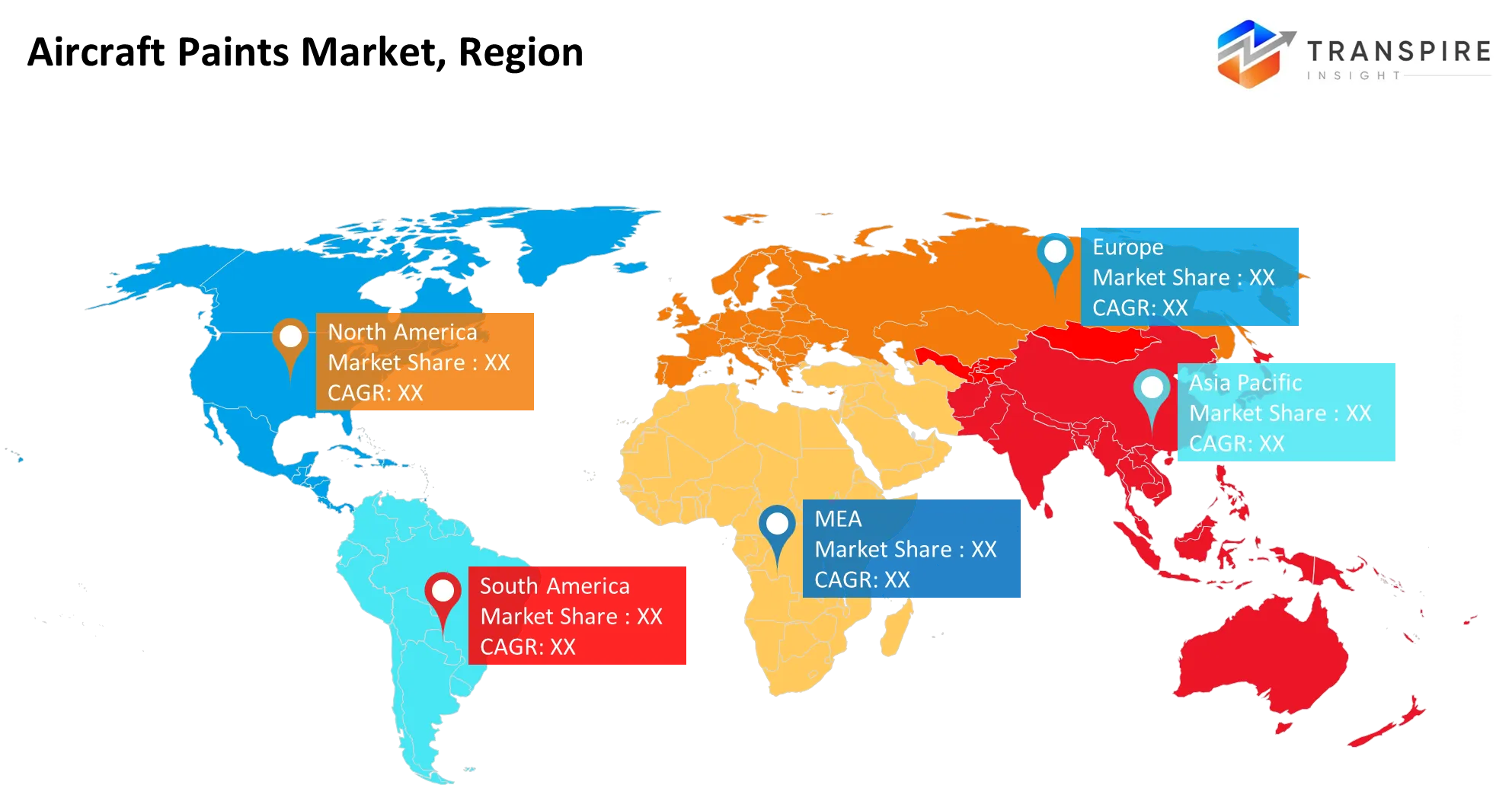
North America is the biggest market, accounting for 32.08% owing to the presence of mature commercial aviation, military aviation, general aviation, and MRO sectors. North America has the advantage of having a large number of aircraft installed and mature aerospace manufacturing infrastructure. Also, OEMs and suppliers play an important role in qualifying new coating solutions. The continuous investments in the development of coatings with better performance, emissions reduction and lightweighting help sustain North America's market dominance.
In May 2025, PPG announced plans to construct a facility for manufacturing aerospace coatings and sealants in Shelby, North Carolina, thereby enhancing production capacities for the aviation sector in that region.https://investor.ppg.com/news/news-details/2025/PPG-to-invest-380-million-to-build-new-U-S--manufacturing-facility-in-Shelby-N-C--for-aerospace-coatings-and-sealants/default.aspx
Europe
Europe holds a 25.00% share in the aircraft paints market owing to mature aerospace manufacturing and MRO infrastructure. This market is driven by aerospace manufacturing companies, airlines, speciality suppliers and stringent environmental regulations for using low-emission coatings in the airframe. European coating companies are continuously making investments in the production of coatings.
In July 2026, AkzoNobel moved ahead in expanding its plant for aerospace coatings in Pamiers, France by including production facilities for non-chromate aircraft coatings.https://aerospace.akzonobel.com/en/news-and-stories/akzonobel-advances-aerospace-coatings-capacity-major-milestone
Asia Pacific
Asia Pacific holds a 28.00% share of the market and represents the region with the highest growth rate of 6.1% CAGR. The key factors driving growth in the region include the increase in the number of commercial aviation aircraft, MRO activities, the development of regional aerospace manufacturing, and the need for locally supplied coating solutions.
In January 2026, AkzoNobel got additional authorisation for its Dongguan plant in China, which will allow for the manufacture of aerospace coating colours in the locality and faster delivery to aircraft MRO customers.https://aerospace.akzonobel.com/en/news-and-stories/akzonobel-aerospace-enhances-speed-support-china-market-through-extended-caac-approval?utm_source
Who are the Key Players in the Aircraft Paints Market, and how do they compete?
Competition within the international aerospace paints market occurs through competition based on product performance, aerospace certification, application efficiency, sustainability, technical services, and availability. Key players utilise differentiation through durable coatings, colour technology, low-VOC formulations, lightweight coatings, OEM certification, and MRO support services. Product consistency within various geographic markets is crucial since airlines and aircraft manufacturers demand consistent specifications.PPG competes through a comprehensive aerospace paint product portfolio including primers, topcoats, clearcoats, electrocoat systems, transparency coatings, and speciality surface treatment systems. This company’s competitive strategy revolves around product innovation and worldwide application support capability. For instance, PPG’s Aerocron electrocoat primer is an automated system with high corrosion protection, low VOC emissions, and chrome-free coating, while the AEROVIEW platform enhances the product selection experience through digital support.AkzoNobel’s competitive strengths lie in lightweight coating technology, regional manufacturing, colour mixing technologies, and airline/OEM partnerships. AkzoNobel has both the Aerobase and Aerodur systems, which enable it to manufacture aircraft exterior paints. AkzoNobel’s regional manufacturing capacity includes Dongguan and the future Dubai facility.
Aircraft Paints Market companies
- PPG Industries
- AkzoNobel
- Mankiewicz
- Hentzen Coatings
- IHI Ionbond
- Sherwin-Williams
- Axalta
- BASF
- Henke
- Mapaero
- AHC Oberflächentechnik
- Sojitz Aerospace
- Kansai Pain
- NCP Coatings
- AkzoNobel Aerospace Coatings
Recent Development News
In July 2026, PPG launched the AEROVIEW virtual aircraft painting system designed to help customers from the business and general aviation sectors see how different colours and finishes can look in a 3D visualisation environment. This innovation links aircraft coatings with digital design and customer experience technologies.https://investor.ppg.com/news/news-details/2026/PPG-introduces-PPG-AEROVIEW-virtual-aircraft-painter-for-business-general-aviation/default.aspx
In November 2025, AkzoNobel set yet another milestone with the use of C919 colours, as the company provided 44 Aerodur 3001 colours used in the painting of China Southern Airlines’ plane with the “Beautiful Greater Bay Area” finish.https://aerospace.akzonobel.com/en/news-and-stories/akzonobel-sets-new-record-color-use-comac-c919
What Strategic Insights Define the Future of the Aircraft Paints Market?
The paints for aircraft industry will be evolving towards coatings that provide more than just aesthetics. Lightweight, chrome-free, low-VOC, fast application, and increased maintenance intervals are becoming integral parts of the value proposition. The best future potential is expected to arise in cases when coatings producers are able to demonstrate a material breakthrough that translates into concrete benefits of airline companies, such as reduced weight of the aircraft, reduced downtimes, and increased efficiency of maintenance.
There is an implicit risk related to lengthy qualification of new coatings for aerospace applications. Despite the fact that a new coating might be environmentally friendly or more cost-efficient, its acceptance could be slow due to the long process of certification or modification of the existing aircraft maintenance processes. Moreover, there is a risk of the high cost of implementing digital inspection and AI-enabled maintenance systems into existing MRO operations. The manufacturers of coatings have to focus on the development of lightweight, low-emission, and digitally supported coatings while expanding regional technical support and manufacturing facilities for aerospace coatings.
Resin Type
- Polyurethane
- Epoxy
- Acrylic
- Fluoropolymer
- Polyester
- Alkyd
- Hybrid Resins
- Others
Application
- Exterior
- Interior
- Components
- Engine Parts
- Landing Gear
- Cabin Structures
- Composite Surfaces
- Others
End User
- Commercial Aviation
- Military Aviation
- General Aviation
- Business Jets
- Helicopters
- UAVs
- Cargo Aircraft
- Others
Coating Type
- Primer
- Topcoat
- Clearcoat
- Basecoat
- Protective Coating
- Anti-Corrosion
- Conductive Coating
- Specialty Coating
Aircraft Type
- Narrow-Body
- Wide-Body
- Regional Jets
- Business Jets
- Military Aircraft
- Helicopters
- UAVs
- Cargo Aircraft
By Regional Analysis
North America
- US
- Canada
- Mexico
Europe
- Germany
- UK
- France
- Italy
- Spain
- Russia
- Rest of Europe
Asia Pacific
- China
- Japan
- India
- South Korea
- Australia
- Rest of Asia Pacific
South America
- Brazil
- Argentina
- Rest of South America
Middle East & Africa
- UAE
- Saudi Arabia
- Qatar
- South Africa
- Rest of the Middle East & Africa
Frequently Asked Questions
Find quick answers to common questions.
The aircraft paints market size was valued at USD 4.02 billion in 2025 and is poised to reach USD 6.27 billion by 2033, expanding at a 5.71% CAGR.
Key segments for the aircraft paints market are Resin Type (Polyurethane, Epoxy, Acrylic, Fluoropolymer, Polyester, Alkyd, Hybrid Resins, Others); Application (Exterior, Interior, Components, Engine Parts, Landing Gear, Cabin Structures, Composite Surfaces, Others); End User (Commercial Aviation, Military Aviation, General Aviation, Business Jets, Helicopters, UAVs, Cargo Aircraft, Others); Coating Type (Primer, Topcoat, Clearcoat, Basecoat, Protective Coating, Anti-Corrosion, Conductive Coating, Specialty Coating); Aircraft Type (Narrow-Body, Wide-Body, Regional Jets, Business Jets, Military Aircraft, Helicopters, UAVs, Cargo Aircraft)
Growth is primarily driven by increase in the manufacturing of aircrafts, increased aircraft fleets, increase in maintenance and repair operations, use of light coatings, and requirements for improved corrosion resistance.
The market is led by major manufacturers including PPG Industries, AkzoNobel, Mankiewicz, Hentzen Coatings, IHI Ionbond, Sherwin-Williams, Axalta, BASF, Henkel, Mapaero, AHC Oberflächentechnik, Sojitz Aerospace, Kansai Paint, NCP Coatings, AkzoNobel Aerospace Coatings
North America accounts for 32.08% of the world aircraft paint market due to its robust aircraft production capacity, sizable aviation fleet, aerospace technology development, and high demand for aircraft maintenance and painting services.
opportunities within the market consist of the increasing requirement for lightweight and environmentally friendly paints, an increase in the production and fleet of aircrafts, the increasing MRO activities, and the use of superior corrosion resistance and high-performance paints for aircrafts.
- PPG Industries
- AkzoNobel
- Mankiewicz
- Hentzen Coatings
- IHI Ionbond
- Sherwin-Williams
- Axalta
- BASF
- Henke
- Mapaero
- AHC Oberflächentechnik
- Sojitz Aerospace
- Kansai Pain
- NCP Coatings
- AkzoNobel Aerospace Coatings
About the Authors

Tejashri Dhatrak
I am Tejashri Dhatrak, a Senior Research Analyst at Transpire Insight, specializing in the Aerospace and Defence sector. My work focuses on analyzing industry trends, defence technologies, market developments, and emerging innovations that shape the global aerospace and security landscape. At Transpire Insight, I research complex topics, evaluate credible sources, and transform technical insights into accurate, well-structured, and easy-to-understand content for industry professionals and decision-makers. My goal is to provide reliable, research-backed information that helps readers stay informed about defence capabilities, aerospace advancements, strategic developments, and the evolving dynamics of the global defence ecosystem.

Chakradhar Khansole
Chakradhar serves as the Research Director at Transpire Insight, bringing over 8 years of experience in technology, innovation, and strategic market intelligence. He specializes in transforming complex market data into actionable business insights that enable organizations to make informed, growth-oriented decisions. Recognized for his strategic vision and analytical expertise, Chakradhar leads high-impact research initiatives, delivering comprehensive market assessments, competitive intelligence, and forward-looking industry analysis.
Recently Published Reports
-
Apr 2026
Aerospace Fluoropolymers Market
Aerospace Fluoropolymers Market Size, Share & Analysis Report By Type (PTFE, FEP, PFA, ETFE, and Others), By Application (Electrical Insulation, Seals & Gaskets, Coatings, and Others), By End User (Commercial Aviation, Military Aviation, General Aviation, and Others), and Geography (North America, Europe, Asia-Pacific, Middle East and Africa, South and Central America), 2021 - 2031
-
Apr 2026
Airborne SATCOM System Market
Airborne SATCOM System Market Size, Share & Analysis Report By Type (SATCOM Terminals, Transceivers, Airborne Radio, Modems and Routers, SATCOM Radomes, and Other), By Application (Government and Defense and Commercial), and Geography (North America, Europe, Asia-Pacific, Middle East and Africa, South and Central America), 2021 – 2031
-
Apr 2026
Ship Leasing Market
Ship Leasing Market Size, Share & Analysis Report By Vessel Type (Container Ships, Bulk Carriers, Tankers, and Specialized Vessels), By Lease Duration (Short-Term Lease (Less than 1 year), Medium-Term Lease (1-5 years), and Long-Term Lease (More than 5 years)), By Lease Type (Bareboat Charter, Time Charter, Financial Lease, and Others), By End-User Industry (Oil and Gas, Manufacturing and Industrial, Automotive, Agriculture and Food, Retail and Consumer Goods, and Others), and Geography (North America, Europe, Asia-Pacific, Middle East and Africa, South and Central America), 2021 – 2031
-
Apr 2026
Thread Rolling Dies Market
Thread Rolling Dies Market Size, Share & Analysis Report By Type (Flat Thread Rolling Dies, Circular (Cylindrical) Dies, Tangential Thread Rolling Dies, Planetary Thread Rolling Dies, and Other Types), By Material Type (High-Speed Steel (HSS), Carbide, Tool Steel, Alloy Steel, and Other Specialized Alloys), By Distribution Channel (Direct Sales, Distributors and Dealers, and Online Platforms), By Application (Automotive Industry, Aerospace and Defense, Construction and Infrastructure, Industrial Machinery, Electronics and Electrical Components, Medical Devices, and Fastener Production), and Geography (North America, Europe, Asia-Pacific, Middle East and Africa, South and Central America), 2021 – 2031
Our Clients





